


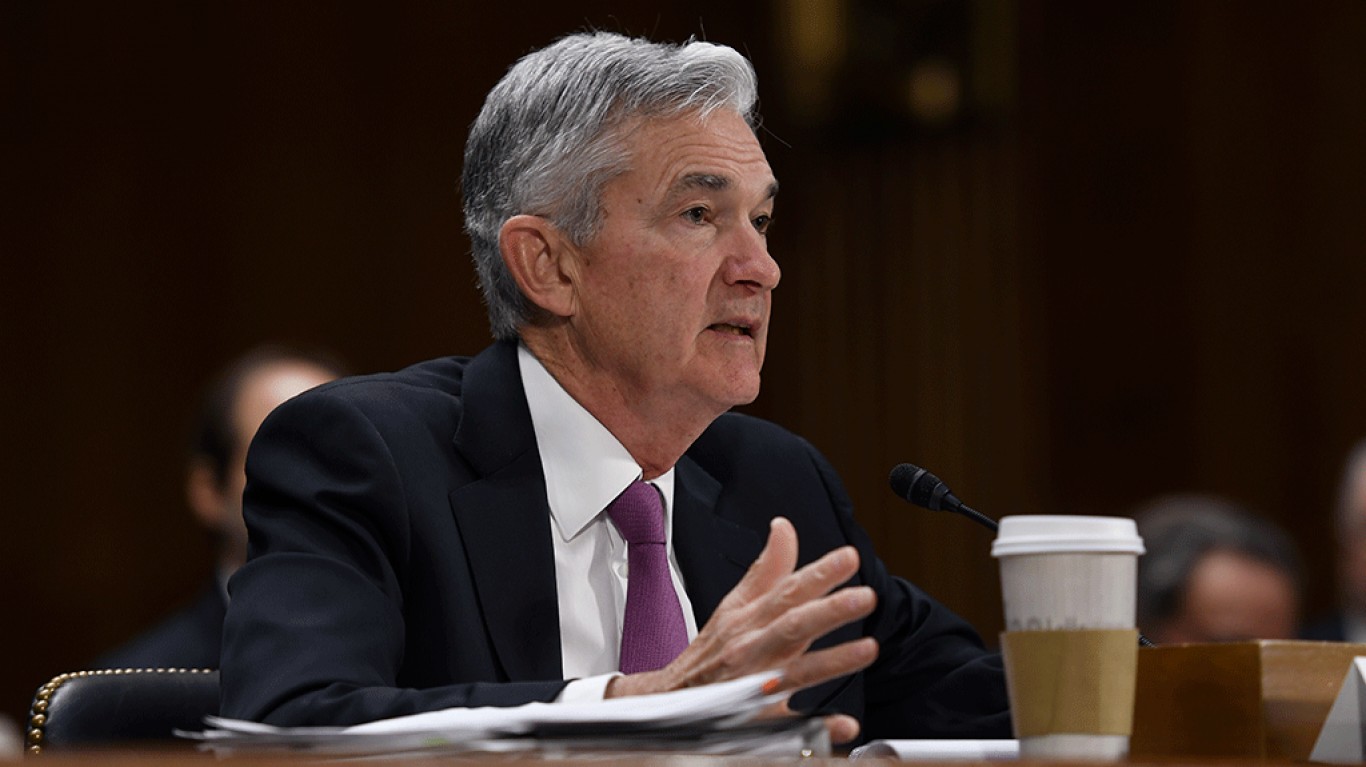
The Federal Reserve Bank published the results of its 2020 stress tests on the nation’s largest banks after markets closed on Thursday. Looking at just the five largest banks, share prices closed higher by 3.5% to nearly 4.8%.
After-hours trading and Friday’s premarket session tell a different story, however. Big bank stocks traded mostly down, ranging from a low at Goldman Sachs Group Inc. (NYSE: GS | GS Price Prediction), down about 2.9%, to a high of at Morgan Stanley (NYSE: MS), up by about 1.6%.
This year’s test included what the Fed called a “sensitivity analysis” designed to test the banks’ resiliency in three scenarios that may result from the COVID-19 pandemic. In those scenarios, collectively called a “severely adverse” scenario, the 34 banks could have experienced loan losses in a range of $560 billion to $700 billion and their aggregate capital ratios declined from 12.0% in the fourth quarter of 2019 to between 7.7% and 9.9%.
Needless to say, the Fed was not impressed by the results of this analysis and has taken steps “to ensure large banks remain resilient despite the economic uncertainty from the coronavirus event.”
[nativounit]
For the third quarter, the Fed is requiring big banks to preserve capital by suspending share repurchases and capping dividend payments. The banks also will be required to reassess their capital needs and resubmit their capital plans before the end of this year. The Fed also plans to require more stress testing later this year as the “economic situation continues to evolve.”
The central bank’s sensitivity scenarios assumed a V-shaped, U-shaped and W-shaped recovery from the coronavirus-related economic meltdown. Under a V-shaped recovery from a severely adverse scenario, the aggregate common equity tier 1 capital ratio would have fallen from its pre-pandemic level of 12.0% to 9.9% before rising to 10.3% in the first quarter of 2022.
That level is “well above” the regulatory minimum, but in a U-shaped or W-shaped recovery, “several firms would approach minimum capital ratios.” In its assessment of the economy since the coronavirus outbreak, the Fed was satisfied: “As a result of their strong current capital levels, the large majority of banks remain sufficiently capitalized over the entirety of the projection horizon in all scenarios.”
The nation’s big banks are in much better shape to deal now with a sharp downturn in the economy than they were in 2008. What concerns investors is the suspension of share buybacks and the limit on dividend payments.
Under the rule announced Thursday, banks may not make share repurchases through the end of the third quarter related to employee stock ownership plans and may not pay dividends of not more than the “average of the firm’s net income for the preceding four calendar quarters.”
The bank most at risk of having to cut its dividend may be Wells Fargo & Co. (NYSE: WFC). Goldman Sachs and Morgan Stanley fared worst in the usual part of the annual stress tests with capital levels falling by 6.4% and 5.5%, respectively.
The overall reaction is that the Fed’s actions were not as harsh as they might have been. Dividends have been preserved and the halt to share buybacks would have happened anyway.
Fed Governor Lael Brainard disagreed with the decision to allow banks to continue paying dividends. She praised the capital buffers required by the Dodd-Frank Act and believes it is a “mistake” to weaken them now: “This is a time for large banks to preserve capital, so they can be a source of strength in a robust recovery.”
Brainard noted that while banks face a “substantial likelihood” of needing larger capital buffers, the Fed is authorizing payments that “will deplete those buffers.”
[recirclink id=715660][wallst_email_signup]






 Top Gaining Stocks
 Top Losing Stocks