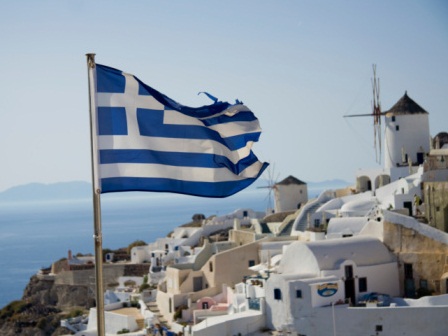
Greece Downgraded by Moody’s

Photo of Douglas A. McIntyre
By Douglas A. McIntyre Published
This post may contain links from our sponsors and affiliates, and Flywheel Publishing may receive compensation for actions taken through them.

In yet another sign that many experts believe Greece cannot reach an accord with its creditors before if runs out of money, Moody’s downgraded its debt from Caa1 to Caa2 with a negative outlook. The movement by the rating agency barely matters since the fate of Greece’s debt is in a very few hands, including the International Monetary Fund, European Commission and European Central Bank. Greece will run out of money in weeks, or days, depending on the source of the analysis.

Moody’s acknowledged that the parties to the negotiations are very small in number:

Negotiations between official creditors (European Financial Stability Facility (EFSF, (P)Aa1 stable), International Monetary Fund (IMF), European Central Bank (ECB) and European Commission) and the Greek government appear to have achieved little over the past two months. The Greek government and its official creditors remain far apart on key objectives, with no immediate prospect of agreement being reached on a new financing package.

As for the primary reasons for its actions, Moody’s experts wrote:

This rating action concludes the review for downgrade that commenced on 6 February 2015.

The key drivers behind the downgrade are :

1) The high uncertainty over whether Greece’s government will reach an agreement with official creditors in time to meet upcoming repayments on marketable debt.

2) The significant implementation risks of a follow-up, medium-term financing programme even if an agreement is reached, given the weakened economy and a fragile domestic political environment.

The negative rating outlook reflects Moody’s view that the balance of economic, financial and political risks in Greece is slanted to the downside.

ALSO READ: Lessons of Force Majeure for 2014, 2015 and Beyond

It is a matter of conjecture what a default would mean to Greece, how badly a default would hurt the rest of Europe economically and whether Greece may quit the European Union altogether.

The rating agency’s forecast for the financial future of Greece is grim:

Moody’s would consider downgrading Greece’s government bond rating if the probability of a default and/or severity of loss to investors in the event of default were to rise and no longer commensurate with a Caa2 rating. That would most likely occur in the context of a further deterioration in the relations between the Greek government and its creditors, or evidence that the Greek electorate is supportive of a more confrontational stance, potentially including exit from the euro area.

Although not likely in the near term given the prevailing downside risks, Moody’s could consider upgrading Greece’s government bond rating in the event of (1) an increase in the pace of fiscal consolidation and structural reforms; (2) sustained economic growth and primary surpluses, both would support a continued decline in debt levels; and (3) more certainty and visibility on future external financial support and the political environment.

The Greek problem certainly will need to be solved by the end of next month, under the most optimistic projections. May might not pass without an ugly resolution.

ALSO READ: Countries That Hate America the Most

Photo of Douglas A. McIntyre
About the Author Douglas A. McIntyre →

Douglas A. McIntyre is the co-founder, chief executive officer and editor in chief of 24/7 Wall St. and 24/7 Tempo. He has held these jobs since 2006.

McIntyre has written thousands of articles for 24/7 Wall St. He is an expert on corporate finance, the automotive industry, media companies and international finance. He has edited articles on national demographics, sports, personal income and travel.

His work has been quoted or mentioned in The New York Times, The Wall Street Journal, Los Angeles Times, The Washington Post, NBC News, Time, The New Yorker, HuffPost USA Today, Business Insider, Yahoo, AOL, MarketWatch, The Atlantic, Bloomberg, New York Post, Chicago Tribune, Forbes, The Guardian and many other major publications. McIntyre has been a guest on CNBC, the BBC and television and radio stations across the country.

A magna cum laude graduate of Harvard College, McIntyre also was president of The Harvard Advocate. Founded in 1866, the Advocate is the oldest college publication in the United States.

TheStreet.com, Comps.com and Edgar Online are some of the public companies for which McIntyre served on the board of directors. He was a Vicinity Corporation board member when the company was sold to Microsoft in 2002. He served on the audit committees of some of these companies.

McIntyre has been the CEO of FutureSource, a provider of trading terminals and news to commodities and futures traders. He was president of Switchboard, the online phone directory company. He served as chairman and CEO of On2 Technologies, the video compression company that provided video compression software for Adobe’s Flash. Google bought On2 in 2009.

Featured Reads

Our top personal finance-related articles today. Your wallet will thank you later.

Continue Reading

Top Gaining Stocks

CBOE Vol: 1,568,143
PSKY Vol: 12,285,993
STX Vol: 7,378,346
ORCL Vol: 26,317,675
DDOG Vol: 6,247,779

Top Losing Stocks

LKQ
LKQ Vol: 4,367,433
CLX Vol: 13,260,523
SYK Vol: 4,519,455
MHK Vol: 1,859,865
AMGN Vol: 3,818,618