Why Is Detroit the Most Dangerous City in US?

Photo of Douglas A. McIntyre
By Douglas A. McIntyre Published
This post may contain links from our sponsors and affiliates, and Flywheel Publishing may receive compensation for actions taken through them.

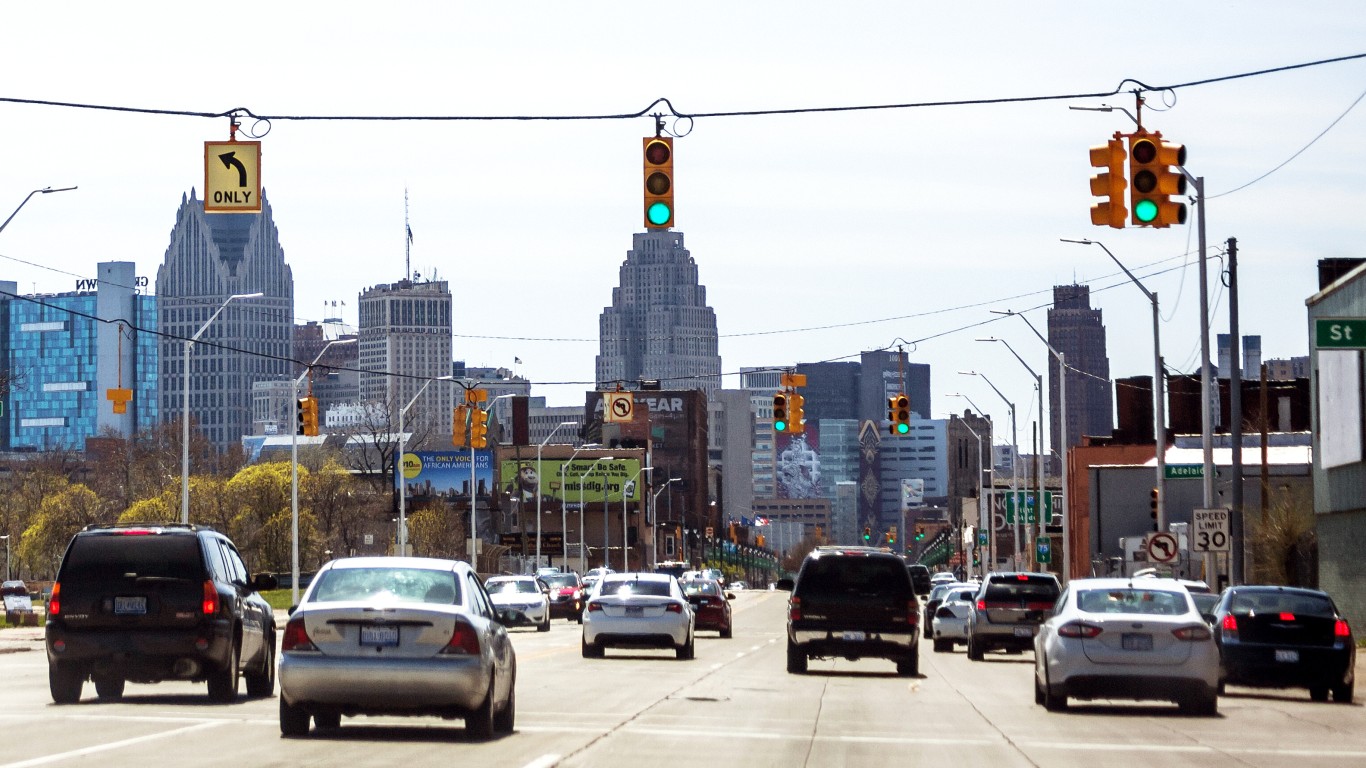
The crime rate in Detroit, a city that has lost half its population since 1960, outdistances that of any other large city in the United States. Statistics show why the figures are so high.

24/7 Wall St. looked at violent crime rates among the nation’s cities with populations of 100,000 or more from the FBI’s 2014 Uniform Crime Report.

Despite crime dropping in the city for three consecutive years, Detroit remains the most dangerous city in America. As is the case with most cities with high crime rates, Detroit’s poverty rate and income levels were among the worst in the country. A typical Detroit household made $25,769 in 2014, second lowest in the country and less than half of what the typical American household made. Similarly, its poverty rate of 39.3% was the second highest in the county, well more than double the national poverty rate of 15.5%.

A total of 298 murders were reported in Detroit last year. The only cities with more murder cases were Chicago and New York, whose populations were about four and 12 times larger than Detroit’s, respectively. The Motor City also led the nation in aggravated assaults, with 1,342.4 incidents reported per 100,000 residents — nearly six times the national rate. A city’s crime rate typically increases as its population declines, as residents who can leave undesirable conditions do so. Between 2010 and 2012, Detroit’s violent crime rate decreased even as its population continued to decline, making the drop in crime rate all the more significant.

Detroit’s population in 1950 was 1.8 million. Today, that figure is below 700,000, according to the U.S. Census. A major reason for the drop is that the large American car companies have moved their manufacturing elsewhere. The only one of The Big Three with its headquarters in Detroit is General Motors Co. (NYSE: GM).

The health of the city, or lack thereof, is highlighted by Detroit’s filing for Chapter 9 bankruptcy in July 2013. The decision cut the city’s debt, but it still has challenges due to a tax base eroded by poverty.


ALSO READ: States With the Widest Gap Between Rich and Poor

Photo of Douglas A. McIntyre
About the Author Douglas A. McIntyre →

Douglas A. McIntyre is the co-founder, chief executive officer and editor in chief of 24/7 Wall St. and 24/7 Tempo. He has held these jobs since 2006.

McIntyre has written thousands of articles for 24/7 Wall St. He is an expert on corporate finance, the automotive industry, media companies and international finance. He has edited articles on national demographics, sports, personal income and travel.

His work has been quoted or mentioned in The New York Times, The Wall Street Journal, Los Angeles Times, The Washington Post, NBC News, Time, The New Yorker, HuffPost USA Today, Business Insider, Yahoo, AOL, MarketWatch, The Atlantic, Bloomberg, New York Post, Chicago Tribune, Forbes, The Guardian and many other major publications. McIntyre has been a guest on CNBC, the BBC and television and radio stations across the country.

A magna cum laude graduate of Harvard College, McIntyre also was president of The Harvard Advocate. Founded in 1866, the Advocate is the oldest college publication in the United States.

TheStreet.com, Comps.com and Edgar Online are some of the public companies for which McIntyre served on the board of directors. He was a Vicinity Corporation board member when the company was sold to Microsoft in 2002. He served on the audit committees of some of these companies.

McIntyre has been the CEO of FutureSource, a provider of trading terminals and news to commodities and futures traders. He was president of Switchboard, the online phone directory company. He served as chairman and CEO of On2 Technologies, the video compression company that provided video compression software for Adobe’s Flash. Google bought On2 in 2009.

Continue Reading

Top Gaining Stocks

CBOE Vol: 1,568,143
PSKY Vol: 12,285,993
STX Vol: 7,378,346
ORCL Vol: 26,317,675
DDOG Vol: 6,247,779

Top Losing Stocks

LKQ
LKQ Vol: 4,367,433
CLX Vol: 13,260,523
SYK Vol: 4,519,455
MHK Vol: 1,859,865
AMGN Vol: 3,818,618