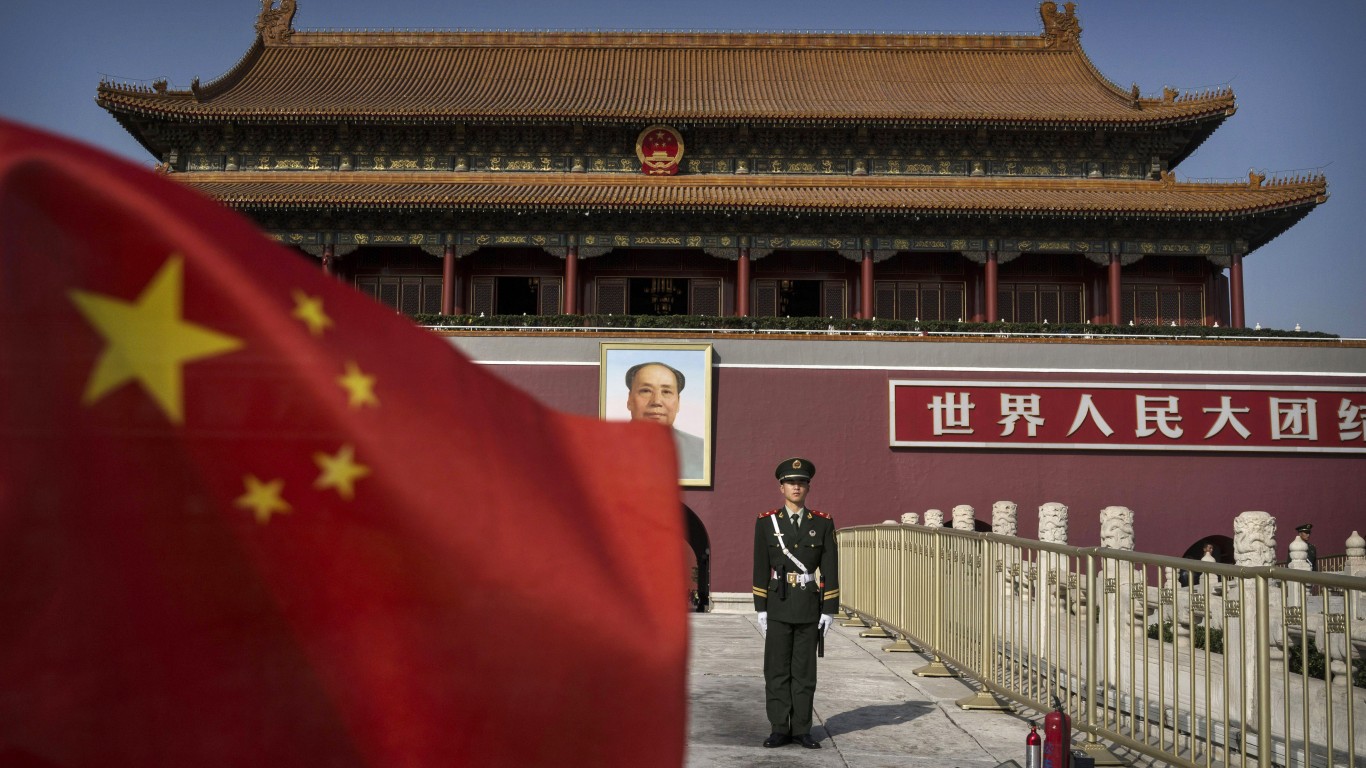
China Economy Staggers at 6.9%

Photo of Douglas A. McIntyre
By Douglas A. McIntyre Updated Published
This post may contain links from our sponsors and affiliates, and Flywheel Publishing may receive compensation for actions taken through them.

For the first time since the Great Recession, China’s economy rose less that 7%. In the first three quarters, the number was 6.9%.

The figure beat most forecasts but was depressing nevertheless. As the second largest economy in the world, China’s industrial production is a reasonable proxy for global consumption. The lack of activity in its business and by its middle class are a proxy for global consumer activity.

Organizations that include the International Monetary Fund and World Bank have cut their global GDP number for 2015 and 2016. China’s figures confirm the reasons and results for the slowdown.

The National Bureau for Statistics in China reported:

In the first three quarters of 2015, as the recovery of the world economy was weaker than expected, China was facing increasing downward pressure of domestic economic development. Under the tough situation, the Central Party Committee and the State Council took full consideration of domestic and global situations, adopted scientific measures to stabilize economic growth, promote reforms, enhance restructuring, benefit people and control risks, implemented effective range-based, targeted and discretionary macro regulation, further deepened the reform and opening up, encouraged mass entrepreneurship and innovation and increased supply of public goods and services. As a result, the overall performance of national economy was stable and moving in a positive direction.

According to the preliminary estimation, the gross domestic product (GDP) of China in the first three quarters of this year was 48,777.4 billion yuan, a year-on-year increase of 6.9 percent at comparable prices. Specifically, the year-on-year growth was 7.0 percent for the first quarter, 7.0 percent for the second quarter and 6.9 percent for the third quarter. The value added of the primary industry was 3,919.5 billion yuan, up by 3.8 percent year-on-year; that of the secondary industry was 19,779.9 billion yuan, up by 6.0 percent; and that of the tertiary industry was 25,077.9 billion yuan, up by 8.4 percent. The gross domestic product of the third quarter of 2015 went up by 1.8 percent on a quarter-on-quarter basis.

If the figure is worse in for the whole year, 2016 will be a rough economy worldwide.

ALSO READ: The Best and Worst Economies in the World

Photo of Douglas A. McIntyre
About the Author Douglas A. McIntyre →

Douglas A. McIntyre is the co-founder, chief executive officer and editor in chief of 24/7 Wall St. and 24/7 Tempo. He has held these jobs since 2006.

McIntyre has written thousands of articles for 24/7 Wall St. He is an expert on corporate finance, the automotive industry, media companies and international finance. He has edited articles on national demographics, sports, personal income and travel.

His work has been quoted or mentioned in The New York Times, The Wall Street Journal, Los Angeles Times, The Washington Post, NBC News, Time, The New Yorker, HuffPost USA Today, Business Insider, Yahoo, AOL, MarketWatch, The Atlantic, Bloomberg, New York Post, Chicago Tribune, Forbes, The Guardian and many other major publications. McIntyre has been a guest on CNBC, the BBC and television and radio stations across the country.

A magna cum laude graduate of Harvard College, McIntyre also was president of The Harvard Advocate. Founded in 1866, the Advocate is the oldest college publication in the United States.

TheStreet.com, Comps.com and Edgar Online are some of the public companies for which McIntyre served on the board of directors. He was a Vicinity Corporation board member when the company was sold to Microsoft in 2002. He served on the audit committees of some of these companies.

McIntyre has been the CEO of FutureSource, a provider of trading terminals and news to commodities and futures traders. He was president of Switchboard, the online phone directory company. He served as chairman and CEO of On2 Technologies, the video compression company that provided video compression software for Adobe’s Flash. Google bought On2 in 2009.

Continue Reading

Top Gaining Stocks

CBOE Vol: 1,568,143
PSKY Vol: 12,285,993
STX Vol: 7,378,346
ORCL Vol: 26,317,675
DDOG Vol: 6,247,779

Top Losing Stocks

LKQ
LKQ Vol: 4,367,433
CLX Vol: 13,260,523
SYK Vol: 4,519,455
MHK Vol: 1,859,865
AMGN Vol: 3,818,618