



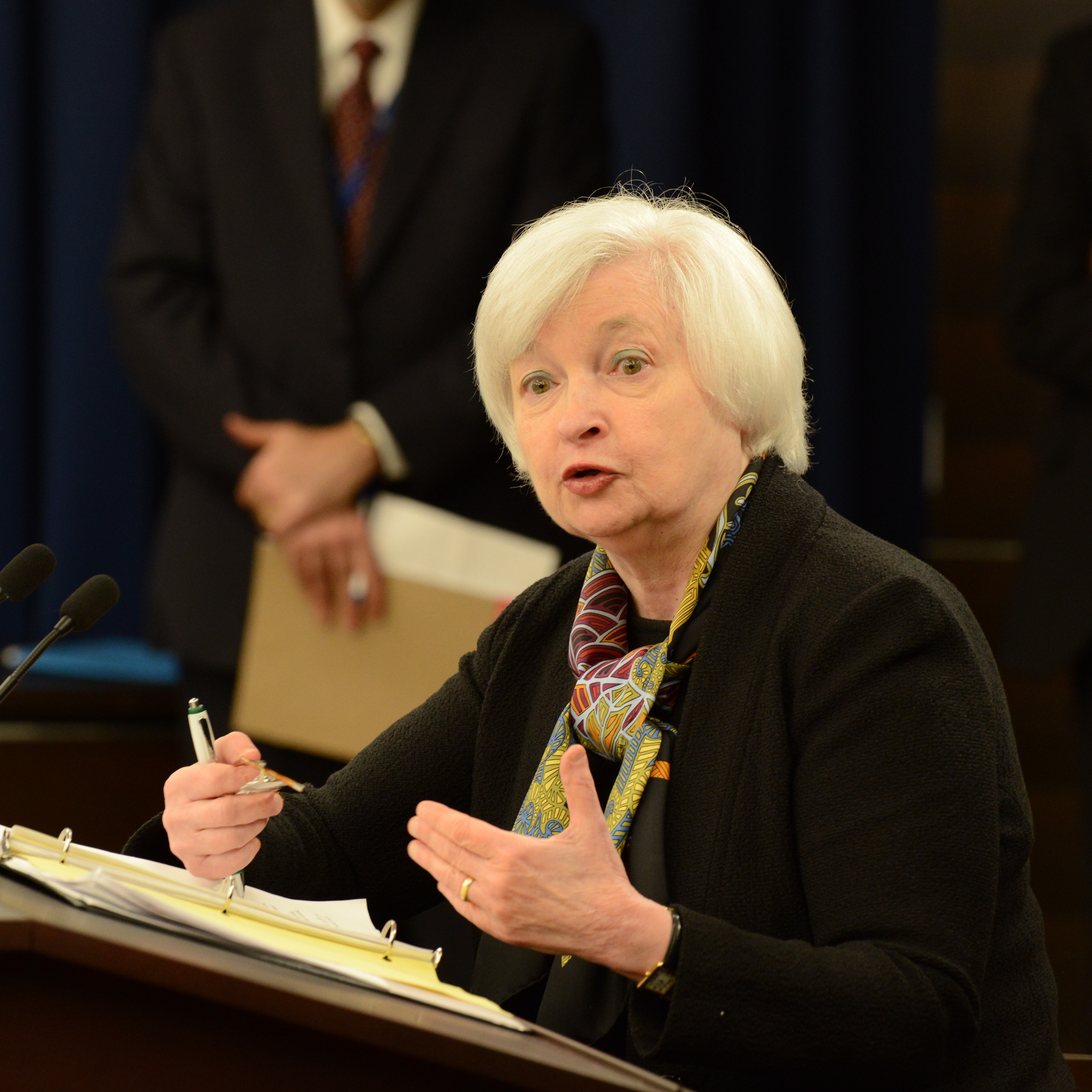
Wednesday marked another day of Federal Reserve testimony: Chair Janet Yellen in front of the House Financial Services Committee. This was the first we have heard from Yellen in over 50 days, despite the persistent market turmoil. 24/7 Wall St. wanted to look at an alternative metric of monetary easing: the Currency in Circulation report.
This report can be viewed weekly or monthly, depending on how close watchers want to look. Quite simply this is how much real money is actually out in the economy. It does not capture all the spending by any means, but it can offer at least one view for what the economy’s spot purchasing power may be at any given time.
While Yellen and the Federal Open Market Committee (FOMC) just hiked interest rates in December, the monetary base has risen and effectively keeps climbing every two or three months up to new highs.
At the end of January the amount of currency in circulation was $1.416547 trillion. While it sounds like a massive number, it needs to have a marker for reference. The Bureau of Economic Analysis showed that a current-dollar gross domestic product (GDP) in 2015 was up by 3.4% ($589.8 billion) to a level of $17.9378 trillion. The fourth quarter’s current-dollar GDP was up by 1.5% (or $68.1 billion) to a level of $18.1282 trillion on an annualized basis.
[nativounit]
So, what about how this compares to the end of the recession? FRED showed that the June 2009 level in the Currency in Circulation report was $907.36 billion. FRED also shows that this was the line where the recessionary period ends. The December 2007 line was $821.852 billion for currency in circulation, the start of the recession. In 2009, GDP started to improve was $14.418 trillion.
Currency in circulation includes paper currency and coins that are held by the public and held in vaults at depository institutions. The total includes Treasury estimates of coins outstanding and Treasury paper currency outstanding, and it differs from the currency component of the money stock, which excludes currency held in vaults of depository institutions.
The numbers are not quite apples to apples because the revisions have been made going back that far and the current numbers still have revisions coming their way. That being said, the currency in circulation was $1.416 trillion at the end of 2015, some 53% higher than at the end of 2009. The first estimate of current dollar GDP for 2015 was up almost 24.5% from the end of 2009’s final revisions.
Again, this is not a perfect view by most measurements. It just aims to show what growth is being seen in the actual supply of currency versus the GDP growth that has been seen. With more and more slowing trends seen at the end of 2015 and into 2016, that base of currency may matter more than it has in the past.
As a seller might say: No job, no problem. No credit, no problem. No cash, sorry but that’s a problem!








 Top Gaining Stocks
 Top Losing Stocks