


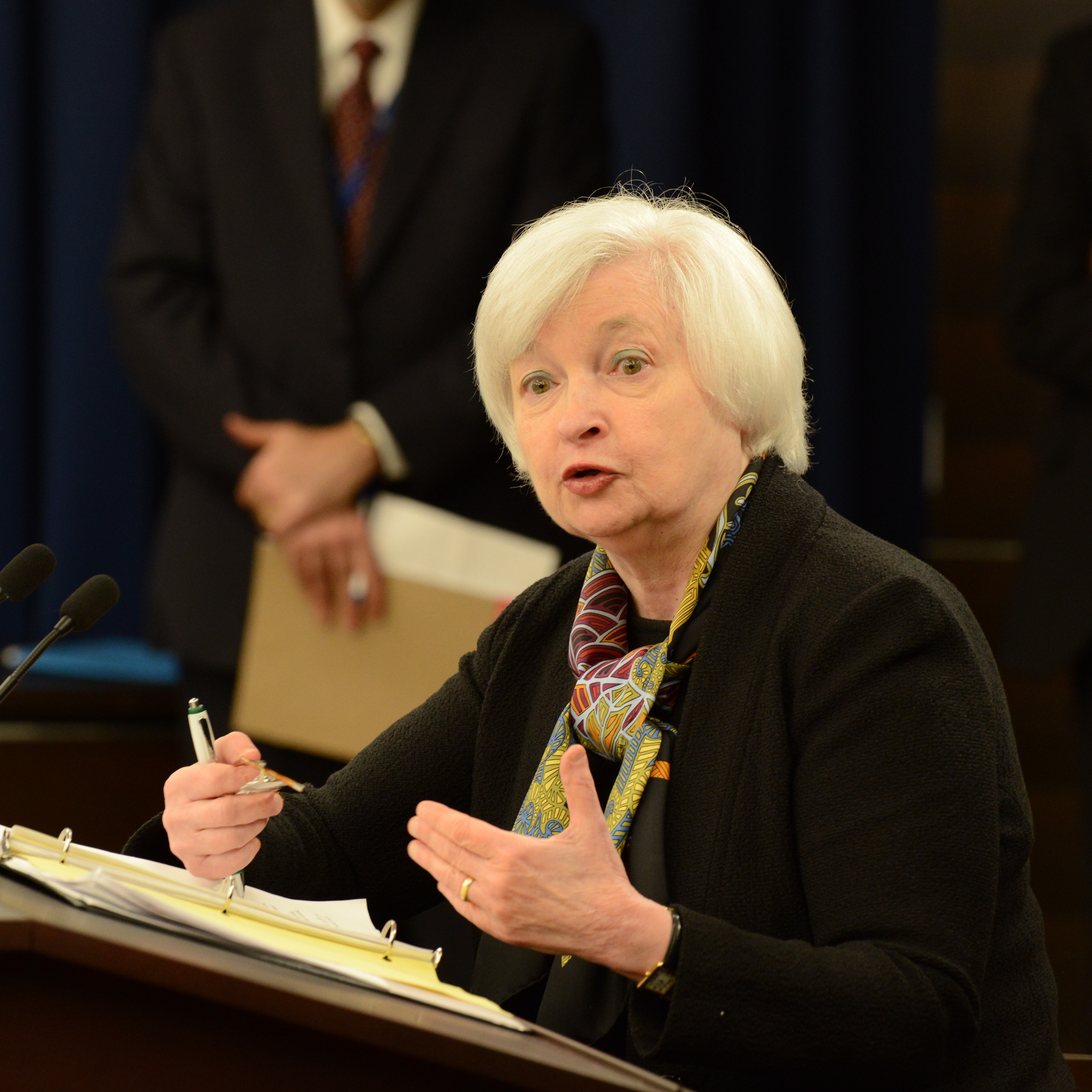
Federal Reserve Chair Janet Yellen spoke on Wednesday, January 18, 2017 at the Commonwealth Club in San Francisco, California. Her speech was titled ‘The Goals of Monetary Policy and How We Pursue Them.’
While the background on what the Fed’s role is, the reality is that investors, economists, job seekers, consumers and borrowers alike all wonder just how far the FOMC plans to raise interest rates and over what sort of time period. The good news is that we got some of that data in Mrs. Yellen’s speech.
It turns out that the Federal Reserve is getting more comfortable with growth. They are also getting more comfortable with inflation at the 2% level. They are also getting more and more comfortable that the economy is close to full employment, and this was defined at close to 4.75%.
[nativounit]
24/7 Wall St. took a look at some of the comments issued to see what was said, and we took out the guts without the historical reference for ease.
These comments have been plucked as paragraphs or as parts of paragraphs and they are not meant to flow back to back. Some of the commentary has been highlighted verbatim below.
- Now, it’s fair to say, the economy is near maximum employment and inflation is moving toward our goal.
- Although inflation has been running below our 2 percent objective for quite some time, we have seen it start inching back toward 2 percent last year as the job market continued to improve and as the effects of a big drop in oil prices faded.
- Now, many of you would love to know exactly when the next rate increase is coming and how high rates will rise. The simple truth is, I can’t tell you because it will depend on how the economy actually evolves over coming months.
- I and most of my colleagues–the other members of the Fed Board in Washington and the presidents of the 12 regional Federal Reserve Banks–were expecting to increase our federal funds rate target a few times a year until, by the end of 2019, it is close to our estimate of its longer-run neutral rate of 3 percent.
- Right now our foot is still pressing on the gas pedal, though, as I noted, we have eased back a bit. Our foot remains on the pedal in part because we want to make sure the economic expansion remains strong enough to withstand an unexpected shock, given that we don’t have much room to cut interest rates.
- Nevertheless, as the economy approaches our objectives, it makes sense to gradually reduce the level of monetary policy support. Changes in monetary policy take time to work their way into the economy. Waiting too long to begin moving toward the neutral rate could risk a nasty surprise down the road–either too much inflation, financial instability, or both. In that scenario, we could be forced to raise interest rates rapidly, which in turn could push the economy into a new recession.
[wallst_email_signup]







 Top Gaining Stocks
 Top Losing Stocks