


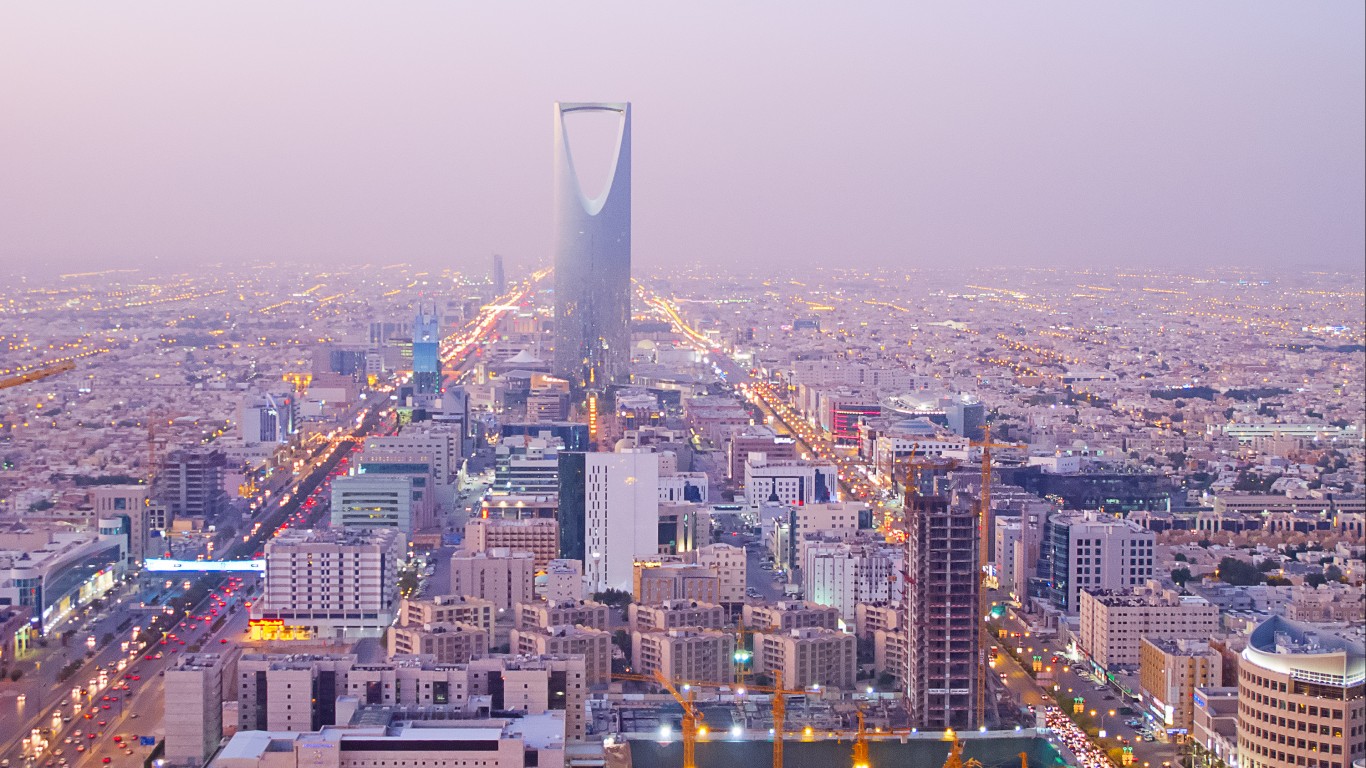
Saudi Arabia ranks fourth in the world based on military expenditures. It ranks 41st in population, and it ranks 19th in nominal gross domestic product (GDP).
Saudi Arabia’s military capacity is extraordinary for a nation its size. The country spent 10% of its GDP on its military budget, which put that expenditure at $64 billion in 2016. By contrast, Russia, which was ranked third in total expenditures at $69 billion, spent 5.3% of GDP. China ranked second in military spending at $215 billion and spent 1.9% of GDP. The U.S. ranked first place with expenditures of $611 billion, which was 3.3% of GDP.
24/7 Wall St. described Saudi Arabia’s military budget as part of its Countries Spending the Most on War analysis:
> Military expenditure: $63.7 billion
> Pct. change military expenditure, 2007-2016: 20.0%
> Expenditure as pct. of GDP: 10.0%
> Per capita military expenditure: $1,978Saudi Arabia spent $63.7 billion on its military in 2016, well above major military powers such as France and Germany, despite having less than half the population of either country. Saudi Arabia is one of the wealthiest nations in one of the least stable regions in the world. Given the number of violent conflicts that have taken place recently — wars in Iraq, Syria, and Yemen, uprisings in Turkey and Egypt, and the emergence of ISIS — the nation has plenty of reasons to beef up military spending. The nation’s total arms expenditure increased by 20% over the past decade.
In 2016, the country’s defense budget accounted for 10% of its GDP, by far the greatest relative expenditure of any country on this list. The next largest spender relative to economic size on this list is another country in the region Israel, which spends 5.8% of its GDP on defense.
[nativounit]
The Saudi population is 32.3 million, which ranks it behind Afghanistan’s 34.6 million, according to UN numbers. It is just ahead of Peru at 31.7 million. Life expectancy is short by most world measures. At 75.5 years, according to the CIA Factbook, it ranks 105th among all nations. The population is well off compared to most nations. GDP per capita is $54,800, which places it 22nd among the world’s countries.
While the economy is large, the International Monetary Fund recently expressed concern about its growth, particularly because of oil prices. Authors of the IMF’s “2017 Article IV Consultation,” which is the organization’s largest analysis of the nation recently, reported:
Non-oil growth is expected to pick-up this year, but overall GDP growth will be close to zero given the decline in oil production. Growth is expected to strengthen over the medium-term as structural reforms are implemented. Risks mainly come from uncertainties about future oil prices and how ongoing reforms will impact the economy.
The CIA Factbook describes the tremendous effect oil prices have on the total economy:
Saudi Arabia has an oil-based economy with strong government controls over major economic activities. It possesses about 16% of the world’s proven petroleum reserves, ranks as the largest exporter of petroleum, and plays a leading role in OPEC. The petroleum sector accounts for roughly 87% of budget revenues, 42% of GDP, and 90% of export earnings.
Finally, the CIA describes Saudi Arabia as an “absolute monarchy” without a single government agency or a population that has any autonomy outside what the rulers allow.
[recirclink id=476142]
[wallst_email_signup]





 Top Gaining Stocks
 Top Losing Stocks