


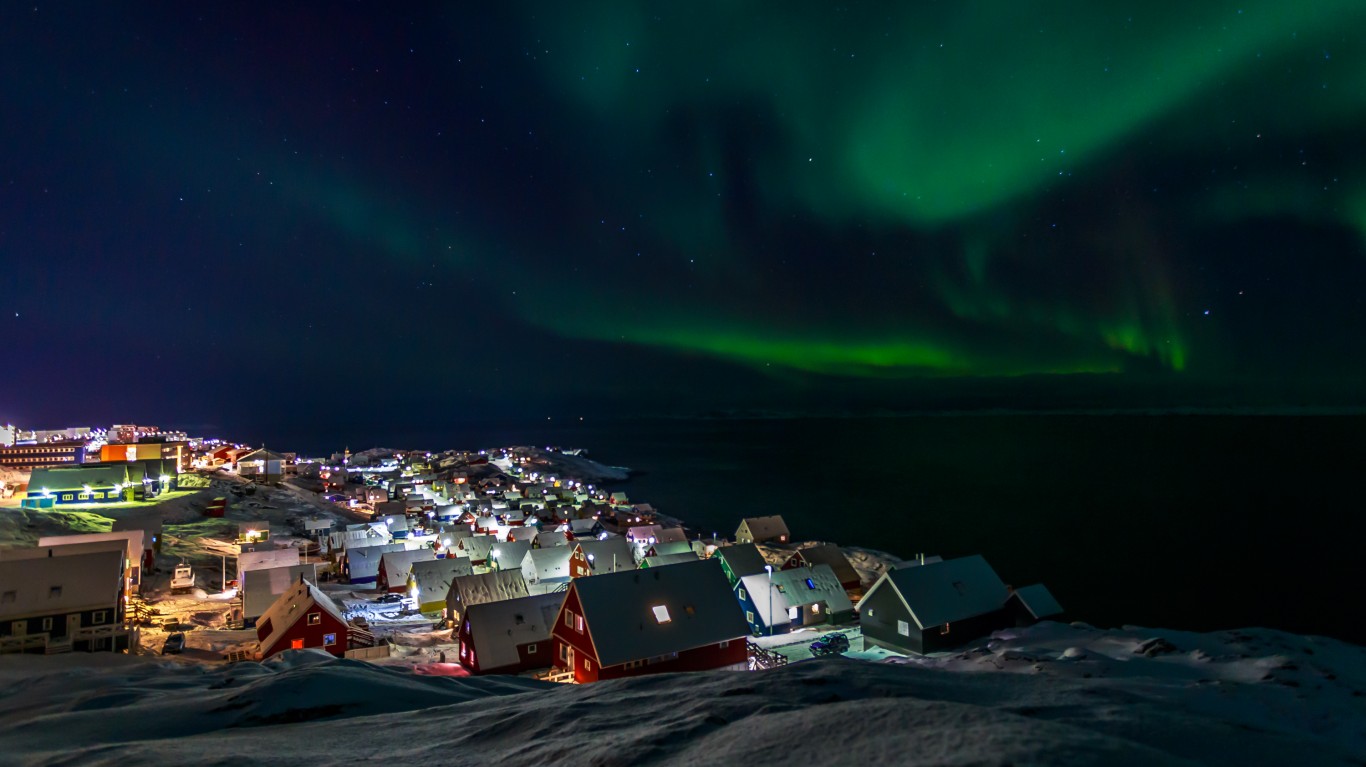
The Trump administration has repeated its interest in the purchase of Greenland. The world’s largest island is currently owned by the Kingdom of Denmark and is officially an autonomous country, based on the constitution of Denmark. Denmark has turned down the administration’s offer. However, there is precedent for large land purchases by the United States. The biggest of these was the Louisiana Purchase, when the Jefferson administration bought 828,000 square miles from France for $15 million. There is no way to set a price on Greenland without an official offer, but there are several ways to estimate one.
Greenland encompasses 536,000 square miles. About 80% of that area is water. Just over 55,000 people live in Greenland. It has virtually no infrastructure outside of Nuuk, its largest city and capital. Nuuk has a population of just under 20,000. Greenland has virtually no economy. Its gross domestic product (GDP) is just above $2 billion. The largest part of the tiny economy is from fishing.
What Greenland does have in abundance is minerals and metals. These include iron, uranium, aluminum, nickel, platinum, tungsten, titanium and copper. Greenland also has what may be vast oil fields. Greenland has its own small oil company, known as Nunaoil.
The Brookings Institute reports it is too early to value Greenland’s mineral and oil deposits, many of which sit offshore. In its report on Greenland’s resources, Brookings wrote, “Considering that only a small fraction of this massive island has been properly explored, in the coming years more data gathering and analysis would be helpful to assess the full potential of Greenland.” That means any valuation based on the size of these deposits carries high risk.
[nativounit]
While it is difficult to find comparable sections of the United States that could be used to create a valuation, the closest are in the Mountain States, where mineral and oil deposits have been only partially exploited, and then apply a discount for the Greenland risk of lack of exploration. Any analysis has to rule out North Dakota because of the established value of shale. Wyoming has no established mineral or oil deposits of similar size to North Dakota’s. 24/7 Wall St. has estimated the value of Wyoming’s land is $97 billion. Wyoming covers 98,000 square miles. Based on its landmass, Greenland would be worth 5.5 times Wyoming’s worth, or $533 billion. That would make the amount almost the size of America’s annual military budget.
Using Wyoming as a yardstick has two drawbacks that need to be used as an adjustment. Wyoming’s GDP is about $38 billion, according to the Bureau of Economic Analysis division of the U.S. Department of Commerce. It has an established economy, with about one-third coming from mining. Agriculture and manufacturing represent about 10% each. Government jobs produce about 15% of GDP. On the other hand, Wyoming’s mineral and oil deposits have been developed for decades. Whatever value they have is established already. Greenland is on the other end of the spectrum. It may have among the largest mineral and oil deposits in the world that have not been already explored and exploited.
Adjusted for the risk of developing a national GDP in the hundreds of billions of dollars a year, is Greenland worth as much or more than the benchmark of Wyoming? If the United States wants it for the strategic value of its property, both on land and offshore, and to project military power, the answer is that a value of $500 billion is not overly rich. Forces placed there could join a list of over 400 U.S. military bases, which ironically are in some of the smallest countries in the world.
[recirclink id=569495]
[wallst_email_signup]










 Top Gaining Stocks
 Top Losing Stocks