


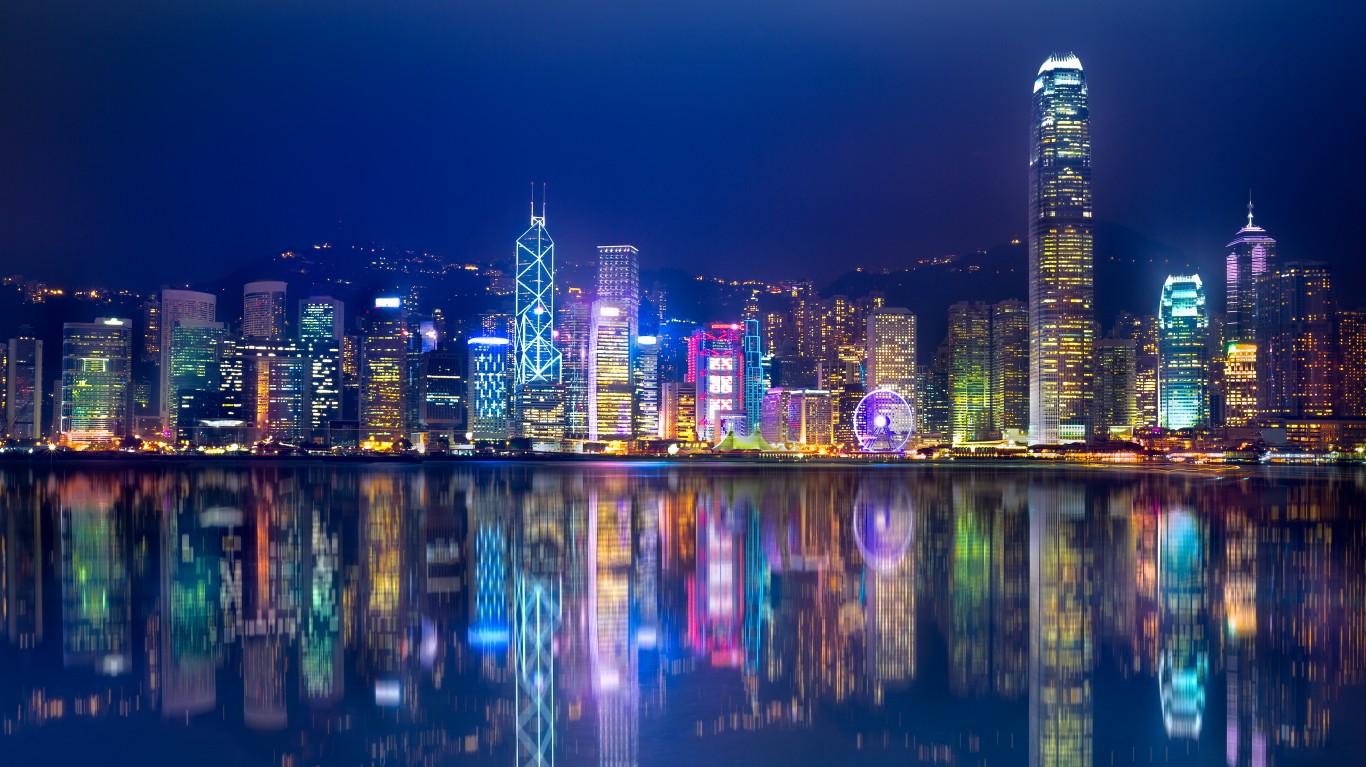
Hong Kong is under siege. China has said it will push new national security laws to control the population. Protests have erupted and the dispute has moved toward violence. More is at stake than the political future of Hong Kong politically. It is the 32nd largest economy in the world by GDP and a major trading partner to some of the world’s largest countries.
Hong Kong’s nominal GDP is $372 billion which is about the same as those of Singapore and Israel.
The IMF reports from research before the COVID-19 pandemic:
Economic activity in Hong Kong SAR weakened significantly in 2019 as rising trade tensions between the U.S. and China and heightened uncertainty took a toll on exports and investment while private consumption and visitor arrivals have declined due to the social unrest that started over the summer. As the cyclical downturn continues, GDP is expected to contract by 1.9 percent in 2019. Growth is projected to rise to 0.2 percent in 2020, led by private consumption, but the pace of recovery over the medium term is expected to be slower than in previous recoveries as increased trade barriers and disruptions to global supply chains would be a drag on trade-related activities.
And,
Hong Kong SAR economy has been hit hard by both external and domestic shocks and fell into a technical recession in the third quarter. The economy is projected to start recovering next year, but the pace is expected to be gradual and both near- and medium-term risks have increased significantly, including from trade and technology tensions, ongoing social unrest, and structural challenges of insufficient housing supply and high income inequality. Hong Kong SAR is well placed to address both cyclical and structural challenges with its significant buffers thanks to its long history of prudent macroeconomic policies.
The CIA Factbook adds, also before the effects of the pandemic:
Hong Kong has a free market economy, highly dependent on international trade and finance – the value of goods and services trade, including the sizable share of reexports, is about four times GDP. Hong Kong has no tariffs on imported goods, and it levies excise duties on only four commodities, whether imported or produced locally: hard alcohol, tobacco, oil, and methyl alcohol. There are no quotas or dumping laws. Hong Kong continues to link its currency closely to the US dollar, maintaining an arrangement established in 1983.
And:
Hong Kong has also established itself as the premier stock market for Chinese firms seeking to list abroad. In 2015, mainland Chinese companies constituted about 50% of the firms listed on the Hong Kong Stock Exchange and accounted for about 66% of the exchange’s market capitalization.
A deep injury to Hong Kong would change its economic relationship with the balance of the world.





 Top Gaining Stocks
 Top Losing Stocks