


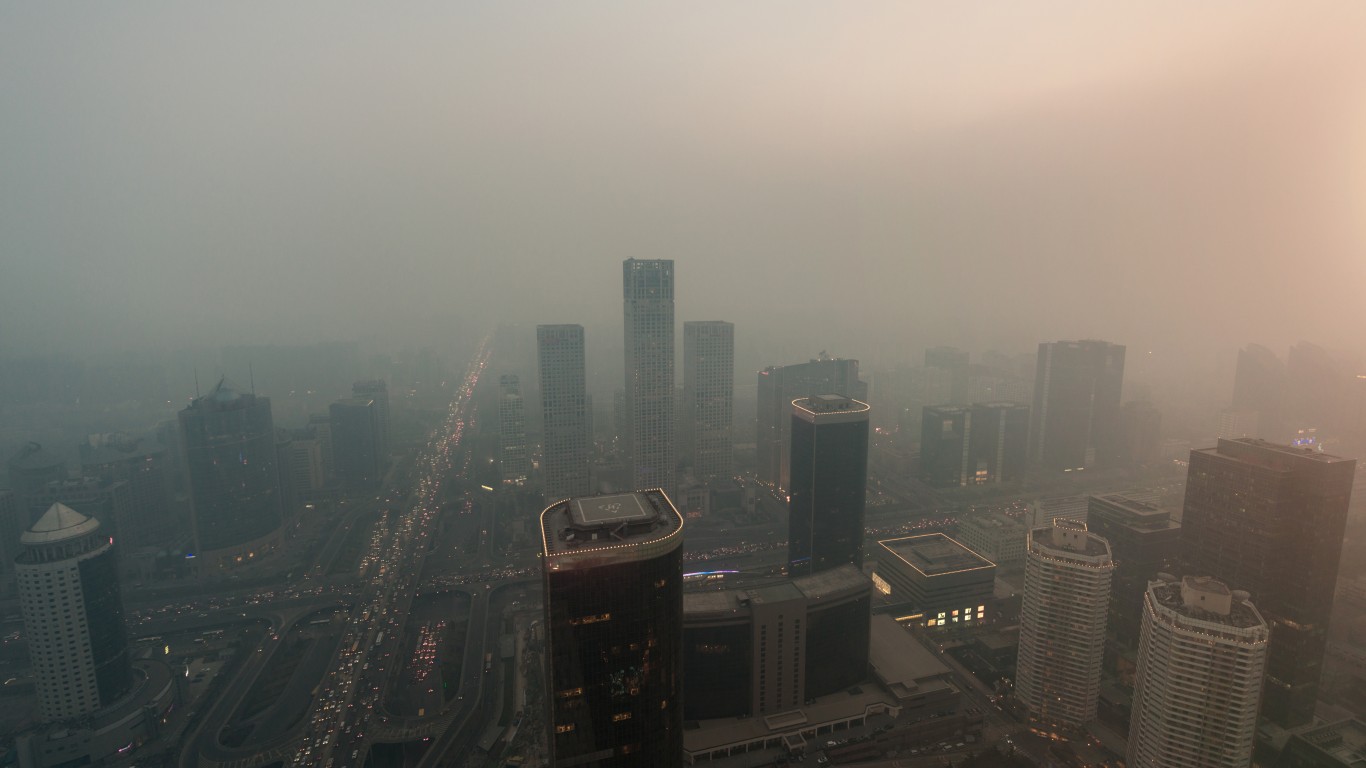
One of the most widely used measures of air quality is the air quality index (AQI). It describes current or near-term forecasts of air quality. Not all countries have adopted it, but AQI has become a primary standard to determine if the air is safe for humans to breathe, depending on several fundamental scientific yardsticks. The AQI has been so high for so long that in some nations, it is unlikely to get better. Rather, it almost certainly will worsen, because these nations have done little if anything to stem rising air pollution. In most cases, they cannot.
[in-text-ad]
According to air quality experts AirNow, AQI measurements take into account five sets of data: ground-level ozone, particle pollution (also known as particulate matter, including PM2.5 and PM10), carbon monoxide, sulfur dioxide and nitrogen dioxide.
“Unhealthy” air quality is measured by an index that runs from 150 to 200. This is a particular problem for some portions of the population, especially those with preexisting conditions that could be affected by air pollution. “Very unhealthy” air conditions are measured on an index from 201 to 300. This level is described as a present health risk for all people. Finally, “hazardous” is pegged at 300 or higher on the index. This triggers emergency health warnings in almost all places. Hazardous warnings occasionally are posted in some large cities, particularly in Afghanistan, Bangladesh, China, India, Mongolia and Pakistan. To see these by day, the World’s Air Pollution organization posts city figures in real-time.
[nativounit]
Over the course of 2019, five countries posted values of 150 for the entire year. Among them, they have 23% of the world’s population. IQAir, which tracks air quality by city and country, lists these as the countries with the worst air quality:
| Country | 2019 AQI | Population |
|---|---|---|
| Bangladesh | 165 | 166 million |
| Pakistan | 159 | 201 million |
| Mongolia | 154 | 3 million |
| Afghanistan | 153 | 36 million |
| India | 152 | 1.34 billion |
Why won’t these numbers ever improve? Among other things is the law of weighted averages. Except for Mongolia, each country has huge cities that routinely have AQI figures above 200, and sometimes much higher.
These cities include, in particular in China, Chengdu, Chongqing, Guangzhou, Shenzhen and Wuhan. These and other Chinese cities with high air pollution have populations in the millions, sometimes over 10 million residents. This helps push the national number higher.
In Pakistan, Karachi, which often has terrible air pollution, has a population of 15 million. In Afghanistan, Kabul exhibits the same problems. Agra, Delhi, Gaya, Jaipur and Muzaffarpur in India have among the worst air pollution problems of any cities in the world. The Indian city of Kanpur has been named as having the worst air pollution of any city in the world.
The most direct answer to why air pollution problems in these nations will not improve, and actually will get worse, is both industry and household energy use practices. In India, according to the Financial Times, pollution is driven by “dirty diesel exhaust fumes, construction dust, rising industrial emissions and crop burning, which has created heavy loads of harmful pollutants in the air.” The Indian government would need to spend untold hundreds of billions of dollars to retrofit plants, change how crops are handled and replace diesel engines with those fitted with clean engine technology.
The chance for change in other countries troubled by very high AQI is equally grim. Afghanistan, Bangladesh, Mongolia and Pakistan are wretchedly poor. The World Bank shows these nations have among the lowest gross domestic product per capita in the world. Central governments lack the resources to change energy sources. As their populations grow, the air quality situation will only worsen.
Other nations may be on the path to permanently high dangerous air quality. However, these five are already there and will not turn back.
[recirclink id=731794]
[wallst_email_signup]






 Top Gaining Stocks
 Top Losing Stocks