


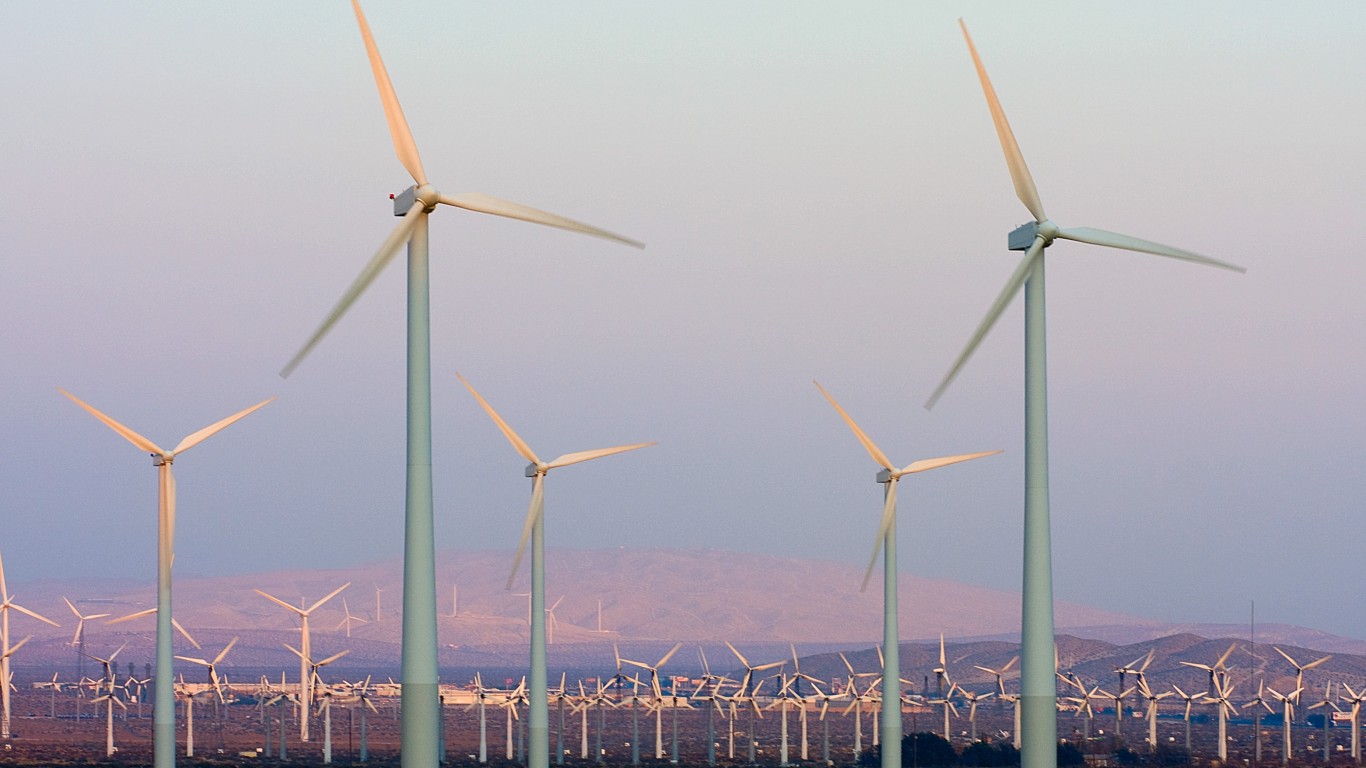
 Get ready for massively larger new wind turbines… Currently available wind turbines for land-based wind farms typically generate between 1.5 and 3 megawatts. Most include a gearbox to transfer the power of the spinning blades to a generator. Larger turbines, with capability to generate up to 7 or even 10 megawatts are also available, and these typically use a direct drive system that eliminates the weight and size of the gearbox. General Electric Co. (NYSE: GE) has announced plans to develop a 15-megawatt direct drive turbine using technology similar to the superconducting magnets used in the magnetic resonance imaging (MRI) systems used in healthcare applications.
Germany’s Siemens AG (NYSE: SI) already sells 2.3- and 3-megawatt direct drive turbines and Denmark’s Vestas Wind Energy Systems A/S (OTC: VWDRY) plans to build a 7-megawatt turbine using a gearbox for mass production by 2015. The GE turbine, more than double the generating capacity of the Vestas machine, is being developed in a two-year program sponsored by the US Department of Energy with a $3 million grant.
Superconducting magnets are made from niobium and other metals wound with superconducting wire. A maker of superconducting wire like American Superconductor Corp. (NASDAQ: AMSC) or SuperPower Inc., a subsidiary of Dutch giant Phillips Electronics NV (NYSE: PHG). Though direct drive superconductor-based turbines are more expensive in smaller sizes, the reductions in size, weight, and speed as more generation capacity is added makes the direct drive turbines more economical at the larger sizes.
Another advantage of the direct drive turbines is that they use less of the scarce and expensive rare earth elements than the amounts needed for the permanent magnets that are used in gear-drive turbines. That, too, will help keep the cost down.
GE’s announcement doesn’t go into a lot of detail, but there is at least one thing that will chill enthusiasm for the new larger turbines: the giant direct-drive turbines will almost certainly require longer blades. The press release mentions the subject obliquely when it notes that other key technologies it is working on include “lighter, more advanced composite materials to enable longer wind blades that enhance wind capture.” The direct drive turbines compensate for that somewhat by developing more torque at lower rotation speeds. But the longer blades also mean taller towers, which to many people just adds to the eyesore factor of wind turbines.
The 15-megawatt turbines are very likely years away from mass production, and perhaps even further away from mass acceptance. Still, it could signal a technological resurgence in the US wind energy business.
Paul Ausick






 Top Gaining Stocks
 Top Losing Stocks