


Since its discovery in 1968, Alaska’s North Slope (ANS) basin has produced nearly 17 billion barrels of oil. Since hitting a peak of 2 million barrels of oil a day in the late 1980s, production has fallen to around 400,000 barrels a day as of last week.
But a lot more North Slope oil remains to be recovered, according to analysts at IHS Markit. According to the firm’s latest estimates, there are 38 billion barrels of oil equivalent of remaining recoverable resources in the North Slope “super-basin,” defined as one that holds at least 5 billion barrels of oil and that already has produced at least 5 billion more.
Of that total 38 billion barrels, 28 billion are crude oil and 50 trillion cubic feet are natural gas. IHS Market sets the basin’s estimated ultimate recovery at nearly 55 billion barrels of oil equivalent, the sum of the 17 billion already produced and the 38 billion recoverable barrels remaining.
IHS Markit noted that the ANS has reached a late-emerging phase because the basin offers such a significant amount of remaining resources. The massive Prudhoe Bay and Endicott fields continue to produce as they have for nearly 40 years, but the added resources have been located in geologic formations that have been only lightly explored and developed.
[nativounit]
Kareemah Mohamed, lead author of the IHS Markit report, warned, however:
[D]espite the geologic potential of the ANS, potential investment risks include needed service-sector expansion to support expected production growth, uncertainty over whether the state of Alaska will maintain its tax-incentive program, infrastructure access for new entrants, and the potential application of unconventional technology in a complex operating environment.
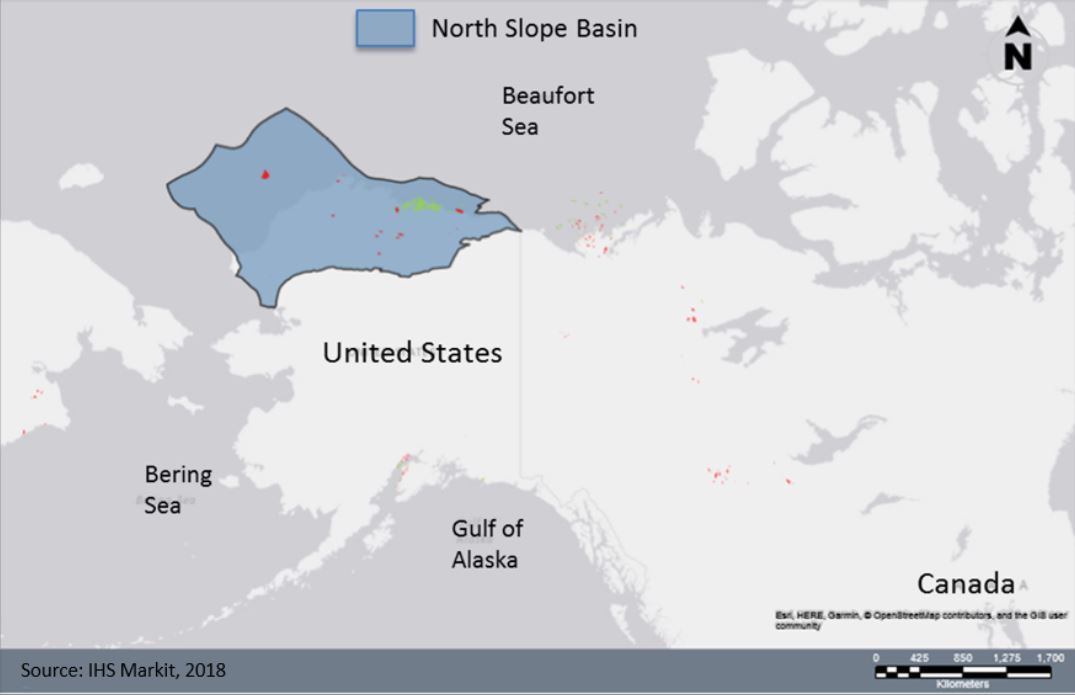
Here’s a map showing the basin as it extends beyond Alaska’s northern coast into the Beaufort Sea. Late last year the Trump administration opened up a portion of the National Petroleum Reserve to development. Area 1002 (the green area on the map) is included in the Alaska National Wildlife Refuge (ANWR). IHS Markit estimates that Area 1002 contains 9.5 billion barrels of oil equivalent in “yet-to-find” resources.
Last month the U.S. Department of the Interior ordered an expedited environmental review of the impact of leasing part of ANWR for drilling. A lease auction could occur as soon as next summer. Such environmental reviews typically require two to three years of work, according to a report last month in The Washington Post. However the review turns out, court challenges are sure to follow.
[recirclink id=487208]
[wallst_email_signup]






 Top Gaining Stocks
 Top Losing Stocks