


Good news for those who suffer from high levels of uric acid and from gout: the U.S. Food and Drug Administration (FDA) has approved a new gout treatment. AstraZeneca PLC (NYSE: AZN) announced on Tuesday that its Zurampic (lesinurad) 200 mg tablets have been approved by the FDA for use in combination with a xanthine oxidase inhibitor (XOI) to treat hyperuricemia associated with gout in patients who have not achieved target serum uric acid (sUA) levels with an XOI alone.
What matters here is that gout treatments have had very improvements over the past 40 to 50 years.
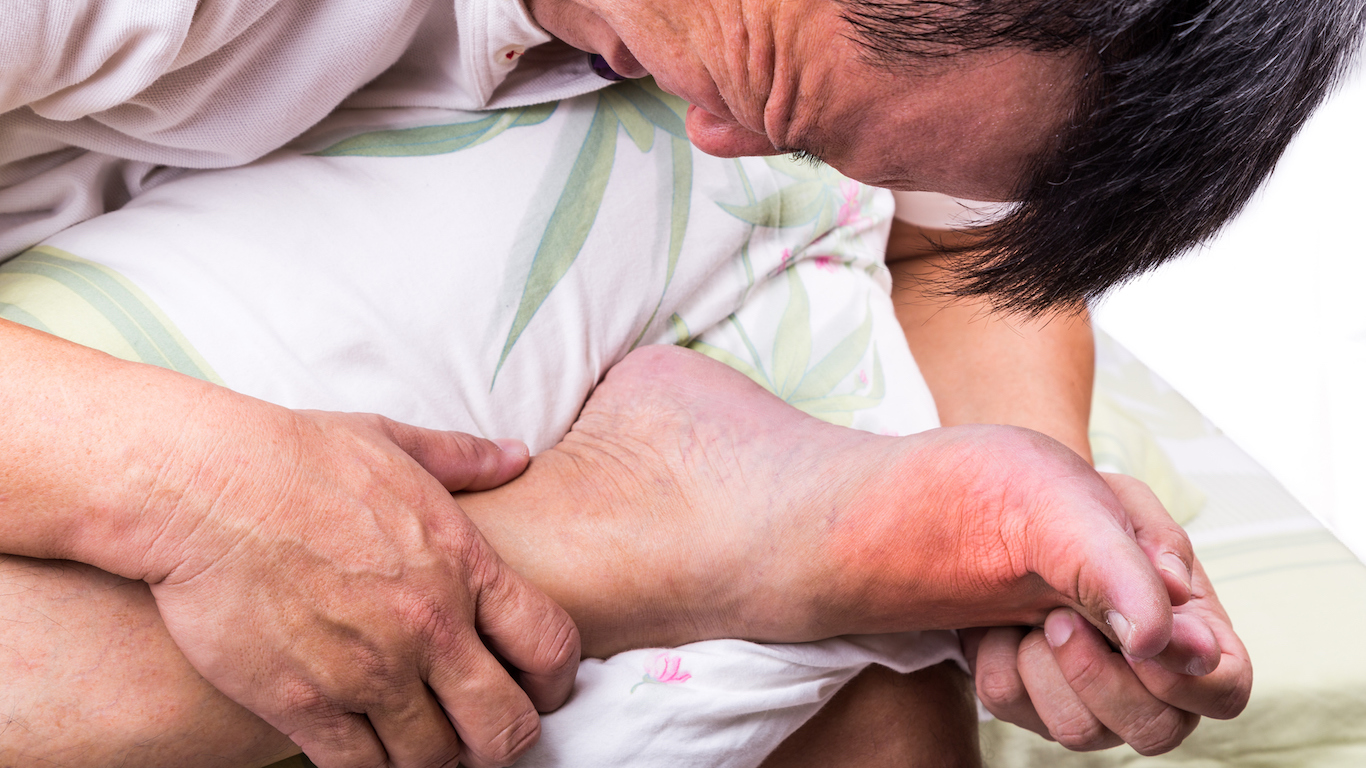
The joint pain associated with gout can be temporarily debilitating to those who suffer from it. Gout is a form of inflammatory arthritis that is now said to affect over 15.8 million people in major markets, and it has historically been referred to as “disease of kings.” Hyperuricemia (elevated sUA) sets in and ultimately leads to the deposition of crystals in joints and in other tissues, and it can be in returning or chronic attacks of inflammatory arthritis.
This treatment may matter handily. The Gout and Uric Acid Education Society website offers a statistic showing that more than 8.3 million Americans are living with gout, and only 10% receive the needed ongoing treatment. The society also identifies an economic cost and impact of gout on its site:
A 2013 literature review estimated the economic burden of gout at more than $6 billion per year. According to a 2013 study from the Arthritis Research Centre of Canada, the University of British Columbia and Boston University, there is a $2,021 annual work productivity loss per gout patient suffering from more than three attacks per year. For those patients that suffer six or more gout attacks per year, direct gout-related health care costs top $12,020.
An additional study in February 2015 reported that elderly and treatment-resistant gout patients could pay $16,925 to $18,362 per person in order to manage their gout.
AstraZeneca’s American depositary shares traded up 0.9% to $33.23 in New York trading on Tuesday, and the shares were indicated up another 1.2% at $33.64 early Wednesday. They trade in a 52-week range of $29.50 to $36.69.
[recirclink id=304447]
AstraZeneca’s press release said of its drug approval:
ZURAMPIC inhibits the urate transporter, URAT1, which is responsible for the majority of the renal reabsorption of uric acid. By inhibiting URAT1, ZURAMPIC increases uric acid excretion and thereby lowers sUA.
In combination with the current standard of care, XOIs allopurinol or febuxostat, ZURAMPIC provides a dual mechanism of action to increase excretion and decrease production of uric acid, enabling more patients with inadequately controlled gout to achieve target treatment goals.
In a pooled analysis of the three clinical trials, the safety profile was similar for ZURAMPIC 200mg in combination with an XOI to that of an XOI alone, with the exception of an increased incidence of predominantly reversible serum creatinine (sCr) elevations.
ZURAMPIC is also under regulatory review in the European Union and other territories. On 18 December 2015, the Committee for Medicinal Products for Human Use (CHMP) of the European Medicines Agency (EMA) adopted a positive opinion recommending the marketing authorisation of ZURAMPIC 200mg tablets.
ZURAMPIC, in combination with an XOI, is recommended for the adjunctive treatment of hyperuricaemia in gout patients (with or without tophi) who have not achieved target sUA levels with an adequate dose of an XOI alone.
This approval even registered a response from the Gout and Uric Acid Education Society. Its chairman and chief executive officer, Dr. Lawrence Edwards, said:
A new approach to treating gout is long overdue given there has been limited therapy innovation over the last 50 years. Combination therapy with ZURAMPIC is an important addition to the medicines available to physicians that will help more gout patients reach their serum uric acid treatment targets, which may ultimately relieve their suffering from this painful disease.










 Top Gaining Stocks
 Top Losing Stocks