


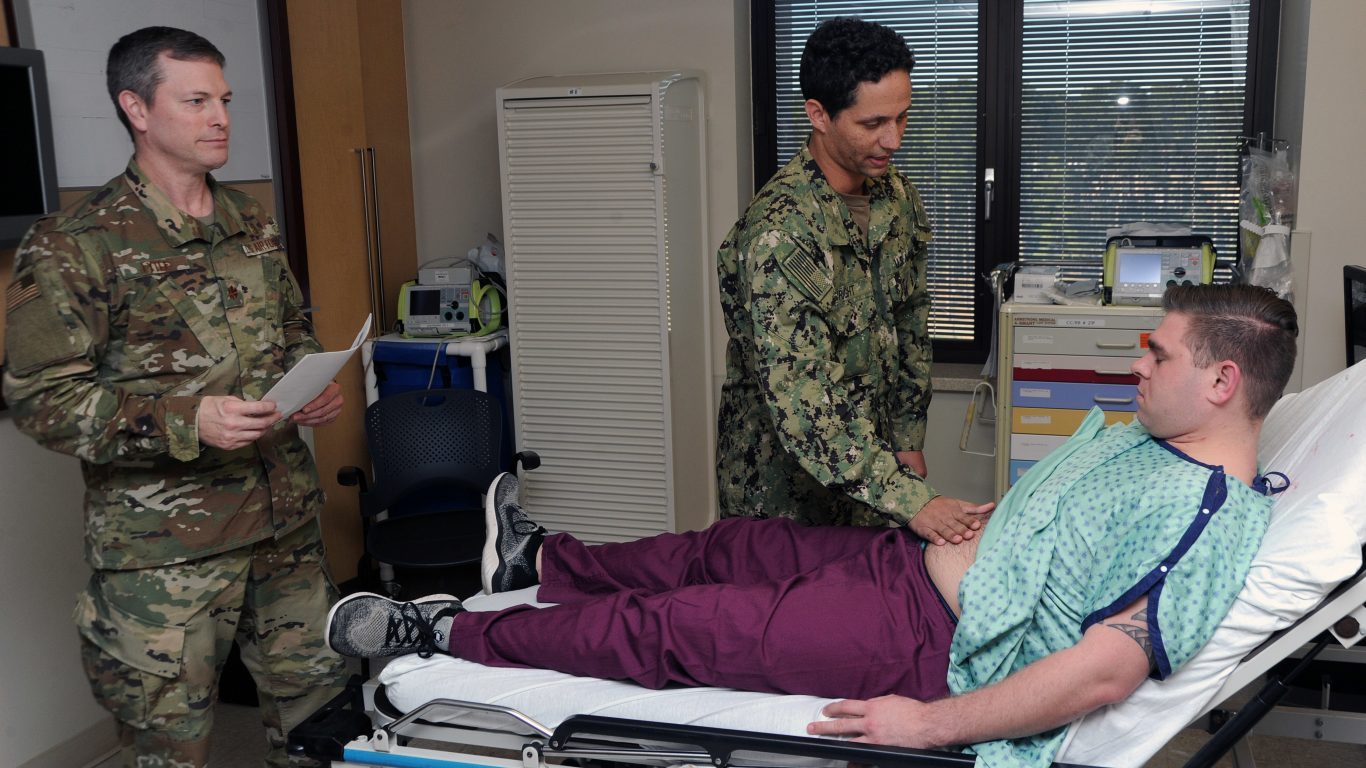
The Department of Defense employs 130,000 medical professionals, according to the Government Accounting Office. Some of these medical professionals work with deployed troops. Other military medical staff provide care in 59 DOD hospitals (VA hospitals) and a larger number of clinics for 9.6 million people. These people include retired veterans and their families. The Trump administration’s budget for 2020 lists a cut of as many as 18,000 military medical personnel. The question is, where are they deployed now? Private and public hospitals need thousands of medical professionals in their frontline fight to care for the surging number of coronavirus infected patients.
These cuts are part of the proposed 2020 budget. They range across the Army, Navy and Air Force. Navy medical personnel serve the marines. Some may be contractors, but that count cannot be determined. Some portion of the debate about the cuts in medical personnel is the need during a major conflict. For the moment, that military conflict does not exist.
Depending on the logistics of moving personnel and how many military-medical people could be spared immediately, the number available to treat coronavirus patients is certainly in the thousands.
The Centers for Disease Control and Prevention reports that there were 139 million emergency room visits in 2017. Only 55,000 doctors are specialists in emergency medicine. There are also many doctors who are part of the staff of emergency departments, even though they are not board-certified emergency medicine specialists. In many parts of America, doctors who are primary care doctors are often the only health care providers available to provide emergency care in clinics or hospitals, especially in rural areas.
In the CDC’s worst-case scenario for the spread of the coronavirus, 2.4 million to 24 million people could require hospitalization. It is projected, based on what we have learned from this epidemic (in China and Italy for example), that the greatest number of cases would be concentrated over a period of a few months. Clearly, the available information about the extent to which emergency rooms will be overwhelmed and woefully understaffed underscores the urgent need for an influx of more medical professionals as rapidly as possible.
[nativounit]
The military has recently begun a very limited level of emergency support. USNS Comfort, which is a large medical ship with room for 1,000 patients, has been deployed in close proximity to New York City.
Military medical personnel would ideally be deployed to the areas with the greatest need for health care providers, including Washington and New York, where the numbers of COVID 19 infections are highest and rising and the hospital situations are worst. The entire staff of hospitals is already overwhelmed as very sick patients surge in number, even though we are early on in this epidemic. The need for additional health care providers throughout hospitals cannot be overemphasized.
The Department of Defense, and ultimately the commander in chief, have nearly complete control of military personnel within the United States and can deploy them as they see fit. It is important to understand quickly that an urgent influx of thousands of additional trained medical military professionals would change the face of this epidemic.
[recirclink id=657367]
[wallst_email_signup]












 Top Gaining Stocks
 Top Losing Stocks