India’s Drawback — No Roads, No Power

Photo of Douglas A. McIntyre
By Douglas A. McIntyre Published
This post may contain links from our sponsors and affiliates, and Flywheel Publishing may receive compensation for actions taken through them.

China has a robust infrastructure that includes roads and bridges. It also has a sophisticated energy delivery system. As a matter of fact, several of the biggest companies in the People’s Republic run the electricity systems. Among them are State Grid Corporation and China Southern Power Grid, each of which has tens of billions of dollars in sales.

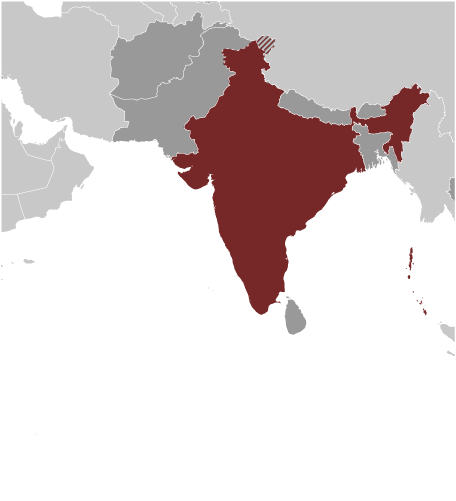
There was a reminder today why India is not the next China, which it would like to be, and why it may never be like China at all. Half of India is in a black out. The Associated Press reports that 600 million people were without power — about twice the entire population of the United States.

The power grid failure is the tip of an iceberg. The Hindu recently reported that the poor quality of India’s roads has increased the price of energy. The paper mentioned one of the conclusions of a government report:

It also called for access-controlled expressways, and suggested that at least 18,637 km of expressway be built in the 13 Five-Year Plan. At present, India has just 600 to 700 km of access-controlled expressway, as against 74,000 km in China.

Government blocks to foreign investment often are blamed for why large companies from outside India do not want to do business there. China also has restrictions, but in general, they are less strict. What the People’s Republic does have that India does not is the infrastructure that sits side-by-side with China’s massive manufacturing and shipping system. Those make it a ready place for companies from the developed world to do business.

China has not had a blackout that affects half of its population. The central government has made sure of that. The headlines about the blackout in India will not sit well with any multinational that might consider putting assets and investments there.

Douglas A. McIntyre

Photo of Douglas A. McIntyre
About the Author Douglas A. McIntyre →

Douglas A. McIntyre is the co-founder, chief executive officer and editor in chief of 24/7 Wall St. and 24/7 Tempo. He has held these jobs since 2006.

McIntyre has written thousands of articles for 24/7 Wall St. He is an expert on corporate finance, the automotive industry, media companies and international finance. He has edited articles on national demographics, sports, personal income and travel.

His work has been quoted or mentioned in The New York Times, The Wall Street Journal, Los Angeles Times, The Washington Post, NBC News, Time, The New Yorker, HuffPost USA Today, Business Insider, Yahoo, AOL, MarketWatch, The Atlantic, Bloomberg, New York Post, Chicago Tribune, Forbes, The Guardian and many other major publications. McIntyre has been a guest on CNBC, the BBC and television and radio stations across the country.

A magna cum laude graduate of Harvard College, McIntyre also was president of The Harvard Advocate. Founded in 1866, the Advocate is the oldest college publication in the United States.

TheStreet.com, Comps.com and Edgar Online are some of the public companies for which McIntyre served on the board of directors. He was a Vicinity Corporation board member when the company was sold to Microsoft in 2002. He served on the audit committees of some of these companies.

McIntyre has been the CEO of FutureSource, a provider of trading terminals and news to commodities and futures traders. He was president of Switchboard, the online phone directory company. He served as chairman and CEO of On2 Technologies, the video compression company that provided video compression software for Adobe’s Flash. Google bought On2 in 2009.

Featured Reads

Our top personal finance-related articles today. Your wallet will thank you later.

Continue Reading

Top Gaining Stocks

CBOE Vol: 1,568,143
PSKY Vol: 12,285,993
STX Vol: 7,378,346
ORCL Vol: 26,317,675
DDOG Vol: 6,247,779

Top Losing Stocks

LKQ
LKQ Vol: 4,367,433
CLX Vol: 13,260,523
SYK Vol: 4,519,455
MHK Vol: 1,859,865
AMGN Vol: 3,818,618