Obesity Drags on the Economy

Photo of Douglas A. McIntyre
By Douglas A. McIntyre Published
This post may contain links from our sponsors and affiliates, and Flywheel Publishing may receive compensation for actions taken through them.

Obese people do not just risk their own health; their health problems cripple the economy. GDP would be given a boost if the number of fat people fell sharply. The Obama administration has not made an attack on obesity part of its stimulus program. Maybe it should.

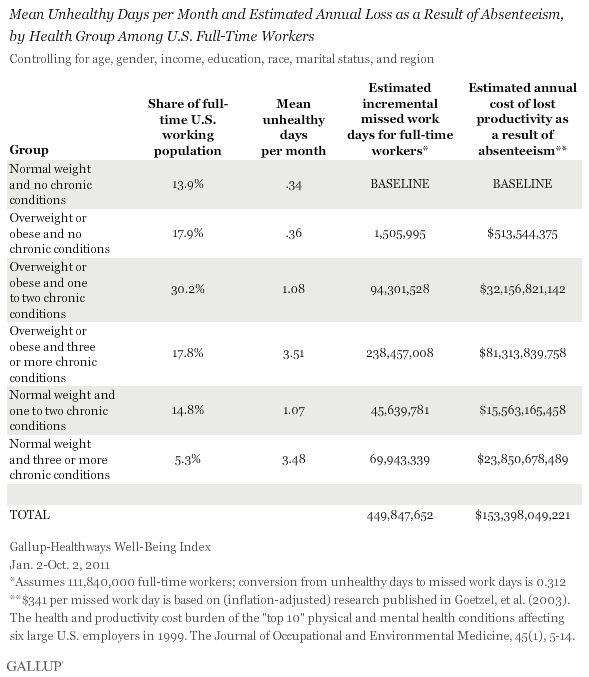
Gallup researchers report that “Full-time workers in the U.S. who are overweight or obese and have other chronic health conditions miss an estimated 450 million additional days of work each year compared with healthy workers — resulting in an estimated cost of more than $153 billion in lost productivity annually.”

The obesity epidemic raises health care costs, which get passed along to insurance companies and the families of the obese. The loss of productivity pressures corporate profit margins, which are already pressed by a weak economy. Obesity is one of the few things damaging the economy that could be changed.

The obese are not expected to carry their own weight in terms of what they pay for insurance. They cost the system more, so they should pay more into insurance pools. That would give those who are overweight some incentive to lose weight. Of course, the other side of it is that anyone who has to pay more for insurance has less discretionary income. For obese people that means less money for food and drink. Insurance company earnings and general productivity would be helped by a drop in the number fat persons. Fast food chains like McDonald’s (NYSE: MCD) would be hurt. It is hard to calculate, on balance, how much a drop in fast food sales would hurt the overall economy.

Obesity is one of several things that costs society money and are based on decisions made by individuals. Drug use, alcohol abuse and smoking are among them. There have never been any financial penalties for these habits beyond sin taxes.

The government and many companies have budget problems now. It is not obvious to most that the habits that cause obesity are part of the problem. Tax the obese and the government makes more money. Or, people go on diets and become more productive.

Methodology: These findings are based on Gallup-Healthways Well-Being Index data collected between Jan. 2 and Oct. 2, 2011. Gallup surveyed 109,875 full-time employees — those who work at least 30 hours per week — during this time period.

Douglas A. McIntyre

Photo of Douglas A. McIntyre
About the Author Douglas A. McIntyre →

Douglas A. McIntyre is the co-founder, chief executive officer and editor in chief of 24/7 Wall St. and 24/7 Tempo. He has held these jobs since 2006.

McIntyre has written thousands of articles for 24/7 Wall St. He is an expert on corporate finance, the automotive industry, media companies and international finance. He has edited articles on national demographics, sports, personal income and travel.

His work has been quoted or mentioned in The New York Times, The Wall Street Journal, Los Angeles Times, The Washington Post, NBC News, Time, The New Yorker, HuffPost USA Today, Business Insider, Yahoo, AOL, MarketWatch, The Atlantic, Bloomberg, New York Post, Chicago Tribune, Forbes, The Guardian and many other major publications. McIntyre has been a guest on CNBC, the BBC and television and radio stations across the country.

A magna cum laude graduate of Harvard College, McIntyre also was president of The Harvard Advocate. Founded in 1866, the Advocate is the oldest college publication in the United States.

TheStreet.com, Comps.com and Edgar Online are some of the public companies for which McIntyre served on the board of directors. He was a Vicinity Corporation board member when the company was sold to Microsoft in 2002. He served on the audit committees of some of these companies.

McIntyre has been the CEO of FutureSource, a provider of trading terminals and news to commodities and futures traders. He was president of Switchboard, the online phone directory company. He served as chairman and CEO of On2 Technologies, the video compression company that provided video compression software for Adobe’s Flash. Google bought On2 in 2009.

Featured Reads

Our top personal finance-related articles today. Your wallet will thank you later.

Continue Reading

Top Gaining Stocks

CBOE Vol: 1,568,143
PSKY Vol: 12,285,993
STX Vol: 7,378,346
ORCL Vol: 26,317,675
DDOG Vol: 6,247,779

Top Losing Stocks

LKQ
LKQ Vol: 4,367,433
CLX Vol: 13,260,523
SYK Vol: 4,519,455
MHK Vol: 1,859,865
AMGN Vol: 3,818,618