


 Some of the companies that trade as part of the Dow Jones Industrial Average already have reported earnings for the third quarter. The fate of their share prices, at least for now, is likely set. Intel Corp. (NASDAQ: INTC) showed weak numbers at PC sales falter. J.P. Morgan Chase & Co. (NYSE: JPM) results indicated a rebound from its trading problems and a likely early recovery of the housing market. Alcoa Inc. (NYSE: AA) numbers showed the effects of volatile metal prices.
But there are several Dow members that have not reported and some of their earnings could press shares lower quickly. Among these are the following.
1. Home Depot
The largest home improvement retailer’s shares have risen more than any other DJIA component this year — 45% to $60.86. Behind this rapid rise is the sentiment that homes prices have indeed begun to recover and that the consumer is also willing to invest in his home. But sales in its fiscal second quarter were really not robust. Revenue rose only 1.7% to $20.6 billion. Net earnings were $1.5 billion, up from $1.4 billion in the same quarter a year ago. Home Depot (NYSE: HD) forecast revenue would rise 4.6% for the entire year and earnings would be up 19% to $2.95, due primarily to cost controls. But cost controls do not a recovery make. The improvement in housing prices has been choppy, and it would not take much of an economic downturn to undermine the turnaround. Additionally, the so-called fiscal cliff may hammer all consumer spending, leaving many Americans with the decision of whether they should buy gas, food and clothing or improve their homes. It will not be a very hard decision.
2. General Electric
Shares of the world’s largest conglomerate are higher by 26% year to date to $22.64%. That compares to an overall improvement of the DJIA of 11% over the same period. Because of its size and the large number of sectors in which it has operations worldwide, General Electric Co. (NYSE: GE) is often looked at as a barometer of the global economy. CEO Jeff Immelt recently said he likes the long-term prospects of the firm’s health care and jet engine businesses, but that leaves a large portion of GE which may not do as well. And, in general, GE has built a reputation for mediocre earnings. GE’s second-quarter revenue rose only 6% to $36.5 billion. EPS was $0.38, up 12%. But results of the company’s health care unit showed flat sales year over previous year. Aviation sales rose only 3%. The headwinds GE faces are substantial as the global economy slows in nearly every region. GE can no longer count on a red-hot Asia economy to offset a sharp slowing in Europe.
3. McDonald’s
McDonald’s Corp.’s (NYSE: MCD) sales improvement already has decelerated. Worries about its prospects currently show in its stock price, which has fallen 0.6% this year to $94.09. But the company’s stock price is up 50% since the start of 2010. And McDonald’s has given shareholders returns over that same time through large dividends and billions of dollars in stock buybacks.The fast-food firm’s problems are only recent, and likely to get worse. McDonald’s same-store sales worldwide rose 3.7% in August, which investors saw as a disappointment. As might be expected, U.S. and European growth rates were less than that. Management showed it was nervous about future prospects when second-quarter earnings were posted. Revenue for the period was flat at $6.9 billion. EPS actually fell 2% to $1.32. Neither was characteristic of results over recently years. When it posted Q2 figures, management said “While the environment has become more challenging, we continue to see significant opportunities to further differentiate and grow the McDonald’s brand.” Wall St. does not like “challenging.” If McDonald’s numbers slip, pressure on shares will grow.
4. Procter & Gamble
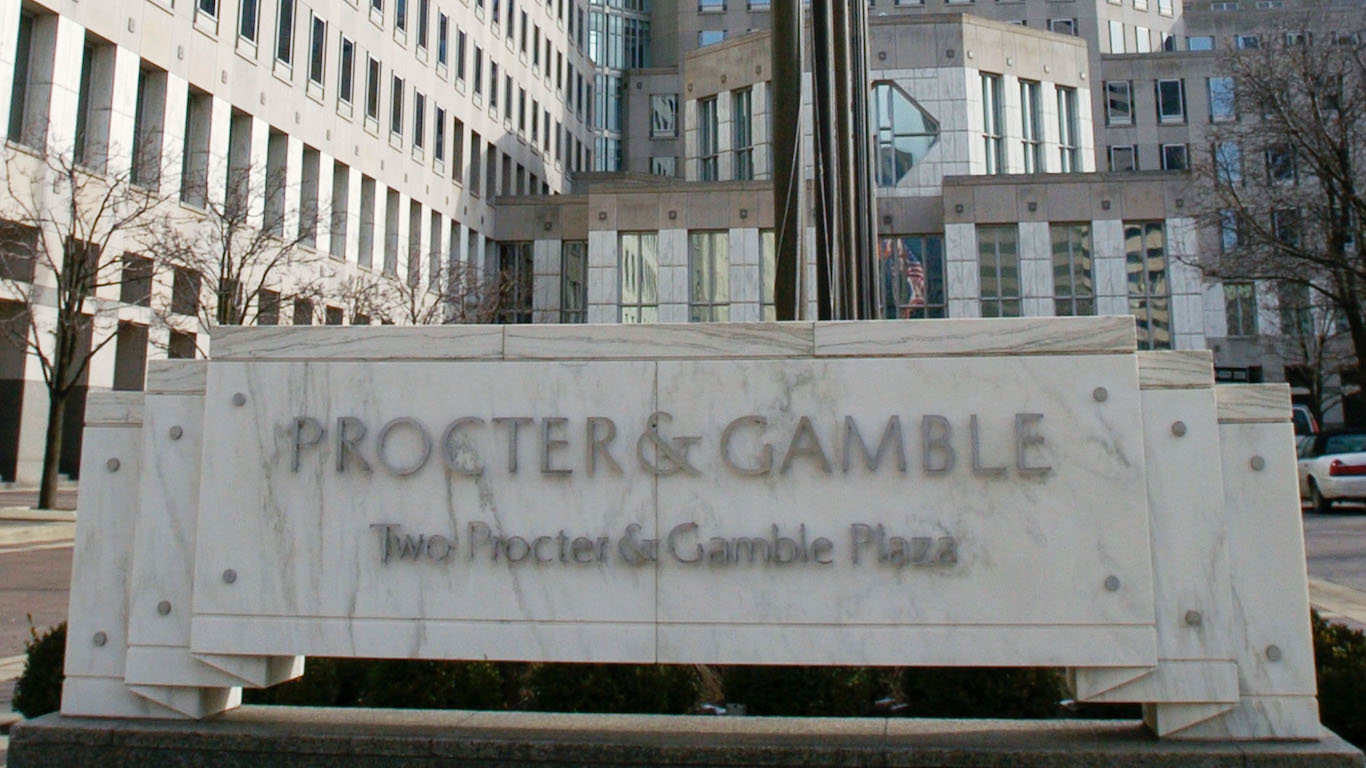
Procter & Gamble Co. (NYSE: PG) shares are higher by 3% this year to $69, but that increase is due in part to outside pressure for better results from CEO Robert McDonald. William Ackman, head of Pershing Square Capital Management, has bought $1.8 billion shares in the consumer products company. He wants the P&G board to move for rapid change to improve the firm’s earnings. So far, the board has supported McDonald. Last month, lead director James McNerney Jr. said the current restructuring plan for P&G is the right direction, and that McDonald has the board’s “wholeheartedly support.” If that statement continues to be true, Wall St. has to gamble that McDonald can do in the future what he has been unable to do in the past. In the most recent quarter, P&G revenue dropped 1% to $20.2 billion. EPS fell 10% to $.74. McDonald trumpeted his turnaround: “We enter fiscal 2013 with very strong developing market momentum, strengthened plans on our core developed market business, and with the benefit of a $10 billion cost savings program, which is well underway.” But Ackman has not been persuaded. Two things could easily hurt shares. The first is more bad earnings. The other is that Ackman walks away, and with him the pressure on management to improve P&G’s prospects more rapidly.
Douglas A. McIntyre





 Top Gaining Stocks
 Top Losing Stocks