


By Gene Munster and Steve Van Sloun of Loup Ventures
During Gamescom 2018, Nvidia introduced its new GeForce RTX product line — three graphics cards ($499-$999) based on its new Turing architecture. Nvidia CEO Jensen Huang called the line’s primary innovation, real-time ray tracing, the “holy grail of computer graphics.” Ray tracing creates photorealistic lighting and shadows, a task typically undertaken by artists during production.
- Bottom line: Nvidia’s latest graphics cards represent a big step towards the future of gaming. Hardware and software innovations will increasingly save developers time and money and will improve the gaming experience.
[nativounit]
GeForce RTX – A Big Step Toward the Future of Gaming
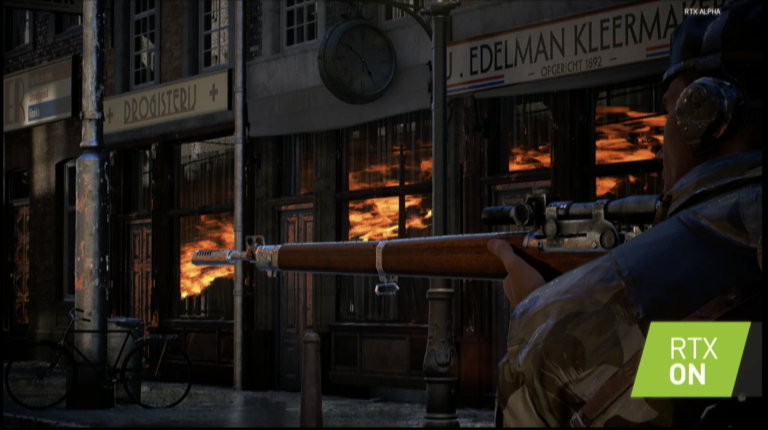
Nvidia’s RTX line adds real-time ray tracing to games, offering a much more realistic experience. In the past, reflections in games were limited to on-screen objects only. Ray tracing allows off-screen objects and environments to be reflected dynamically, as seen with the fire in the image below. They also offer a great demo on the GeForce RTX product page.
AI Is Changing Computer Graphics
Jensen believes deep learning is the single most powerful computing technology in the last 30 years. He also talked about Nvidia NGX, a neural graphics framework for AI image processing. He pointed out some of the ways deep learning is used in computer graphics, such as colorizing images, adding super-resolution, segmenting videos, and turning 2D sketches into 3D objects.
Turing Architecture Improves VR Experiences
Real-time ray tracing has big implications for VR. More realistic shadowing and lighting will make the VR experience more life-like and immersive. For example, Nvidia’s Turing SM processor, included in the new architecture, allows for variable rate shading (variable shading rates in different regions of an image). This is particularly useful for foveated rendering, an important VR technology. Foveated rendering uses eye tracking to optimize particular areas of the display based on where a viewer is looking. Accurate foveated rendering promises to give users the impression of higher-resolution VR experiences within the limitations of today’s VR displays.
Disclaimer: We actively write about the themes in which we invest or may invest: virtual reality, augmented reality, artificial intelligence, and robotics. From time to time, we may write about companies that are in our portfolio. As managers of the portfolio, we may earn carried interest, management fees or other compensation from such portfolio. Content on this site including opinions on specific themes in technology, market estimates, and estimates and commentary regarding publicly traded or private companies is not intended for use in making any investment decisions and provided solely for informational purposes. We hold no obligation to update any of our projections and the content on this site should not be relied upon. We express no warranties about any estimates or opinions we make.
[recirclink id=487397]
[wallst_email_signup]








 Top Gaining Stocks
 Top Losing Stocks