


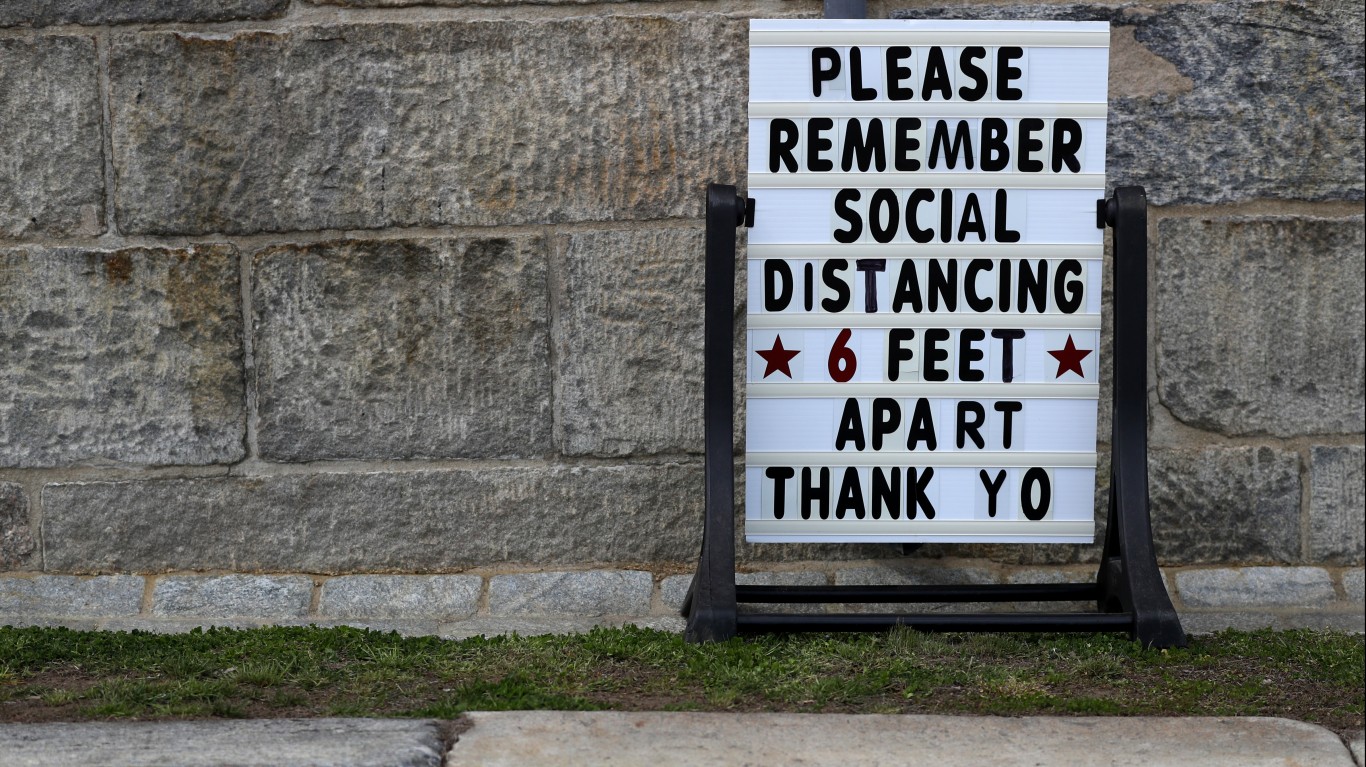
The COVID-19 pandemic’s growth has slowed in the U.S. New confirmed cases rose at over 200,000 a month ago. Yesterday, they were up 64,375 to 28,325,091, which is 25% of the world’s total. Death in the U.S. rose by 4,000 many days a month ago. Yesterday, there were up by 1,660 to 502,493, about 20% of the world’s total. However, many scientists and public health experts worry that new variants of the disease could spread more quickly, and may be more deadly. Three of these are now in the U.S. And, as the number of cases of people infected by these grows, there may be a race with vaccination rates to keep away another surge.
There are two opposing schools of thought about another surge. In an Op-Ed article in The Wall Street Journal, Dr. Martin Makary, a professor at the Johns Hopkins School of Medicine and Bloomberg School of Public Health, wrote:
There is reason to think the country is racing toward an extremely low level of infection. As more people have been infected, most of whom have mild or no symptoms, there are fewer Americans left to be infected. At the current trajectory, I expect Covid will be mostly gone by April, allowing Americans to resume normal life.
Experts who believe his analysis is wrong currently claim that variants will spread fast enough to trigger a sharp rise in cases again next month. Unfortunately, vaccination rates of adults in the U.S. are under 15% of the adult population and are rising slowly. President Joe Biden said that the federal government has 200 million doses on the way by late July, a date that many public health officials believe it is too late to curb another surge. In an article in The Wall Street Journal, a reporter wrote:
Scientists say the world has reached a precarious point in the Covid-19 pandemic, one where conditions are ripe for the rise of more new coronavirus variants that could complicate efforts to control the disease.
The virus continues to spread rapidly in many parts of the world, even as segments of the population have gained some degree of immunity as a result of having been infected or vaccinated.
Currently, the variant scientists worry the most about is labeled B.1.1.7. Authorities fear this fast-spreading variant could be the dominant strain in the U.S. within weeks. The other two variants detected in the U.S. are labeled B.1.351 and P.1
[nativounit]
The CDC has only reported 1,523 cases of B.1.1.7 so far across 42 states, according to its “US COVID-19 Cases Caused by Variants.” A closer look at each state shows that the ones with the highest number of variants reported are Florida at 433, followed by California at 195, and Michigan at 157.
These numbers seem very small. If the spread of B.1.1.7 is as rapid as scientists believe it will be, each of these states will have tens of thousands of cases by the end of next month. The hope for a quick dying-out of COVID-19 will have ended.
Click here to read these are the most dangerous U.S. cities for COVID-19
[wallst_email_signup]










 Top Gaining Stocks
 Top Losing Stocks