Nvidia CEO: China’s AI Is Already As Good As The US

Photo of Douglas A. McIntyre
By Douglas A. McIntyre Published

Key Points

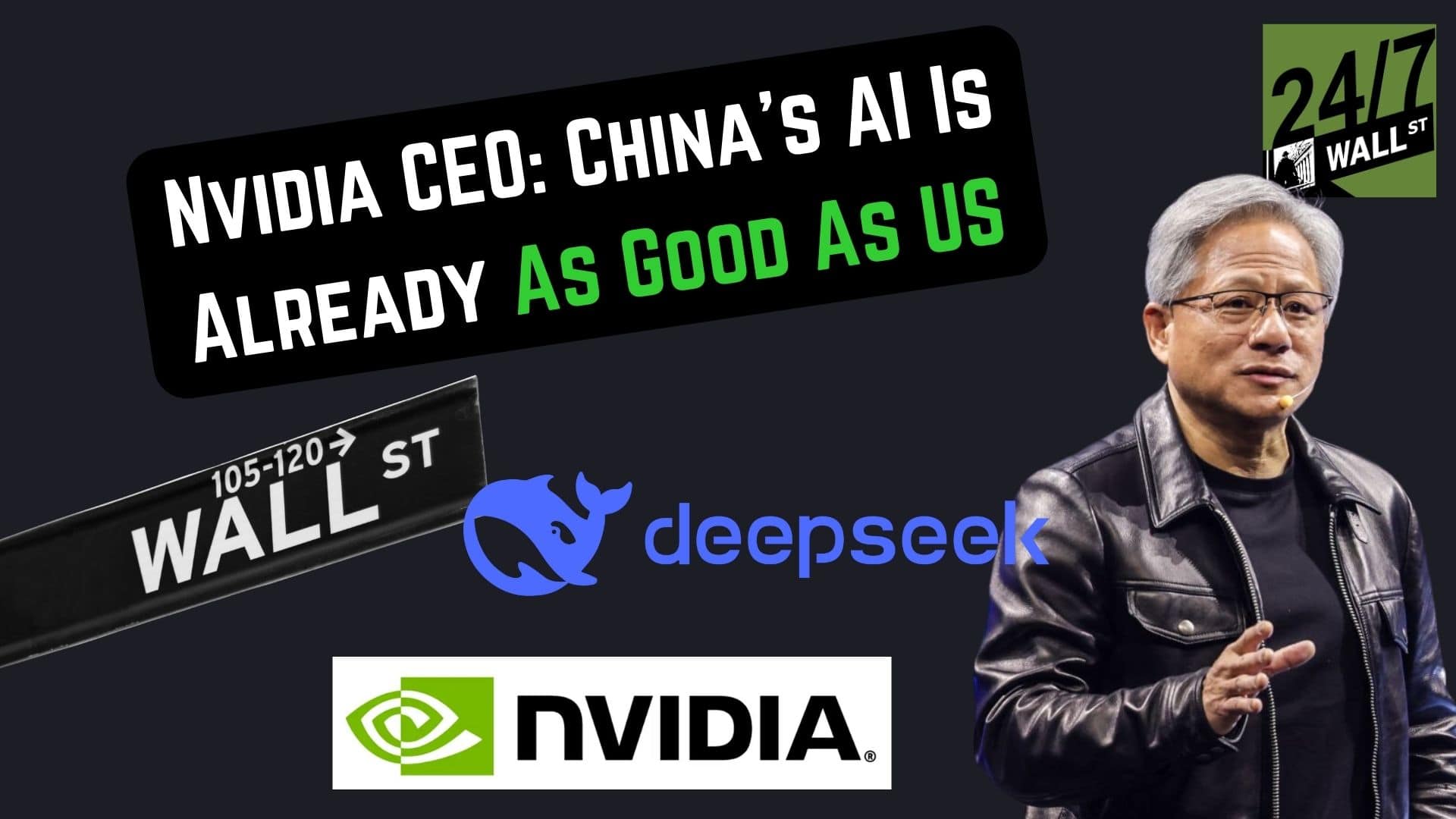
  • Nvidia (NASDAQ: NVDA) CEO Jensen Huang acknowledged that Chinese AI capabilities now rival those of the U.S., undermining assumptions of American technological lead in AI infrastructure.

  • Huang’s statement also implies that powerful AI models can now run on lower-end chips, which may erode demand for Nvidia’s high-margin, high-performance GPUs—especially under U.S. export restrictions.

  • Nvidia’s stock, up over 1800% in five years, could face valuation pressure if earnings growth slows amid intensifying global competition and reduced chip differentiation.

This post may contain links from our sponsors and affiliates, and Flywheel Publishing may receive compensation for actions taken through them.
Nvidia CEO: China’s AI Is Already As Good As The US

© 24/7 Wall St

Watch the Video

Transcript:

[00:00:04] Doug McIntyre: So yesterday, Jensen Wong, the CEO of Nvidia, the third most valuable company in the world, the stocks up I think 1800% in the last five years. He said something very, telling Chinese AI is basically as good as US AI, they’re, they’re comparable. Now what does that mean? Well, number one, it means that we’ve kitted ourselves into the fact that we’ve got a year or two head start on ai.

[00:00:36] Doug McIntyre: And that means that the one area where. The US might continue to best. China has sort of gone away. The second thing is, is that the Chinese are using less powerful chips to have comparable AI software.

[00:00:51] Lee Jackson: Right?

[00:00:52] Doug McIntyre: That’s bad for him because he’s still Mark, he’s still convinced everybody that AI has to run on his super expensive, super powerful chips.

[00:01:04] Doug McIntyre: Although there could be a hidden agenda here, the Trump administration is saying you can’t sell your high-end chips into China because you’ll be helping them with ai. What he’s saying is they don’t need any help. They’re already there. True. Is what he said good for him, or is it bad for him?
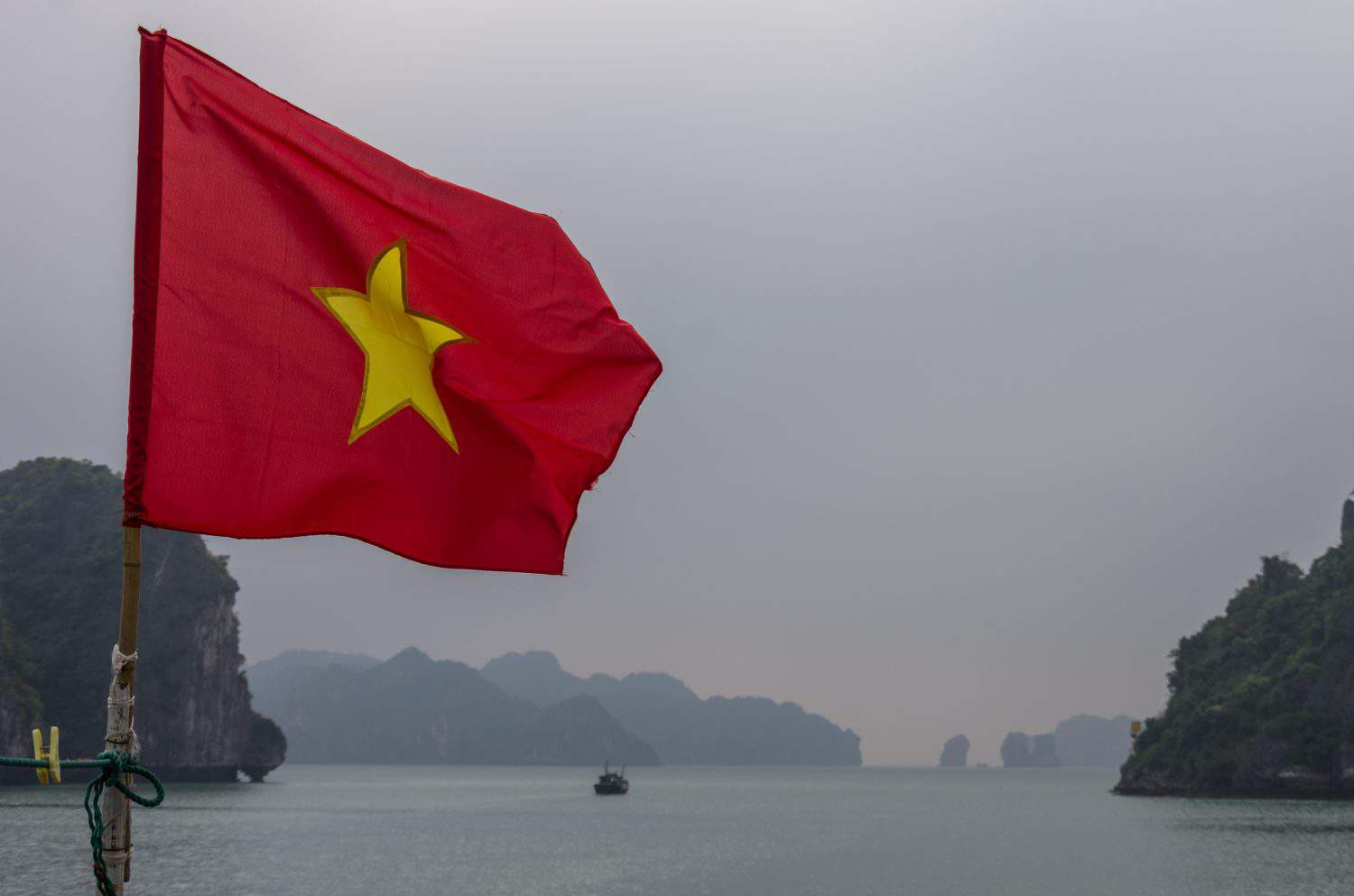
The flag of Vietnam fluttering on ship in the Halong Bay at the Gulf of Tonkin of the South China Sea, Vietnam.
Igor Dymov / Shutterstock.com

[00:01:28] Lee Jackson: Well, you can, it’s very difficult to trust the Chinese on anything simply because.

[00:01:33] Lee Jackson: They obfuscate and lie and, pedal stuff and steal our AI and or, or steal our applications and things of that nature. So yeah, that’s gonna be interesting to see if, advanced AI, programs can run, effectively on chips made there. The thing that I think that’s the most interesting to everybody is that, the Nvidia run was, was typically one of your parabolic Wall Street, oh my God, moves, I mean, literally from when I first started covering that stock, it was probably 2014, maybe 10, 11 years ago. And it was basically the only lift they got is when they put a processor that helped gamers get better gaming graphics. And that was kind of the start. But I mean, the stock traded under $10 for years and just the parabolic move higher is you, you’re gonna hit, you’re gonna hit a wall at one point.

[00:02:31] Lee Jackson: there’s just no way to keep that absurd growth going. And if, if that’s the case, it could be, it could be not a kill shot for ’em, but it that could devastate some of their earnings potential


Photo of Douglas A. McIntyre
About the Author Douglas A. McIntyre →

Douglas A. McIntyre is the co-founder, chief executive officer and editor in chief of 24/7 Wall St. and 24/7 Tempo. He has held these jobs since 2006.

McIntyre has written thousands of articles for 24/7 Wall St. He is an expert on corporate finance, the automotive industry, media companies and international finance. He has edited articles on national demographics, sports, personal income and travel.

His work has been quoted or mentioned in The New York Times, The Wall Street Journal, Los Angeles Times, The Washington Post, NBC News, Time, The New Yorker, HuffPost USA Today, Business Insider, Yahoo, AOL, MarketWatch, The Atlantic, Bloomberg, New York Post, Chicago Tribune, Forbes, The Guardian and many other major publications. McIntyre has been a guest on CNBC, the BBC and television and radio stations across the country.

A magna cum laude graduate of Harvard College, McIntyre also was president of The Harvard Advocate. Founded in 1866, the Advocate is the oldest college publication in the United States.

TheStreet.com, Comps.com and Edgar Online are some of the public companies for which McIntyre served on the board of directors. He was a Vicinity Corporation board member when the company was sold to Microsoft in 2002. He served on the audit committees of some of these companies.

McIntyre has been the CEO of FutureSource, a provider of trading terminals and news to commodities and futures traders. He was president of Switchboard, the online phone directory company. He served as chairman and CEO of On2 Technologies, the video compression company that provided video compression software for Adobe’s Flash. Google bought On2 in 2009.

Continue Reading

Top Gaining Stocks

CBOE Vol: 1,568,143
PSKY Vol: 12,285,993
STX Vol: 7,378,346
ORCL Vol: 26,317,675
DDOG Vol: 6,247,779

Top Losing Stocks

LKQ
LKQ Vol: 4,367,433
CLX Vol: 13,260,523
SYK Vol: 4,519,455
MHK Vol: 1,859,865
AMGN Vol: 3,818,618