


By the time a lot of people are ready to claim Social Security, they’re done earning a paycheck from a job.
The earliest age to claim Social Security is 62. Some older Americans, however, opt to wait until full retirement age (FRA) so they can claim their Social Security benefits without a reduction. FRA is 67 for those born in 1960 or later.
There’s also the option to delay Social Security past FRA for boosted monthly checks. For each year filers hold off, until age 70, their benefits grow 8%.
You may be collecting a Social Security paycheck right now. And if you have a robust nest egg to supplement those benefits, you may be maintaining a pretty comfortable lifestyle.
But a lot of people unfortunately don’t manage to retire with much or any savings. And if you’re in that situation, you may have to work in some shape or form to boost your retirement income.
The good news is that you’re allowed to work while collecting Social Security. But there are rules to follow.
Those rules, however, have changed for the better in 2026.
Understand how Social Security’s earning test works in 2026
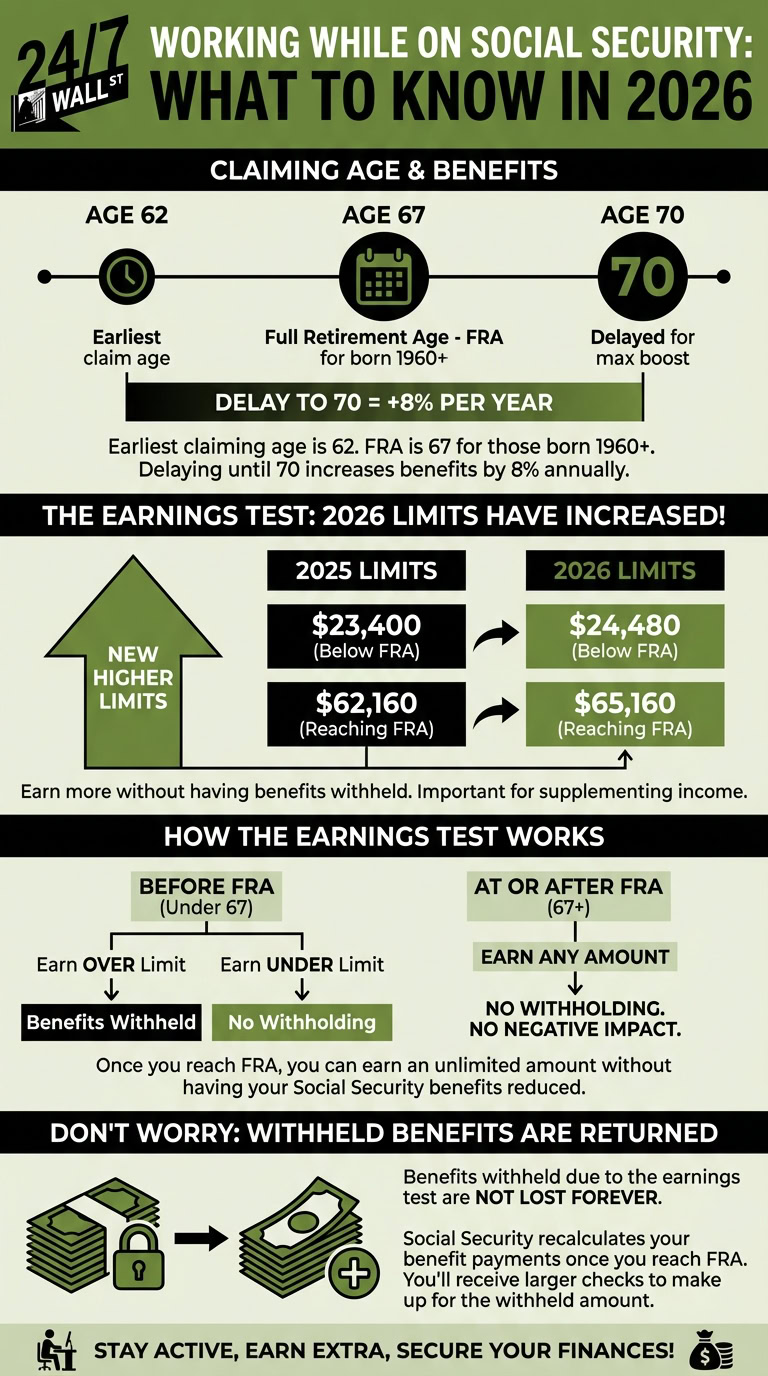
Once you reach FRA, you can earn any amount of money without it having a negative impact on your Social Security benefits. It’s if you’re working while on Social Security before having reached FRA that you need to be more careful.
If you’re in the latter situation, you should know that earning too much money could result in having some of your Social Security checks withheld. So it’s important to be mindful of Social Security’s earnings test.
The earnings test represents the amount of money you can earn from a job without having benefits withheld. And its limits change every year.
This year, though, Social Security’s earnings test has higher limits than in 2025. So if you’re working while collecting benefits, you can earn more money before having to worry about having a portion of those monthly checks withheld.
In 2025, Social Security’s earnings test had a limit of $23,400, or $62,160 for recipients who would be reaching FRA sometime that year.
In 2026, Social Security’s earnings test has a limit of $24,480, or $65,160 for people who will reach their FRA at some point this calendar year. This increase is important, because it gives older workers more leeway to earn money from a job without consequences.
Given that inflation has been persistent and costs are high across the board, it’s important that seniors be able to supplement their Social Security benefits nicely. A higher earnings test limit allows for that.
Don’t worry about losing benefits permanently
One big misconception about Social Security’s earnings test is that if you have benefits withheld for making too much money, you’ll lose those benefits for good.
That’s not true. What’ll happen instead is that the Social Security Administration will recalculate your benefit payments once you reach FRA. From that point onward, you’ll start getting larger checks to make up for the money that was held back initially.
For this reason, you shouldn’t let Social Security’s earnings test stop you from working if you feel you need the money. And even if you don’t need the money, you may find that having a job helps you anchor your weeks and stay busy. So it could be a good thing to continue working even if your retirement finances are sound.












 Top Gaining Stocks
 Top Losing Stocks