


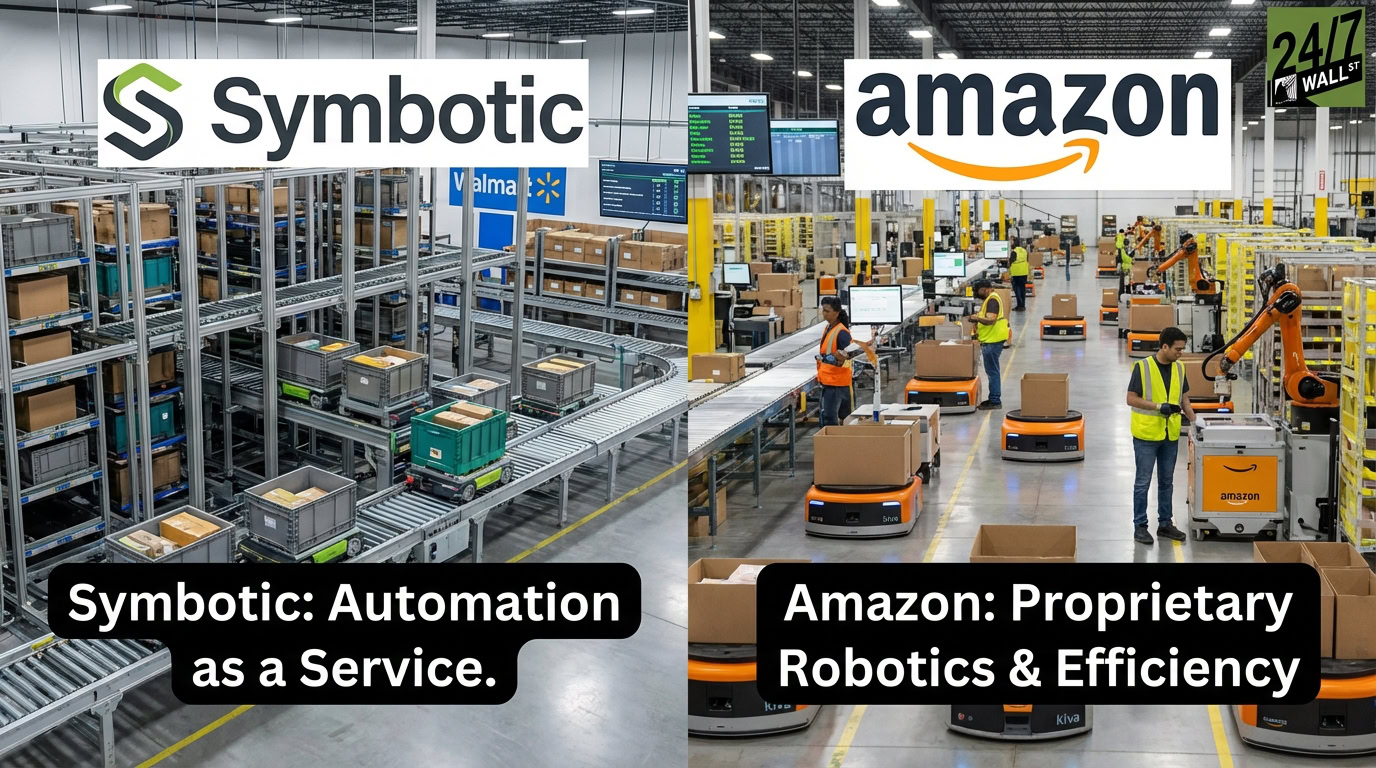
Symbotic (NASDAQ: SYM | SYM Price Prediction) and Amazon (NASDAQ: AMZN) recent earnings crystallized a fundamental question: own the warehouse automation provider or the company building its own solution? Symbotic delivered its first profitable fiscal year with $1.02 EPS in FY 2025, then plunged 30% in December. Amazon posted $7.07 EPS on $691 billion revenue, up 36% year-over-year in earnings, while expanding Amazon Robotics across its fulfillment network.
Symbotic Delivers Profitability, Market Delivers Volatility
Symbotic’s Q3 2025 earnings (ended September 30) showed $0.58 EPS against $0.08 estimates, a 625% beat marking the culmination of a four-year journey from losses to profitability. Revenue hit $618.5 million with 20.6% gross margins. The company generated $530.7 million in operating cash flow, showing the automation-as-a-service model finally converting contracts into cash.
Then December happened. The stock collapsed from $85 to $60, erasing gains despite the profitability inflection. Insider data showed heavy selling across all executive levels, with Chief Strategy Officer William Boyd disposing of 34,000 shares between October and January at prices ranging from $59 to $83. SoftBank’s SVF Sponsor III liquidated 3.5 million shares at $53.21 on December 8. No executives bought during the weakness.
Reddit sentiment held at 80-82 (Very Bullish) throughout the decline, concentrated in r/options rather than fundamental investing communities. One December 30 post reframed Symbotic as “AI Warehouse as a service” rather than pure robotics, suggesting narrative evolution among holders rationalizing the valuation.
Amazon Builds While Symbotic Sells
Amazon reported $180.2 billion Q3 revenue with $21.2 billion net income, maintaining 11.1% profit margins while deploying $35.1 billion in capital expenditures. A significant portion flows into warehouse infrastructure, including Amazon Robotics development. The company operates over 1,000 fulfillment centers globally, each a potential automation deployment site.
The strategic divergence is stark. Symbotic sells warehouse systems to customers like Walmart and Target, capturing 80-85% gross margins on technology deployment. Amazon develops proprietary robotics internally, treating automation as competitive advantage rather than revenue source. When Amazon Robotics solves a problem, the benefit accrues entirely to Amazon’s fulfillment cost structure rather than appearing as Symbotic-style contract revenue.
| Dimension | Symbotic | Amazon |
| Business Model | Automation provider | Automation user + developer |
| Gross Margin | 20.6% | 50.8% |
| Profit Margin | -0.75% | 11.1% |
| Market Cap | $39.8B | $2.53T |
| 1-Year Return | +167% | +9% |
Why I See Them as Complementary, Not Competitive
I view these as different bets on the same thesis rather than direct competitors. Symbotic offers pure-play exposure to warehouse automation adoption across retail and logistics. The 167% one-year gain reflects market belief in the $2.25 billion revenue base expanding as more companies automate. The December plunge and insider selling suggest that belief got ahead of execution risk.
Amazon provides diversified exposure to automation benefits through cost savings rather than revenue growth. If Amazon Robotics cuts fulfillment costs by 20%, that improvement flows directly to operating margins on $691 billion in revenue. You get automation upside wrapped in AWS growth, advertising revenue, and retail scale.
If you believe warehouse automation is inevitable and want concentrated exposure with high risk, Symbotic makes sense despite the volatility and profitability questions. If you want automation exposure with mega-cap stability and proven profitability, Amazon delivers that plus everything else. I would not expect Symbotic to displace Amazon Robotics in Amazon warehouses, which limits the total addressable market but does not eliminate the opportunity with other retailers competing with Amazon’s fulfillment speed.











 Top Gaining Stocks
 Top Losing Stocks