


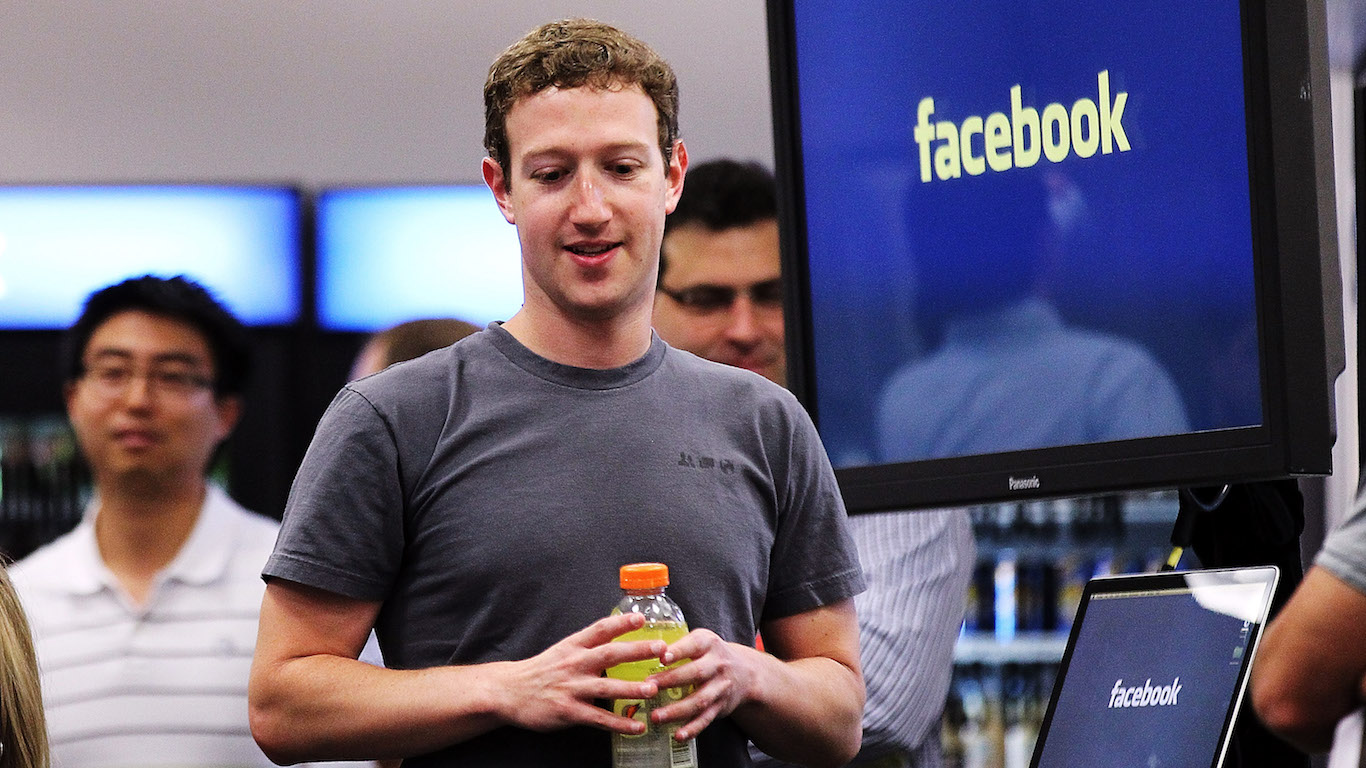
Meta Platforms (NASDAQ:META | META Price Prediction) has delivered outstanding performance compared its hyperscaler peers such as Apple (NASDAQ:AAPL), Amazon (NASDAQ:AMZN), Alphabet (NASDAQ:GOOG)(NASDAQ:GOOGL), and Microsoft (NASDAQ:MSFT).
Over the last 12 months, revenue growth hit 21.3%, far exceeding the low- to mid-teens rates for the others, such as with Alphabet at 13.4% and Amazon below that. And in the past three years, in the midst of the artificial intelligence (AI) boom, Meta Platforms’ stock rose over 368%, while Microsoft gained 95% and Apple, 91%.
Yet META trades at a P/E of about 21x, roughly 36% below all of the other major hyperscalers, which average around 33x earnings. Does this mean Meta Platforms is poised for a valuation re-rating upward, or do underlying factors justify the discount?
Scratch Just Below the Surface for the Answer
Success for the owner of Facebook, Instagram, and WhatsApp hinges almost exclusively on advertising, which made up 97.7% of third-quarter revenues, exposing it to economic cycles that can swing demand sharply. Although Alphabet is also very dependent upon advertising, Google Cloud contributes around 15% total revenue, giving it greater diversification.
Similarly, Amazon offers e-commerce and cloud services, while Microsoft gets revenue from software and the cloud. Apple’s primary segment is consumer electronics, but its services division remains its fastest-growing unit. Meta simply lacks any buffers against cyclical ad slowdowns, which makes its earnings much more volatile.
And where all hyperscalers are ramping up data center investments, with a collective $600 billion expected to be spent this year between Meta, Alphabet, Amazon, and Microsoft, Meta’s $70 billion to $72 billion 2025 capex tab — set to grow notably in 2026 to over $100 billion — is focused internally on AI, without external revenue streams like its peers’ cloud services. This limits its monetization potential, pressuring free cash flow, which is projected to drop 53% in 2026.
Zuckerberg’s Big Bets
Arguably, one of the biggest reasons behind Meta Platforms’ discount to the other hyperscalers is CEO Mark Zuckerberg and his penchant for making bold spending bets. It adds a level of risk that the market feels is necessary to mark down the stock.
Meta Platforms is still licking the open wound of its metaverse push through Reality Labs, which has incurred cumulative losses exceeding $70 billion to $73 billion since 2021 — with a $4.43 billion operating loss in Q3 alone.
Recent workforce reductions of about 10% in Reality Labs (over 1,500 jobs) and studio closures show how Meta is pivoting toward AI, but again, the pattern echoes prior heavy commitments. Its AI investments are following suit, and investors are concerned there will be a repeat of the metaverse mistakes that were made.
With Meta’s earnings growth forecasted to slow dramatically to around 12% annually over the next five years, the unpredictability is clouding forecasts and shaking investor trust.
Antitrust Scrutiny Weighs on Growth
Meta Platforms also faces ongoing regulatory challenges that could further justify its valuation discount. In December, the European Commission opened a formal antitrust investigation into Meta’s new policy prohibiting third-party AI providers from using WhatsApp for general-purpose AI assistants — effective yesterday — potentially shutting out rivals while favoring Meta AI. This follows a 200 million euro fine under the Digital Markets Act in 2025 for its “pay-or-consent” model.
In the U.S., the FTC’s antitrust case alleging it holds a monopoly in personal social networking through Instagram and WhatsApp acquisitions was dismissed in November, with the court ruling Meta lacks current monopoly power. However, similar probes in the Common Market for Eastern and Southern Africa (COMESA) and elsewhere continue, and EU oversight on ad practices is ongoing, potentially leading to fines or restrictions that heighten earnings volatility amid possible operational limits.
Key Takeaway
Meta Platforms’ ongoing Reality Labs’ debacle, with massive losses and recent restructuring efforts, highlights the real execution risks the market is taking into account. Heavy capex, which is now being partly debt-financed because cash flows can no longer cover it, strains its finances without diversification.
In short, Zuckerberg’s aggressive bets make earnings unpredictable compared to Meta’s peers. That suggests the market’s valuation of the stock is not mispricing, but rather an accurate reflection of these very real risks.









 Top Gaining Stocks
 Top Losing Stocks