



Passive investors looking to take on a more contrarian position may wish to consider some of the sectors that most investors may be ignoring as the rise of the artificial intelligence (AI) boom continues. Undoubtedly, there’s more to this market than just AI or agents!
Indeed, valuations on various AI stocks have been getting frothy. And while there may be no AI bubble on the verge of bursting, one has to think that a market correction would likely see the tech sector take on amplified damage. The fastest gainers tend to be the quickest to fall when market momentum flies south and investors begin taking profits or panicking en masse.
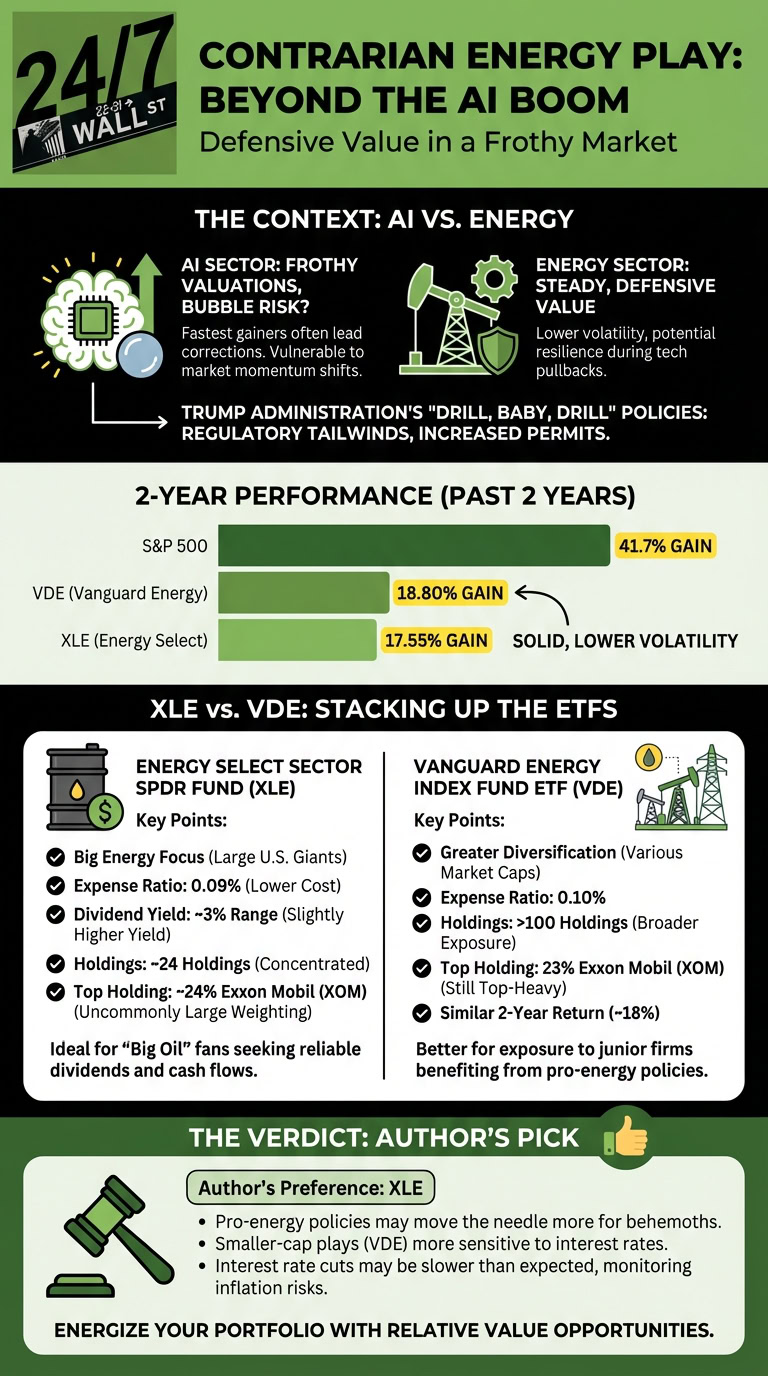
The energy sector has delivered solid, steady gains in recent years, with the popular Energy Select Sector SPDR Fund (NYSEARCA:XLE | XLE Price Prediction) and Vanguard Energy Index Fund ETF (NYSEARCA:VDE) climbing 17.55% and 18.80%, respectively, over the past two years. While these returns trail the S&P 500‘s impressive 41.7% gain over the same period, the sector has offered much lower volatility, making it an appealing defensive play in an increasingly unpredictable market.
The big question for 2026 and beyond is whether the energy plays will accelerate their gains under the Trump administration, which has now been implementing its “Drill, Baby, Drill” policies for over a year. With regulatory tailwinds and increased drilling permits becoming reality, the energy sector could see continued fundamental support.
In any case, if you’re looking for contrarian value opportunities, the energy scene may have what you’re looking for. Should the market turn lower, led by a souring of AI stocks (remember the DeepSeek disruption from early last year?), perhaps the energy names, which have offered steady but unspectacular gains, could continue their reliable performance. Heck, they may even gain in the face of stock market volatility.
Let’s stack up the XLE and VDE ETFs to see which may be the better buy for investors looking to energize their portfolio with relative value.
Energy Select Sector SPDR Fund (XLE)
The XLE is a low-cost way (0.09% expense ratio vs. 0.10% for the VDE) to play some of the larger energy giants in the U.S. market. If you’re a big fan of big oil and their sizeable dividends and cash flows, the XLE will probably be a better pick for you. Additionally, you’re getting a tad more yield with the XLE, which boasts a dividend yield in the3% range at the time of writing.
While I don’t think you can do wrong with either popular energy sector ETF, I do think that it ultimately comes down to whether investors want a heavier weighting to the top names or broader exposure to the sector.
With around 24% weighted to Exxon Mobil (NYSE:XOM) alone, you’re getting an uncommonly large weighting to a single holding. If you’re comfortable with that, the XLE is a top pick to bet on Big Energy’s continued dominance as they leverage their economies of scale.
Vanguard Energy Index Fund ETF (VDE)
As is typical with most Vanguard ETFs, you’re gaining greater diversification across stocks of various different market caps. Indeed, if you think the junior energy firms will also prosper under Trump’s pro-energy policies, the VDE should be your go-to option.
Personally, I like the portfolio composition a bit better, with more than 100 holdings in the ETF versus two dozen for the XLE. Despite the larger number of names, you’re still getting a top-heavy fund, one that’s 23% weighted to energy behemoth Exxon Mobil. With a very close correlation and ample overlap, I don’t expect a vast difference in performance over the year ahead—both have delivered nearly identical 18% returns over the past two years.
If I had to pick one ETF, I’d go with the XLE simply because Trump’s pro-energy policies could be more of a needle-mover for the behemoths in the space. Additionally, the smaller-cap plays will be more sensitive to interest rates. And with the Fed lowering interest rates at the end of 2025, questions linger as to whether a more dovish tilt will be in the cards moving forward. I think it could take time, especially as the Fed monitors inflation risks from potential tariffs and other policy shifts.












 Top Gaining Stocks
 Top Losing Stocks