


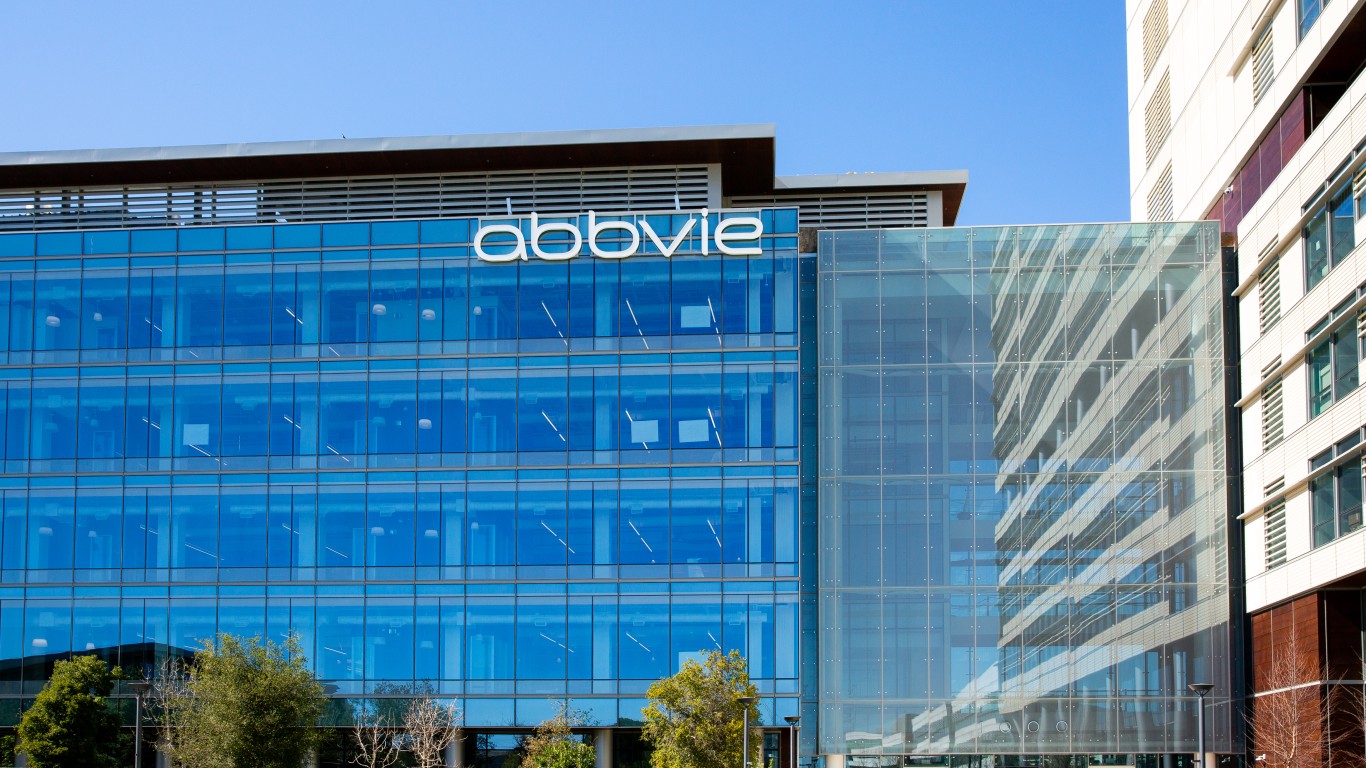
AbbVie (NYSE:ABBV | ABBV Price Prediction) stock has pulled back 12% over the past month, sliding to around $204. JPMorgan isn’t running from that weakness — it’s calling it a buying opportunity, maintaining its Overweight rating and $260 price target on shares.
Investor sentiment has “become decidedly more negative” due to competitive dynamics, particularly from Johnson & Johnson (NYSE:JNJ). Yet JPMorgan argues that current share levels offer an “increasingly attractive story” heading into AbbVie’s Q1 report.
| Ticker | Company | Firm | Action | Old Rating | New Rating | Old Target | New Target |
|---|---|---|---|---|---|---|---|
| ABBV | AbbVie | JPMorgan | Buying Opportunity / Maintains | Overweight | Overweight | N/A | $260 |
The Analyst’s Case
JPMorgan sees upside to consensus estimates and AbbVie’s own guidance, even after the company revised its full-year adjusted diluted EPS outlook to $13.96 to $14.16 following a $744 million pre-tax IPR&D charge. The firm points to Skyrizi and Rinvoq continuing to show healthy growth as the core reason to stay constructive.
That confidence isn’t unfounded. Skyrizi generated $5.01 billion in Q4 2025 revenue, up 32.5% year over year, while Rinvoq posted $2.37 billion, up 29.5%. The immunology segment as a whole grew 18.3% year over year to $8.63 billion in Q4.
Company Snapshot
AbbVie is a global biopharmaceutical company with key franchises spanning immunology, neuroscience, oncology, aesthetics, and eye care. It delivered record full-year 2025 net revenues of $61.16 billion, up 8.57% year over year, with Skyrizi and Rinvoq now surpassing peak Humira sales.
Humira continues to face biosimilar erosion, declining 25.9% year over year in Q4 to $1.25 billion. The neuroscience segment is picking up meaningful slack, growing 17.9% to $2.96 billion in Q4, led by migraine drugs Qulipta (+42.6%) and Ubrelvy (+12%).
Why the Move Matters Now
The near-term noise is real. A $744 million R&D charge cut the per-share impact by $0.41, and Johnson & Johnson’s Icotyde has introduced fresh competitive pressure on Skyrizi in the immunology market. AbbVie’s stock is now trading below its 50-day moving average of $221.37.
That said, the analyst consensus remains broadly bullish, with 22 buy ratings and zero sell ratings among covering analysts. Scotiabank separately maintains a Buy with a $280 price target, suggesting JPMorgan isn’t alone in seeing value here.
What It Means for Your Portfolio
For income-focused investors, AbbVie carries a dividend yield of 3.18% and raised its quarterly dividend 5.5% to $1.73 per share in Q3 2025. CEO Robert A. Michael stated, “Based on our strong fundamentals, we expect another year of robust growth in 2026.”
If you believe Skyrizi and Rinvoq can sustain their growth trajectories and management’s 2026 adjusted diluted EPS guidance of $13.96 to $14.16 holds, the recent pullback may represent a reasonable entry point for long-term holders. If competitive pressure from Johnson & Johnson intensifies beyond current expectations, however, the near-term path could stay bumpy.











 Top Gaining Stocks
 Top Losing Stocks