


The U.S. Senate recently rejected an amendment in the $1.9 trillion COVID-19 relief bill that would have raised the federal minimum wage to $15 per hour. This means that millions of Americans will continue to live in states in which they can be paid as little as $7.25 for an hour of work.
Someone working 40 hours a week at the federal minimum wage level would take home just over $15,000 per year before taxes. Though a relatively small percentage of the U.S. labor force earns the federal minimum wage level, there are dozens of major metropolitan areas where the typical worker earns wages of less than $32,000 per year.
To identify the city with the lowest paying jobs, 24/7 Wall St. reviewed the median annual wage in 389 metropolitan statistical areas using data from the May 2019 Occupational Employment Statistics program of the Bureau of Labor Statistics. It is important to note that our data reflects wages before the pandemic. It is likely that economic conditions in many of the cities on this list, and in others, have worsened and median wages in 2020 were even lower.
Out of the 25 metro areas that were finalists as we screened to find the one with the lowest paying jobs in the U.S. in 2019, 23 were in Southern states. Residents of this region are much more likely to face poverty, low incomes, and other economic challenges.
[nativounit]
Geography is not the only deciding factor in determining income levels. An area’s income level This also depends on natural resources, local laws and regulations, and the population’s educational attainment. Workers with high school diplomas tend to earn higher wages than those without, and those with a bachelor’s degree or higher tend to earn also typically have higher wages earnings than those who have not finished college.
Our Methodology: To identify the city with the lowest paying jobs, 24/7 Wall St. reviewed the median annual wage in 389 metropolitan statistical areas using data from the May 2019 Occupational Employment Statistics program of the Bureau of Labor Statistics. Cities were ranked based on the median annual wage for all occupations.
The measure of concentration of various occupations is based on location quotient of employment, which also comes from the BLS OES. Location quotients are ratios measuring the relative concentration of jobs in an area compared to their concentration in the national workforce. Supplemental data on unemployment rates came from the BLS Local Area Unemployment Statistics program and is seasonally adjusted for December 2020.
Data on poverty rates came from the U.S. Census Bureau’s 2019 American Community Survey and figures are one-year estimates. Job categories defined as miscellaneous or that include the description “all other” were not considered for the most highly concentrated job. It should be noted that the data used is for 2019 and does not reflect changes to employment caused by COVID-19.
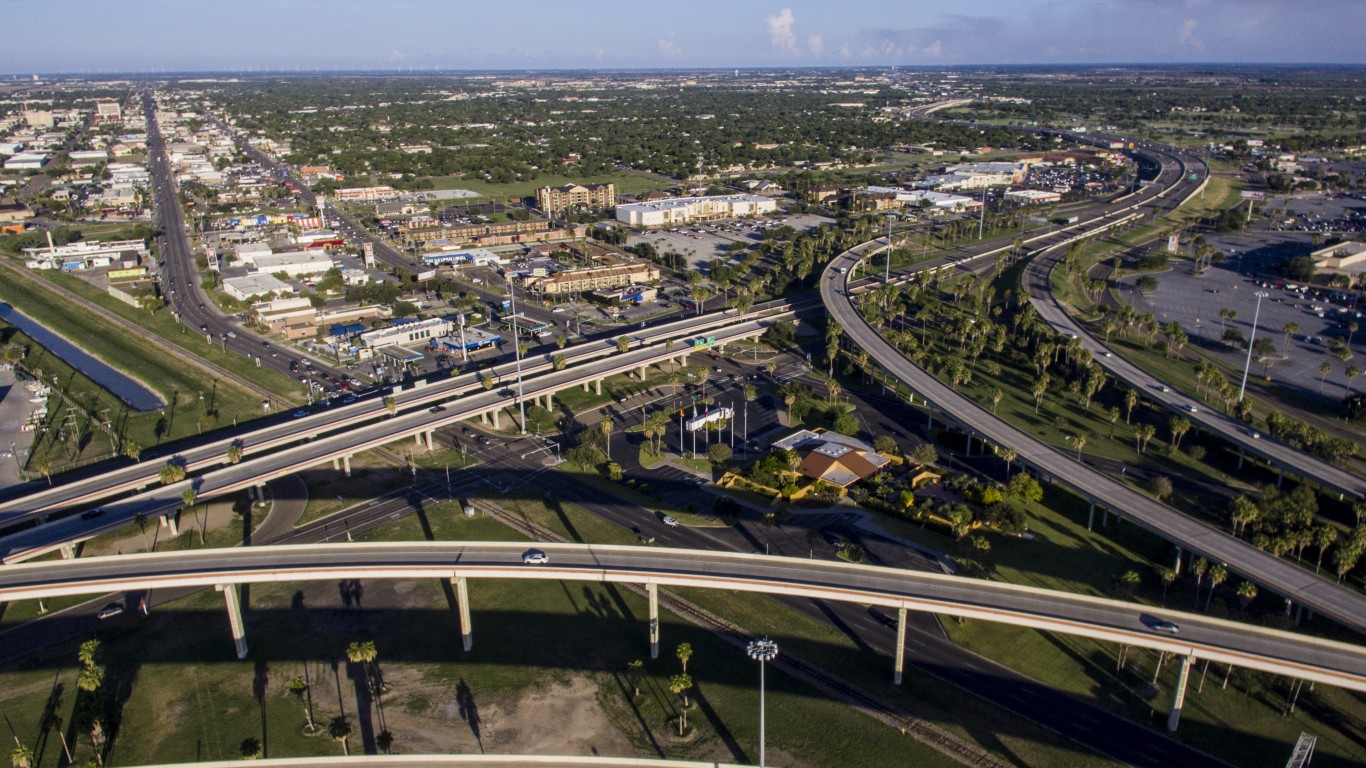
Brownsville-Harlingen, TX is the city with the lowest-paying jobs. Some details:
> 2019 median annual wage: $24,910
> Most highly concentrated occupation: Pump operators, except wellhead pumpers (9.1 times more common than national distribution)
> Annual wage of area pump operators, except wellhead pumpers: $34,710 (national median wage: $45,040)
> 2019 poverty rate: 25.6% (4th highest out of 383 metro areas)
The Brownsville-Harlingen metro area at the southern tip of Texas is the only one of the nearly 400 U.S. metro areas in which most workers earned less than $25,000 in 2019. The area’s 2019 median wage was $24,910 — $1,900 lower than the next closest metro area, and nearly $15,000 less than the U.S. median wage that year.
Education and incomes are highly correlated, and Brownsville area adults have some of the lowest educational attainment rates in the nation. Just 68.3% of area residents 25 and older have finished high school, the third lowest percentage in the U.S. Also, just 17.1% hold at least a bachelor’s degree, just over half of the U.S. bachelor’s degree attainment rate.
Click here to see the 25 cities with the lowest-paying jobs.
[wallst_email_signup]















 Top Gaining Stocks
 Top Losing Stocks