


Last Friday, the National Labor Relations Board (NLRB) issued a ruling in a dispute that began more than five years ago when drivers for a Cemex concrete plant approached the Teamsters Union to help the drivers organize and, ultimately, bargain collectively with the company. In the vote, the union lost by a margin of 179 to 166. The union alleged coercive conduct that, if proven, would set aside the election results and order Cemex to bargain with the union. (The American jobs with zero union members last year.)
The union sought just such a ruling from the NLRB. That process ended Friday when the NLRB not only announced a decision in the case but issued a new framework for determining when an employer must bargain with unions even if there has been no representation election. In the prior standard, an employer could file a good-faith petition claiming to doubt the union’s claim of majority status and thereby avoid having to bargain.
The NLRB’s ruling changes that in a big way. Now, when a union seeks recognition because a majority of the employees have designated it as their representative, the company must recognize and bargain with the union or “promptly file” a petition to hold an election. By itself, that is a significant change.
[nativounit]
But there is more:
However, if an employer who seeks an election commits any unfair labor practice that would require setting aside the election, the petition will be dismissed, and—rather than re-running the election—the Board will order the employer to recognize and bargain with the union.
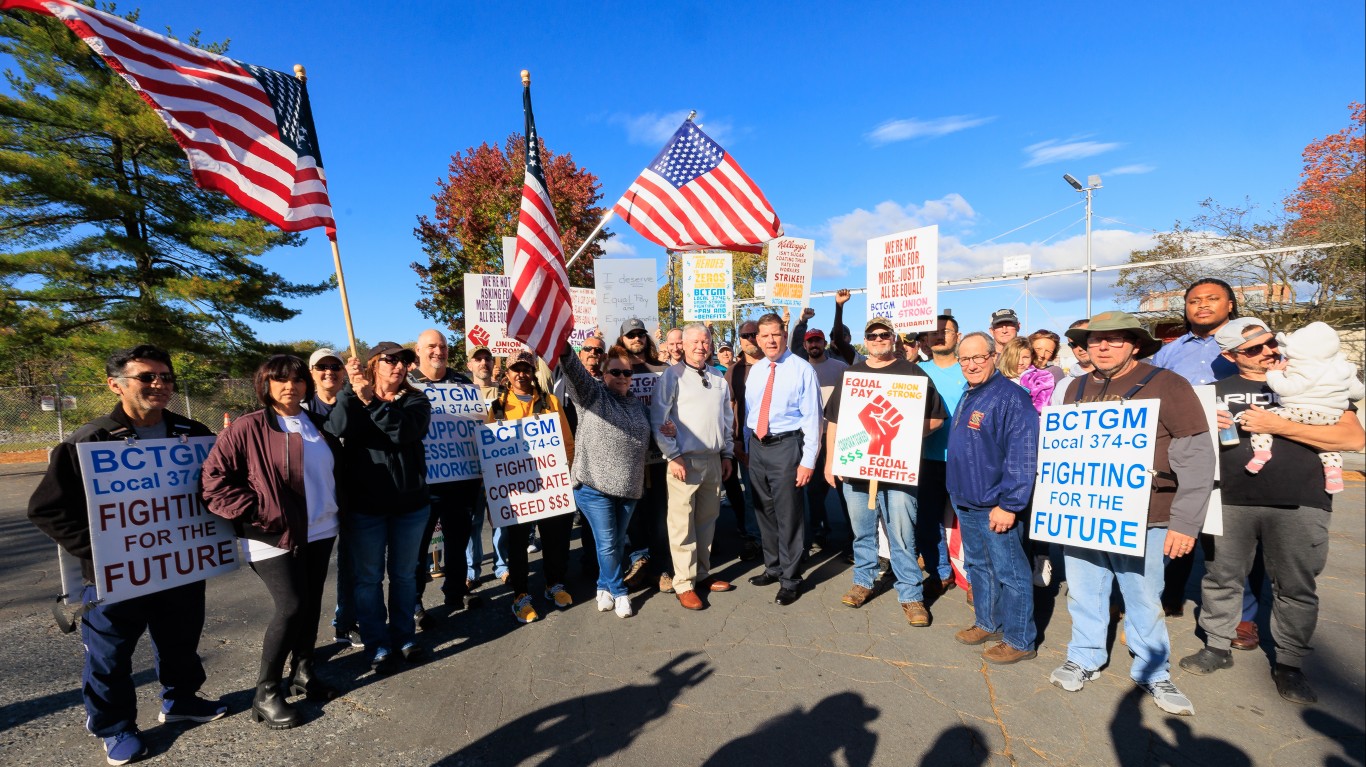
In a statement issued Monday, the Teamsters Union called the ruling a “landmark victory,” and union president Sean O’Brien said it would be a “catalyst for workers who are standing up and demanding their worth–not just at Cemex, but at every other employer in the country.”
Why this decision has received so little news coverage is something of a mystery. Maybe it is because unions now represent only about 12% of American workers. Some of that 12% (the 150,000-strong autoworkers union) have threatened a strike against the Detroit Three (Ford, GM and Stellantis) if the union does not have a contract by September 14.
United Autoworkers President Shawn Fain even threatened a strike at all three simultaneously, an unprecedented action by the union. The autoworkers’ demands may seem outrageous (a 46% wage boost, reinstatement of company-paid pensions and a four-day work week), but Americans’ support for unions has risen from 54% in 2013 to 71% as of August 2022, according to a Gallup poll.
[wallst_email_signup]
If recent union victories at UPS and at several Starbucks locations around the country have not demonstrated the new power of labor under the Biden administration, a new report issued Monday by the Treasury Department is like a neon arrow calling attention to the benefits of unionization.
The report, Labor Unions and the Middle Class, gets right to the point in the first paragraph of the executive summary, citing the National Labor Relations Act of 1935 (that created the NLRB) as the impetus behind unionization until the late 1950s. Despite the civil rights and women’s liberation movements, however, “declining union membership rates reflected weakened worker bargaining power and contributed to sluggish wage growth and rising inequality.”
Among the report’s key findings:
- Unions raise the wages of their members by 10% to 15% while also improving fringe benefits and “workplace procedures such as retirement plans, workplace grievance policies, and predictable scheduling.”
- Unions generate a “spillover effect” that raises wages for workers at non-unionized companies and provides other benefits.
- Unions help create a “fairer economy” because they benefit all demographic groups, meaning that “the benefits of any policy” that makes unions stronger are felt across the entire population.
[recirclink id=1107616]
A bipartisan group of U.S. Representatives and Senators in February introduced the Protecting the Right to Organize (PRO) Act, which would strengthen even further employee rights to organize; for example, prohibiting companies from forcing employees to attend company meetings where the employer delivers an anti-union message.
Will U.S. unions succeed in raising their membership from 12% to something approaching the one-third of the nation’s workers that they represented in the mid-1950s? It is too early to tell, but the signs are encouraging.








 Top Gaining Stocks
 Top Losing Stocks