


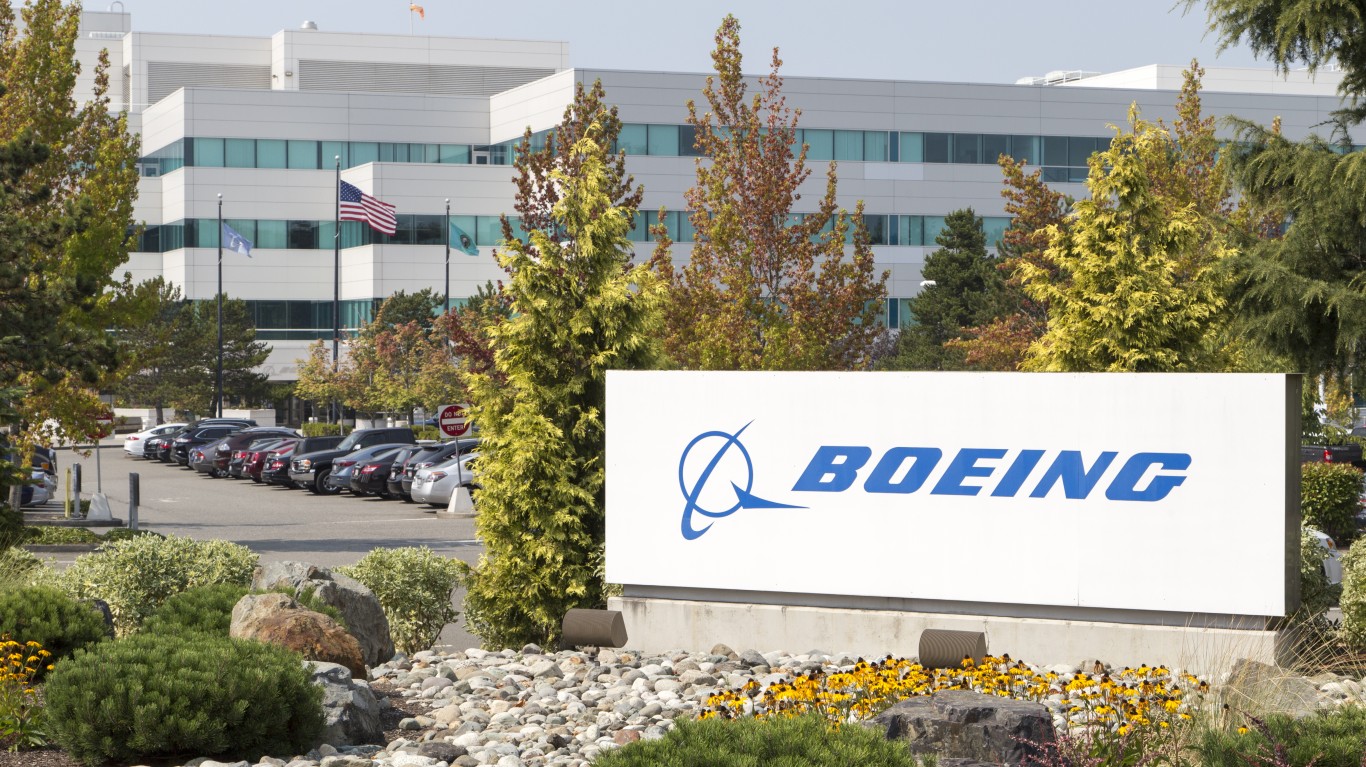
At noon on Monday, the Dow Jones industrial average was trading up about 164 points, after opening about 240 points higher than Friday’s closing total. Boeing Co. (NYSE: BA) shares traded up $13.01 at noon, a gain of about 3.8%.
Boeing, the most heavily weighted component among the price-weighted Dow 30, accounted for 9.2% of the index’s value as of Friday’s close. That pencils out to around 60% of the session’s gain for the day. Boeing’s impact on the index was even higher earlier in the day when the shares were trading even higher.
That the priciest Dow stock is having that much impact should be no surprise, but why is Boeing back in favor after 11 months of trading? As of Friday’s close, Boeing was up 16.8% for the year to date, compared to a gain of just 3.9% for the Dow. But while a 17-point gain is good news, Boeing stock gained an almost unheard of 89% in 2017. And since September 1, Boeing is up just 0.1% and the Dow is down 0.6%.
Certainly, the news that the United States and China have agreed to cool off their trade war has a lot to do with today’s increase to Boeing’s share price. Boeing sold $4.68 billion worth of commercial jets in China last quarter, according to MarketWatch, accounting for 31% of its total commercial airplane revenue. The threatened Chinese tariff on imported aircraft did not promise to have much effect on Boeing because it was directed at smaller jets than Boeing’s bread-and-butter 737 family of single-aisle planes, but any easing of the trade dispute with China is viewed as a plus by investors.
[nativounit]
What Boeing has going for it is rising production, a better mix of airplanes coming off its production lines, including the more profitable 787-9s and 787-10s, stable or falling supplier prices as it continues to squeeze out costs, and no labor near-term labor negotiations.
Add to that discombobulation if not outright disarray at Airbus, Boeing’s only real competitor. The European company’s top management has turned over, problems with the company’s single-aisle A320 engines won’t be solved until early next year, and orders for its A-350 wide-body are drying up and being canceled. Airbus’s weaknesses, all temporary, are nonetheless strengthening Boeing’s hand.
Boeing’s consensus 12-month price target is right around $417, giving the stock an implied upside of about 20% based on Friday’s closing price. Any good economic news that touches Boeing — better relations with China, falling steel and aluminum prices, better-than-expected profits — is likely to push that target even higher.
Boeing traded at $357.79, up 3.2% in the mid-afternoon Monday, in a 52-week range of $274.00 to $394.28.
[recirclink id=508589]
[wallst_email_signup]









 Top Gaining Stocks
 Top Losing Stocks