


Donald Trump’s victory in the 2016 presidential election was perhaps the most stunning upset in modern American political history. Though he lost the popular vote — amassing 2.9 million fewer votes than Democratic rival Hillary Clinton — Trump won the White House through a series of narrow victories in a handful of closely contested states. Whether or not the president can pull off a similar feat in November 2020 remains to be seen.
Currently, Trump remains the apparent front-runner in the majority of states he won in the previous election, but not all. Democratic nominee Joe Biden currently appears to have an advantage in several of these states.
Using data from FiveThirtyEight, a polling aggregation platform, 24/7 Wall St. determined who would most likely win the states that went to Trump in 2016, if the election were held today.
Of course, the election is not today, and much can change in the weeks leading up to Nov. 3. At this juncture in the 2016 presidential election, Clinton had a slight advantage over Trump in the national polls as well as a strong lead in places like Michigan, Pennsylvania, and Wisconsin — so-called “Blue Wall” states that had not gone to a Republican presidential candidate since the 1980s. Clinton ended up losing each of those states — and the election along with them.
Biden is also currently leading in these states. If, unlike Clinton, he can maintain that edge and also win the same states his Democratic predecessor won four years earlier, he will become the next president of the United States.
One factor that could prove decisive in several of the states on this list is voter turnout. Participation rates among eligible voters can fluctuate from one election to another, and motivation among likely voters remains a critical unknown factor going into Election Day. Voter turnout tends to fluctuate more among Democratic voters — and as has been the case in recent presidential elections, and high voter turnout will likely benefit the Democratic Party in 2020. Here is a look at the states with the highest voter turnout.
Click here to see who would win red states if the election was today
Click here to read our methodology
1. Alabama
> Trump margin of victory in 2016: +27.7 points
> 2020 election front runner: Trump; 57% to 39%
> Electoral votes: 9
> Nov. 2016 voter participation in Alabama: 56.4% (18th lowest)
[in-text-ad]

2. Alaska
> Trump margin of victory in 2016: +14.7 points
> 2020 election front runner: Trump; 50% to 44%
> Electoral votes: 3
> Nov. 2016 voter participation in Alaska: 59.4% (24th highest)
[recirclink id=356841]

3. Arizona
> Trump margin of victory in 2016: +3.5 points
> 2020 election front runner: Biden; 49% to 44%
> Electoral votes: 11
> Nov. 2016 voter participation in Arizona: 53.3% (10th lowest)

4. Arkansas
> Trump margin of victory in 2016: +26.9 points
> 2020 election front runner: Trump; 47% to 45%
> Electoral votes: 6
> Nov. 2016 voter participation in Arkansas: 56.0% (16th lowest)
[in-text-ad-2]

5. Florida
> Trump margin of victory in 2016: +1.2 points
> 2020 election front runner: Biden; 48% to 46%
> Electoral votes: 29
> Nov. 2016 voter participation in Florida: 52.9% (8th lowest)

6. Georgia
> Trump margin of victory in 2016: +5.1 points
> 2020 election front runner: Trump; 47% to 46%
> Electoral votes: 16
> Nov. 2016 voter participation in Georgia: 55.7% (15th lowest)
[in-text-ad]
7. Idaho
> Trump margin of victory in 2016: +31.8 points
> 2020 election front runner: Trump; 60% to 34%
> Electoral votes: 4
> Nov. 2016 voter participation in Idaho: 58.3% (23rd lowest)
[recirclink id=356833]

8. Indiana
> Trump margin of victory in 2016: +19.0 points
> 2020 election front runner: Trump; 53% to 39%
> Electoral votes: 11
> Nov. 2016 voter participation in Indiana: 56.0% (17th lowest)

9. Iowa
> Trump margin of victory in 2016: +9.4 points
> 2020 election front runner: Trump; 47% to 45%
> Electoral votes: 6
> Nov. 2016 voter participation in Iowa: 60.7% (19th highest)
[in-text-ad-2]

10. Kansas
> Trump margin of victory in 2016: +20.4 points
> 2020 election front runner: Trump; 51% to 41%
> Electoral votes: 6
> Nov. 2016 voter participation in Kansas: 58.0% (22nd lowest)
11. Kentucky
> Trump margin of victory in 2016: +29.8 points
> 2020 election front runner: Trump; 57% to 39%
> Electoral votes: 8
> Nov. 2016 voter participation in Kentucky: 55.3% (13th lowest)
[in-text-ad]

12. Louisiana
> Trump margin of victory in 2016: +19.6 points
> 2020 election front runner: Trump; 54% to 38%
> Electoral votes: 8
> Nov. 2016 voter participation in Louisiana: 59.7% (23rd highest)
[recirclink id=567518]
13. Maine Congressional District 2
> Trump margin of victory in 2016: +10.3 points
> 2020 election front runner: Biden; 47% to 45%
> Electoral votes: 1
> Nov. 2016 voter participation in Maine: 71.3% (the highest)

14. Michigan
> Trump margin of victory in 2016: +0.2 points
> 2020 election front runner: Biden; 50% to 42%
> Electoral votes: 16
> Nov. 2016 voter participation in Michigan: 61.8% (13th highest)
[in-text-ad-2]
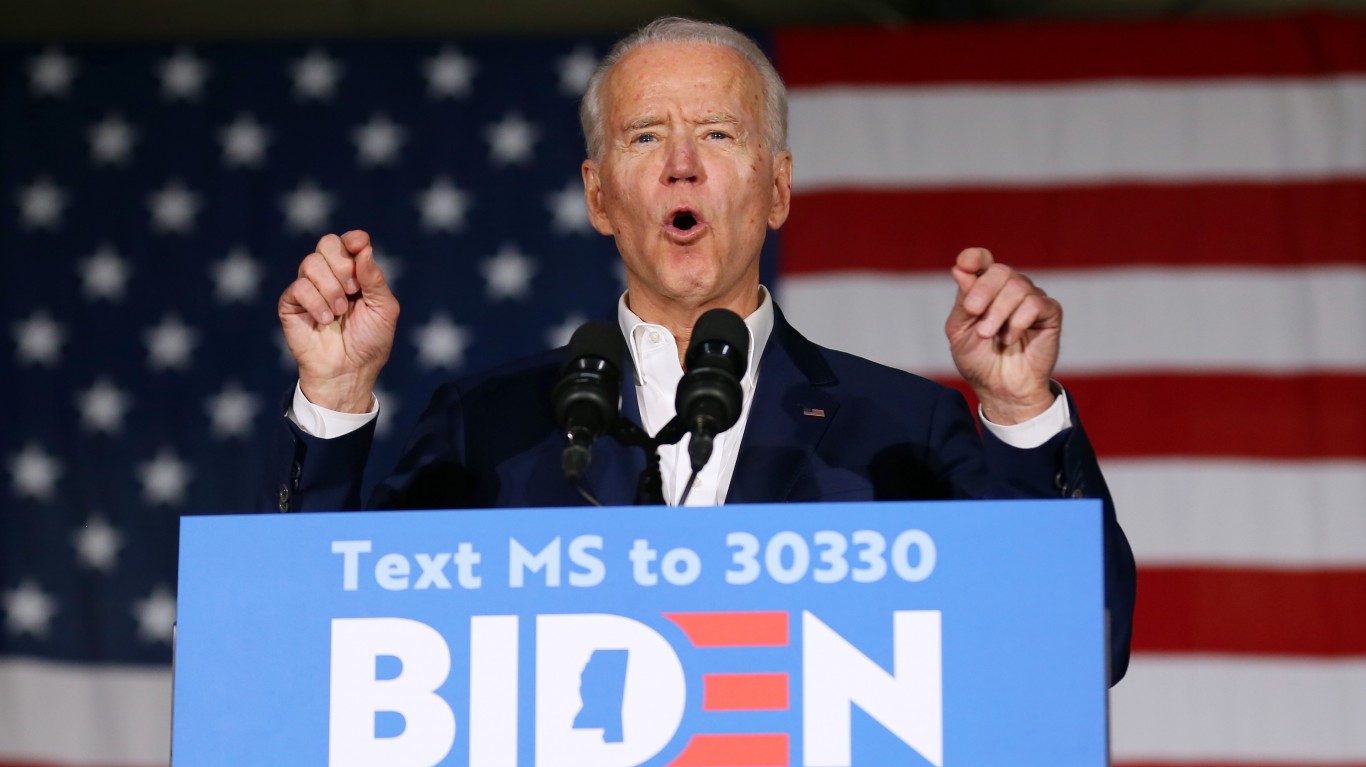
15. Mississippi
> Trump margin of victory in 2016: +17.8 points
> 2020 election front runner: Trump; 54% to 41%
> Electoral votes: 6
> Nov. 2016 voter participation in Mississippi: 66.7% (4th highest)

16. Missouri
> Trump margin of victory in 2016: +18.5 points
> 2020 election front runner: Trump; 50% to 44%
> Electoral votes: 10
> Nov. 2016 voter participation in Missouri: 62.8% (10th highest)
[in-text-ad]

17. Montana
> Trump margin of victory in 2016: +20.2 points
> 2020 election front runner: Trump; 52% to 43%
> Electoral votes: 3
> Nov. 2016 voter participation in Montana: 65.2% (6th highest)
[recirclink id=356841]

18. Nebraska Congressional District 1
> Trump margin of victory in 2016: +21.3 points
> 2020 election front runner: Trump; 48% to 46%
> Electoral votes: 1
> Nov. 2016 voter participation in Nebraska: 63.4% (9th highest)

19. Nebraska Congressional District 2
> Trump margin of victory in 2016: +2.2 points
> 2020 election front runner: Biden; 51% to 44%
> Electoral votes: 1
> Nov. 2016 voter participation in Nebraska: 63.4% (9th highest)
[in-text-ad-2]

20. Nebraska Congressional District 3
> Trump margin of victory in 2016: +54.9 points
> 2020 election front runner: Trump; N/A
> Electoral votes: 1
> Nov. 2016 voter participation in Nebraska: 63.4% (9th highest)
21. Nebraska
> Trump margin of victory in 2016: +25.1 points
> 2020 election front runner: Trump; 59% to 41%
> Electoral votes: 2
> Nov. 2016 voter participation in Nebraska: 63.4% (9th highest)
[in-text-ad]

22. North Carolina
> Trump margin of victory in 2016: +3.7 points
> 2020 election front runner: Biden; 47% to 46%
> Electoral votes: 15
> Nov. 2016 voter participation in North Carolina: 61.6% (15th highest)
[recirclink id=356833]

23. North Dakota
> Trump margin of victory in 2016: +35.7 points
> 2020 election front runner: Trump; 55% to 38%
> Electoral votes: 3
> Nov. 2016 voter participation in North Dakota: 62.1% (12th highest)
24. Ohio
> Trump margin of victory in 2016: +8.1 points
> 2020 election front runner: Trump; 48% to 47%
> Electoral votes: 18
> Nov. 2016 voter participation in Ohio: 61.4% (16th highest)
[in-text-ad-2]

25. Oklahoma
> Trump margin of victory in 2016: +36.4 points
> 2020 election front runner: Trump; 59% to 35%
> Electoral votes: 7
> Nov. 2016 voter participation in Oklahoma: 53.2% (9th lowest)

26. Pennsylvania
> Trump margin of victory in 2016: +0.7 points
> 2020 election front runner: Biden; 50% to 45%
> Electoral votes: 20
> Nov. 2016 voter participation in Pennsylvania: 60.2% (21st highest)
[in-text-ad]
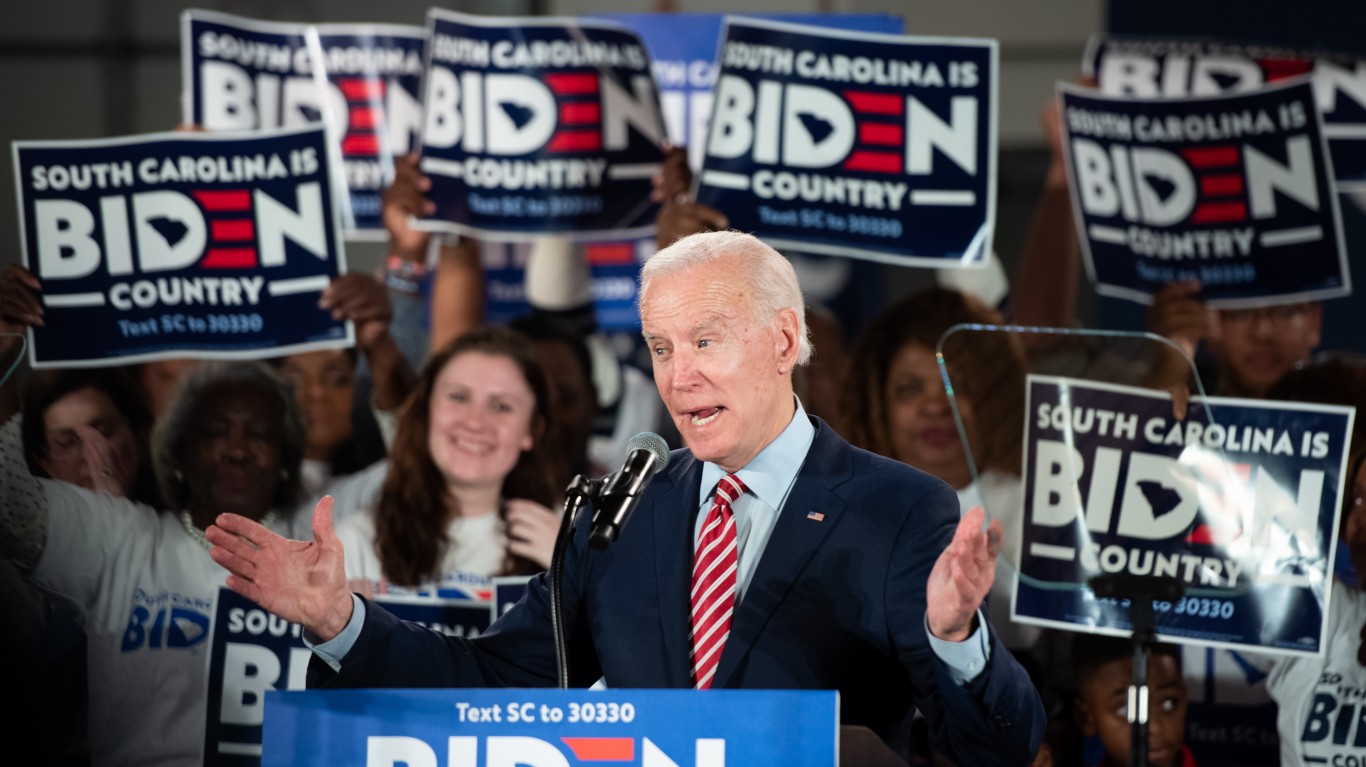
27. South Carolina
> Trump margin of victory in 2016: +14.3 points
> 2020 election front runner: Trump; 51% to 44%
> Electoral votes: 9
> Nov. 2016 voter participation in South Carolina: 59.8% (22nd highest)
[recirclink id=567518]

28. South Dakota
> Trump margin of victory in 2016: +29.8 points
> 2020 election front runner: Trump; 61% to 39%
> Electoral votes: 3
> Nov. 2016 voter participation in South Dakota: 57.3% (20th lowest)

29. Tennessee
> Trump margin of victory in 2016: +26.0 points
> 2020 election front runner: Trump; 53% to 41%
> Electoral votes: 11
> Nov. 2016 voter participation in Tennessee: 52.0% (7th lowest)
[in-text-ad-2]

30. Texas
> Trump margin of victory in 2016: +9.0 points
> 2020 election front runner: Trump; 48% to 46%
> Electoral votes: 38
> Nov. 2016 voter participation in Texas: 47.7% (2nd lowest)
31. Utah
> Trump margin of victory in 2016: +17.9 points
> 2020 election front runner: Trump; 49% to 37%
> Electoral votes: 6
> Nov. 2016 voter participation in Utah: 58.9% (25th lowest)
[in-text-ad]

32. West Virginia
> Trump margin of victory in 2016: +41.7 points
> 2020 election front runner: Trump; 66% to 31%
> Electoral votes: 5
> Nov. 2016 voter participation in West Virginia: 50.4% (5th lowest)
[recirclink id=356841]

33. Wisconsin
> Trump margin of victory in 2016: +0.8 points
> 2020 election front runner: Biden; 50% to 44%
> Electoral votes: 10
> Nov. 2016 voter participation in Wisconsin: 68.7% (2nd highest)
34. Wyoming
> Trump margin of victory in 2016: +46.3 points
> 2020 election front runner: Trump; 71% to 29%
> Electoral votes: 3
> Nov. 2016 voter participation in Wyoming: 63.5% (8th highest)
Methodology
To determine who would win Trump states if the presidential election were today, 24/7 Wall St. reviewed the most recent available polling data in the 34 states and districts that Donald Trump won in the 2016 presidential election. Polling data came from FiveThirtyEight, a political poll analysis company. Polling data are not necessarily from the same time period for each state.
For states with at least five total polls from at least three pollsters, the average result was used to identify the front-runner in the 2020 presidential election. In states that did not meet that standard, the front-runner was determined using the most recent poll results.
Polling data is not available for Nebraska’s 3rd Congressional District. However, Trump is widely considered to be the favorite. Polling data for Nebraska, South Dakota, and Wyoming is from The Economist, a weekly news publication.
Voter participation in the 2016 presidential election by state came from the U.S. Census Bureau’s Current Population Survey.






 Top Gaining Stocks
 Top Losing Stocks