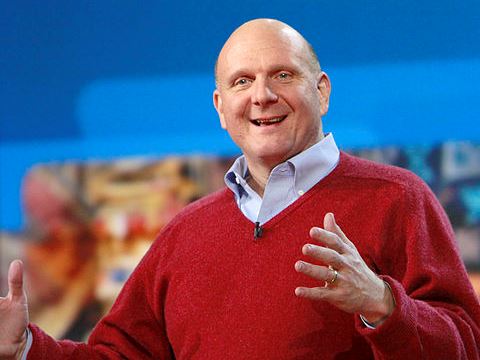
Microsoft’s Strong Quarter, an Appropriate Farewell to Steve Ballmer

Photo of Douglas A. McIntyre
By Douglas A. McIntyre Updated Published
This post may contain links from our sponsors and affiliates, and Flywheel Publishing may receive compensation for actions taken through them.

If Microsoft Corp. (NASDAQ: MSFT) had posted a long string of quarters similar to its most recent one, Steve Ballmer might not be on his way out the door as CEO of the software giant. This quarter, which may be the last of his reign of more than a decade, was among his best. Ballmer’s work to transform Microsoft, through a series of management changes, product introductions and M&A transactions, has begun to pay off in some critical ways.

Microsoft posted a profit of $5.24 billion, or $0.62 a share, on revenue of $18.53 billion. In the same quarter a year ago, the firm earned $4.7 billion, or $0.52 cents a share, on $16 billion in sales. Wall Street rewarded the company by pushing is shares up 5% to $35.42. Shares finally have reached the point at which their performance since Ballmer took over has come close to the performance of the Nasdaq over the same period.

Ballmer’s Achilles’ heel — Windows — failed him again, as revenue at the unit that represents its sales fell. He has never been able to get the product releases for the operating system just right. This did not change with Windows 8. Combine that with the fact he was largely blindsided by the rise of tablets and smartphones, and the decisions that dogged him in the flagship part of the company are ones from which he could not recover.

However, Ballmer’s push into business and server software has been an unqualified success. The divisions that contain the revenue from these barely existed in 2000. They now produce an outsized portion of Microsoft’s sales, and effectively compete with huge enterprise software companies led by Oracle Corp. (NYSE: ORCL) and SAP A.G. (NYSE: SAP). Investors looked at these operations as afterthoughts compared to Windows. Nothing could be further from the truth.

Ballmer’s work to move Microsoft into hardware will be remembered for two things — the large success of the Xbox, which the company spent billions to support until it did well, and Surface — a lame attempt to mimic Apple Inc.’s (NASDAQ: AAPL) iPad. Whether Ballmer’s risky buyout of dying Nokia Corp. (NYSE: NOK) will work will not be known for several quarters, it is a desperate attempt to enter the smartphone market and will not work.

Finally, there is Bing, Ballmer’s quixotic run at Google Inc.’s (NASDAQ: GOOG) search business. Its revenue was actually higher last quarter, but it continues to be dwarfed by its larger competitor. That will never change. Bing fell well short of its goals.

So, Ballmer’s mixed legacy will stay as just that — even if he began to turn Microsoft in the right direction at the end of his tenure.

Photo of Douglas A. McIntyre
About the Author Douglas A. McIntyre →

Douglas A. McIntyre is the co-founder, chief executive officer and editor in chief of 24/7 Wall St. and 24/7 Tempo. He has held these jobs since 2006.

McIntyre has written thousands of articles for 24/7 Wall St. He is an expert on corporate finance, the automotive industry, media companies and international finance. He has edited articles on national demographics, sports, personal income and travel.

His work has been quoted or mentioned in The New York Times, The Wall Street Journal, Los Angeles Times, The Washington Post, NBC News, Time, The New Yorker, HuffPost USA Today, Business Insider, Yahoo, AOL, MarketWatch, The Atlantic, Bloomberg, New York Post, Chicago Tribune, Forbes, The Guardian and many other major publications. McIntyre has been a guest on CNBC, the BBC and television and radio stations across the country.

A magna cum laude graduate of Harvard College, McIntyre also was president of The Harvard Advocate. Founded in 1866, the Advocate is the oldest college publication in the United States.

TheStreet.com, Comps.com and Edgar Online are some of the public companies for which McIntyre served on the board of directors. He was a Vicinity Corporation board member when the company was sold to Microsoft in 2002. He served on the audit committees of some of these companies.

McIntyre has been the CEO of FutureSource, a provider of trading terminals and news to commodities and futures traders. He was president of Switchboard, the online phone directory company. He served as chairman and CEO of On2 Technologies, the video compression company that provided video compression software for Adobe’s Flash. Google bought On2 in 2009.

Our $500K AI Portfolio

See us invest in our favorite AI stock ideas for free

Our Investment Portfolio

Continue Reading

Top Gaining Stocks

CBOE Vol: 1,568,143
PSKY Vol: 12,285,993
STX Vol: 7,378,346
ORCL Vol: 26,317,675
DDOG Vol: 6,247,779

Top Losing Stocks

LKQ
LKQ Vol: 4,367,433
CLX Vol: 13,260,523
SYK Vol: 4,519,455
MHK Vol: 1,859,865
AMGN Vol: 3,818,618