


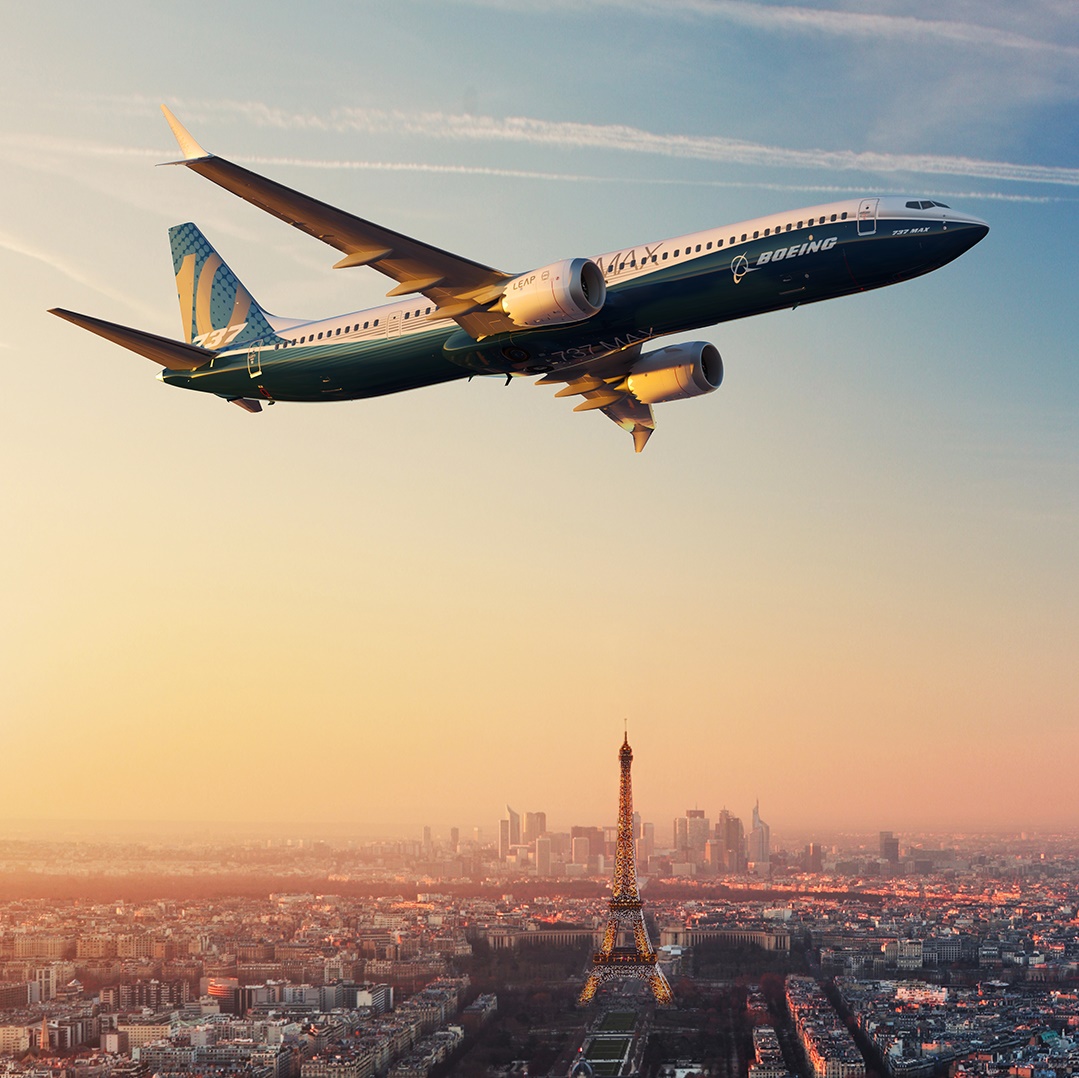
Boeing Co. (NYSE: BA) continues to dominate the news flow from the Paris Air Show. Shortly after we posted our report Tuesday morning, the company announced a firm order for 100 737 MAX 10s (737-10) from United Continental Holdings Corp. (NYSE: UAL), matching the largest previous order placed during the show by General Electric Co.’s (NYSE: GE) GECAS leasing division for 100 Airbus A320neos.
At the end of the day Tuesday, Boeing had taken orders and commitments for 656 737-10s and has added about a dozen more as of Wednesday morning. The largest of the new orders is a conversion of a previous order for 10 737 MAXes to 10 737-10s by China’s Donghai Airlines in a deal valued at $1.2 billion at list prices.
The more important news, perhaps, was Boeing’s discussion of its plans for the so-called New Midsize Airplane (NMA). The new plane is expected to fill a gap in the company’s product line for a plane capable of carrying around 250 passengers on flights of up to 5,000 nautical miles.
[nativounit]
In a presentation, Mike Delaney, vice president of Boeing Commercial Airplanes and general manager of airplane development, revealed several new details on the proposed NMA. Delaney said that the NMA will include a fifth-generation composite wing, a “hybrid” fuselage, next-generation electronics and “super-efficient, very-high-bypass turbofans,” according to a report at Aviation Week.
Here’s how Aviation Week parsed the meaning of “hybrid” fuselage:
[I]t is believed to reflect the proposed geometry of the cross section rather than the choice of structural materials. The cross section is therefore expected to combine the width and profile of the upper lobe of a 787- or 777-like design with the lower lobe of a 737-like ovoid fuselage.
Essentially that means a dual-aisle plane that will be designed to yield single-aisle operating costs.
Delaney also presented a timeline for the NMA. Following current market studies and initial product development, Boeing would launch the NMA in early 2019, finalize the design in 2020, begin fabrication in 2021 or 2022, and build the first planes in 2023. Entry into service would occur in 2025.
Boeing’s stock closed at $198.33 on Tuesday after posting a new 52-week high of $201.24. Shares traded up about 0.5% shortly after Wednesday’s opening bell at $199.45.
[wallst_email_signup]







 Top Gaining Stocks
 Top Losing Stocks