


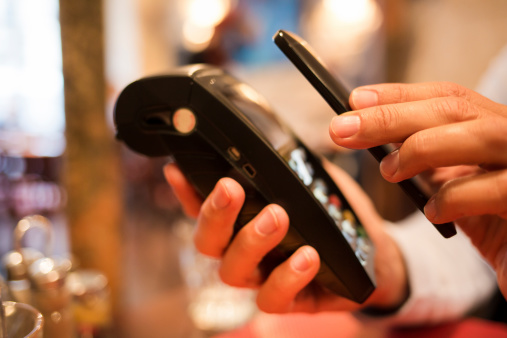
The one note that stands out handily is where Fitch talked up Apple being better positioned to succeed where other institutions have had limited success (or failure). After all, Apple’s financial resources and history of strong new product adoption is quite unique.
As a reminder, it was just on Thursday that 24/7 Wall St. highlighted a RBC research report highlighting the winners from Apple Pay. Most, but not all, were established financial players and banks. This view is partially shared by Fitch, although there is a warning to consider for the banks and credit card merchants as well.
READ ALSO: What Supposed to Be in the iPhone 6, but Wasn’t!
Here is where this gets really interesting: Fitch does not view the unveiling of Apple Pay as a watershed moment for the nascent mobile payments industry. Still, Fitch does recognize Apple Pay’s potential to disrupt the payments landscape longer term.
Fitch said:
We believe that the impact of any success on the payments industry remains uncertain and will depend on a number of factors including customer acceptance, merchant conversion and continued support from the payment networks (e.g. Visa, MasterCard, American Express) and banks. Thus far, 11 banks, representing 83% of the credit card purchase volume in the US, have or are expected to agree to support Apple Pay. Over the short term, card issuers could benefit from higher transaction volumes and enhanced security, but a key unknown lies within the undisclosed contracts and how much of the card economics and control of transaction data will be ceded to Apple.
On what the risks are to the banks, Fitch said:
We see Apple’s present strategy with Apple Pay as enhancing the brand by contributing to the company’s services while boosting the attractiveness of its suite of products that consumers are increasingly integrating into their lives. As mobile payments continue to grow and Apple is able to drive substantial consumer adoption of Apple Pay, Fitch believes Apple could re-evaluate its strategy and attempt to renegotiate its contracts and erode the card companies’ incremental volume gains. Other technology firms behind mobile payment methods could ultimately do so as well.
One bit of good news is the increased security driving down the potential for fraud. Fitch noted:
The near field communication (NFC) technology on the iPhone is not a new development and has been made available previously on other types of mobile phones and cards, yet has failed to become widely used by consumers. The security features of touch pay, including no visible card numbers, dynamic transaction identifiers and finger print identification at the point of sale are advances beyond traditional card payment means… Apple’s capacity to educate consumers on how security is improved could lead to greater acceptance and higher usage of mobile payment technology. Wider use of phone payments could trim back card fraud over the longer term, which alone may be a rationale for banks and card firms to be amenable to the Apple Pay service.
READ ALSO: Two Very Unusual Small-Cap Stock Winners of Apple Pay
While Fitch has insight into bank credit trends that are above and beyond those that are not credit ratings agencies, the opinions over who wins and loses in the near term and in the long term due to Apple Pay is a very diverse list — with equally diverse opinions. This is likely to be a trend that is years in the making, and winners and losers are unlikely to explode or implode overnight.
Stay tuned.







 Top Gaining Stocks
 Top Losing Stocks