



Last week the U.S. Environmental Protection Agency (EPA) released its report on fuel economy and greenhouse gas emissions for model year 2014 light-duty vehicles (cars, minivans and pickups mostly). As a group, carmakers topped the stricter 2014 emissions standards and maintained fuel economy at the highest level the EPA has ever recorded.
First the good news. Overall, the auto industry’s compliance with greenhouse gas (GHG) emissions standards was better than it needed to be by 13 grams of GHG emissions per mile driven. The standard for model year 2014 was 287 grams per mile and carmakers achieved 274 grams per mile, a nominal year-over-year decline of 5 grams per mile.
Only two carmakers, Mercedes and Kia, exceeded their fleet compliance values. Volkswagen cars are not included due to the current investigation into the company’s fiddling with its diesel cars’ software.
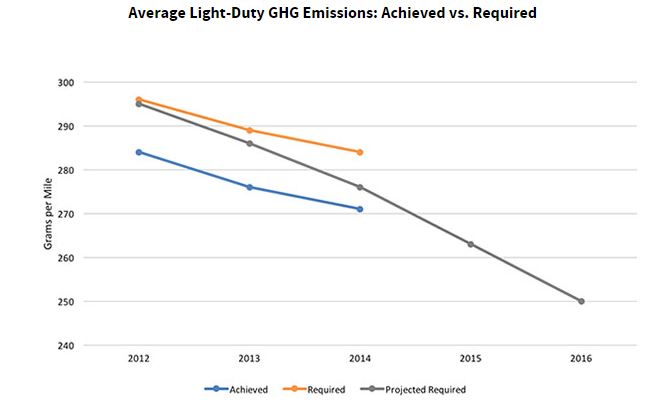
The less good news is that the low-hanging fruit may have now been picked. The American Council for an Energy-Efficient Economy (ACEEE) created this chart to indicate where the industry has been and where it is headed regarding GHG emissions:
[ims_survey]
Here’s ACEEE’s explanation of the chart, which is based on data from the EPA report:
Required values (orange) for 2013-14 are less demanding than projected (gray), largely because the standards adjust to the size and type of vehicle sold. And the discrepancy between projected and actual requirements is increasing as sales of bigger vehicles grows. Average emissions (blue) remain lower than the rule’s projected requirements, but that advantage nearly vanished in model year 2014, and the trend is not encouraging.
In other words, all those pickup trucks and sport utility vehicles that U.S. consumers have been buying have narrowed the gap between what the EPA expects and what carmakers can deliver, and as long as gasoline prices are around $2 a gallon, there is no incentive for consumers to buy more fuel-efficient vehicles. That means that meeting projected 2015 and 2016 targets is highly doubtful.








 Top Gaining Stocks
 Top Losing Stocks