


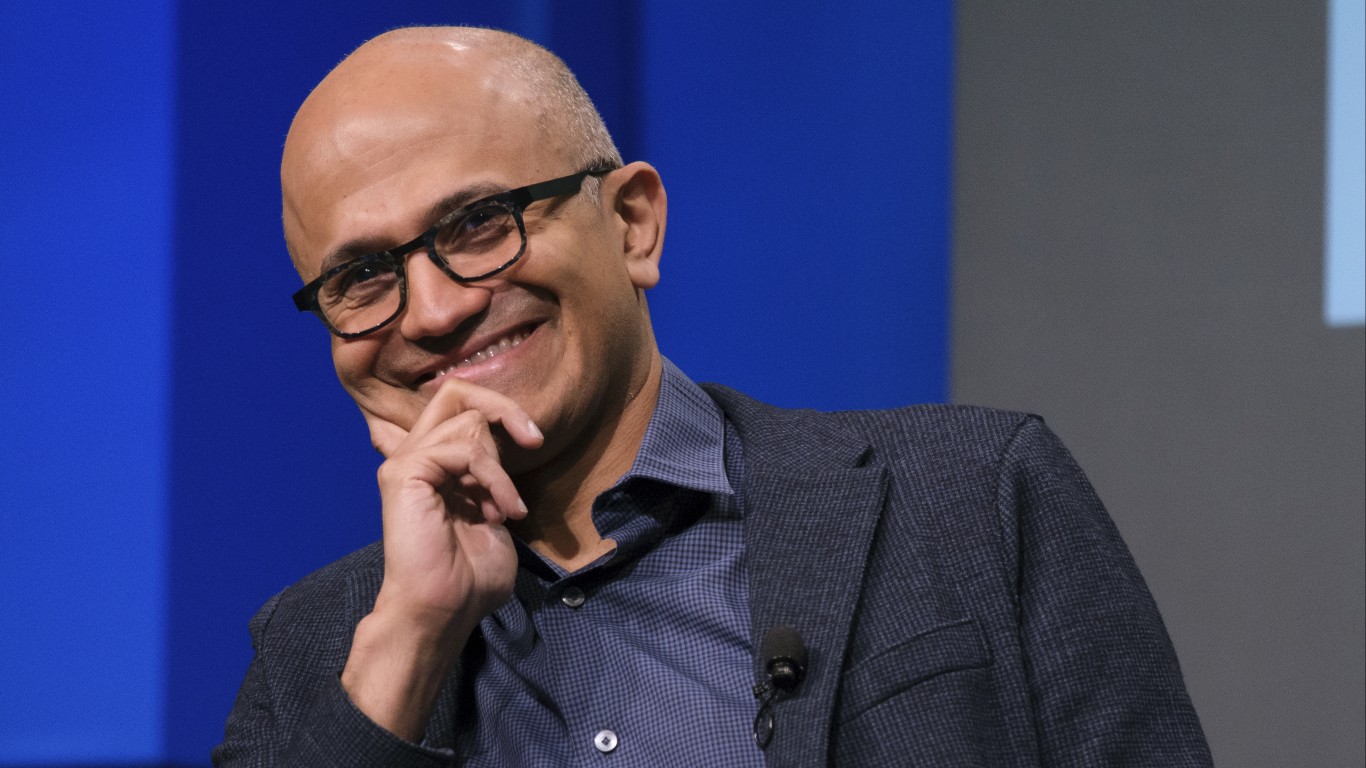
What do Sundar Pichai, Satya Nadella and Arvind Krishna have in common? They are Indian Americans and all three are (or soon will be) chief executive officers of three of America’s premier technology companies: Alphabet Inc. (NASDAQ: GOOGL), Microsoft Corp. (NASDAQ: MSFT) and International Business Machines Corp. (NYSE: IBM), respectively. Adobe Systems Inc. (NASDAQ: ADBE) CEO Shantanu Narayen and Ajay Banga, CEO of Mastercard Inc. (NYSE: MA), are other Indian Americans leading major American companies.
Missing from that list are leaders of American companies from East Asia; that is, China, Japan and Korea. John Chen, CEO of Blackberry Ltd. (NYSE: BB), is the only Chinese American who leaps immediately to mind, and no Japanese American comes to mind as CEO of a major (S&P 500) company. (Apologies in advance if anyone has been omitted.)
A new paper by Jackson G. Lu of MIT’s Sloan School of Management, Richard E. Nisbett of the University of Michigan and Michael W. Morris of Columbia University’s Business School sought to determine why Asian Americans are underrepresented in the corner offices of U.S. companies and whether the lack of top managers applied to all Asians or only to particular Asian subgroups.
Their results indicate that East Asians are less likely than South Asians (from India, Pakistan and Bangladesh) or white Americans to advance to leadership positions in American companies. As a percentage of their portion of the total U.S. population, South Asians even outperformed white Americans.
The researchers focused on three possible kinds of mechanisms (mediators) responsible for underrepresentation or, using a term from Jane Hyun’s 2005 book, what they called the “bamboo ceiling.” The three mediators are prejudice, motivation and assertiveness.
The following chart, using data from the new report, shows the number of East Asian (EA), South Asian (SA) and white CEOs among S&P 500 companies, along with the ratio of CEOs per million population of each group. The U.S. East Asian population ranged from 5.51 million in 2010 to 6.35 million in 2017, with a mean of 5.9 million. The South Asian population fell in a range of 3.13 million to 4.35 million, with a mean of 3.67 million. The white population ranged from 224.90 million to 234.37 million, with a mean of 230.60 million.
| Year | EA CEOs | SA CEOs | White CEOs | EA per million | SA per million | White per million |
|---|---|---|---|---|---|---|
| 2010 | 3 | 8 | 433 | 0.54 | 2.56 | 1.93 |
| 2011 | 3 | 9 | 437 | 0.54 | 2.77 | 1.92 |
| 2012 | 4 | 10 | 433 | 0.70 | 2.97 | 1.89 |
| 2013 | 3 | 9 | 443 | 0.52 | 2.56 | 1.92 |
| 2014 | 4 | 10 | 446 | 0.67 | 2.71 | 1.92 |
| 2015 | 4 | 12 | 451 | 0.66 | 3.06 | 1.94 |
| 2016 | 4 | 12 | 451 | 0.65 | 2.93 | 1.93 |
| 2017 | 3 | 13 | 440 | 0.47 | 2.99 | 1.88 |
| Mean | 3.50 | 10.38 | 441.75 | 0.59 | 2.82 | 1.92 |
As the table shows, there was a mean of nearly three times as many South Asian CEOs as East Asians even though the East Asian population is more than 1.5 times larger than the East Asian population. East Asians also fared worse than South Asians on five other studies conducted by the researchers.
Among the mediating conditions of prejudice, motivation and assertiveness being tested, researchers identified the last as the significant mediator in all five studies that tested those conditions. While prejudice (defined as antipathy toward a social group) is present, South Asians experience greater prejudice than East Asians in everyday life, but that prejudice does not keep South Asians from climbing the corporate ladder.
Work motivation did not differ appreciably between East Asians and South Asians. Neither were the two groups significantly different in leadership motivation or aptitude.
When it comes to gaining leadership of a major U.S. company, South Asians fare better than East Asians because they demonstrate more of the assertiveness that American leaders are supposed to have. The authors cite research that suggests that a prototypical American leader blazes a trail from the front of the group while an East Asian leader “trails behind the group as a steady protector.”
South Asian culture encourages assertiveness: “Indian people tend to be forceful and lively, use overt body language, and think aloud, whereas Japanese people tend to be modest and quiet, use little body language, and think in silence.”
That difference leads the authors to write that “cultural differences in assertiveness reliably mediated the leadership attainment gap between [East Asian]s and [South Asian]s, suggesting that [East Asian]s suffer from the bamboo ceiling partly because they communicate less assertively.”
The takeaway from this research, according to the authors, is that “American organizations should be cognizant of the underrepresentation of EAs in leadership roles.” Further, the organizations need to understand the cultural differences among subgroups of Asians (this post-2016 election survey is an eye-opener, for example).
“To break the bamboo ceiling,” the research concludes, “organizations need to understand how [East Asian]s’ low assertiveness may be incongruent with the American prototype of leadership. … The bamboo ceiling is not an Asian issue, but an issue of cultural fit—a mismatch between [East Asian] norms of communication and American norms of leadership.”
Interestingly, there are three Asian Americans on the list of 2019’s most highly paid CEOs. All have cultural roots in South Asia.











 Top Gaining Stocks
 Top Losing Stocks