



Dividend Aristocrats deliver income that grows quietly, raising payouts year after year.
Realty Income (NYSE:O | O Price Prediction), PepsiCo (NASDAQ:PEP), and Procter & Gamble (NYSE:PG) are three of the most reliable income machines in the market. Split $10,000 evenly among them today, and you’d collect roughly $1,150 per year in dividends. But the more interesting question is how these stocks actually performed over time, and whether they still deserve a spot in your portfolio.
Three Brands, One Thesis: Boring Is Beautiful
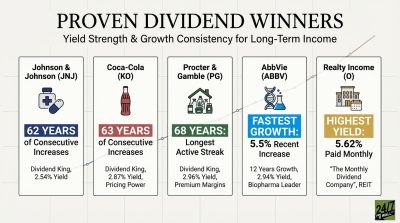
Realty Income buys commercial properties, leases them on long-term net leases, and passes the income to shareholders monthly. The company has raised its dividend 113 consecutive times since listing on the NYSE in 1994.
PepsiCo’s moat is brand shelf space. Pepsi, Lay’s, Doritos, Gatorade, and Quaker sit in nearly every pantry globally. The company has raised its dividend for 54 consecutive years, and while FY2025 showed pressure from North American volume declines, international results remain strong: EMEA core operating profit rose 29%, and Asia Pacific Foods jumped 35% in Q1 2026.
Procter & Gamble runs a tighter ship. Tide, Pampers, Gillette, Bounty, and Crest dominate their categories. The company has decades of consecutive dividend increases and generates a 26.3% operating margin. New CEO Shailesh Jejurikar inherited a business facing roughly $400 million in after-tax tariff costs for FY2026 and a 1% unit volume decline in Q2, but P&G’s pricing power and brand loyalty have carried it through tougher cycles.
The Passive Income Math: $1,150 a Year From $10,000
A $10,000 investment split equally among all three yields the following annual dividend income today:
- Realty Income yields roughly 4.97%, buying approximately 153 shares and generating $496.64 per year, paid monthly.
- PepsiCo yields roughly 3.61%, buying approximately 63 shares and generating $358.47 per year, paid quarterly.
- Procter & Gamble yields roughly 2.96%, buying approximately 68 shares and generating $295.80 per year, paid quarterly.
- Combined: approximately $1,150.91 annually.
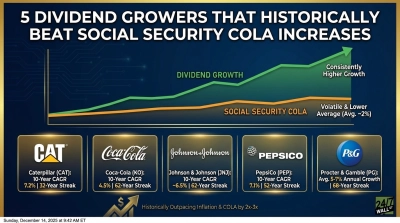
That income isn’t static. All three companies have track records of raising payouts over time, which means the yield on your original cost basis grows even if the share price doesn’t.
Evaluating These Three Dividend Aristocrats
Realty Income’s outlook depends heavily on the interest rate environment and the company’s global expansion trajectory. The $8 billion 2026 investment volume guidance signals aggressive growth, and the monthly dividend is rare. Rate sensitivity remains a key risk: elevated rates compress AFFO growth and weigh on REIT valuations. Realty Income carries $1.13 billion in annual interest expense, and that burden compresses AFFO growth. The 2026 AFFO guidance of $4.38 to $4.42 per share implies modest growth, and the stock’s valuation at a forward P/E of 41x reflects rate expectations.
PepsiCo offers a dividend that has grown every year for over five decades and a stock that has pulled back to a more reasonable valuation. The forward P/E of 18x is among the more attractive valuations PepsiCo has offered in years. The bear case is real: tariff-driven commodity costs, North American volume declines, and consumers trading down to private label. If those headwinds persist, the 2026 organic revenue growth target of 2% to 4% will be a stretch.
P&G’s ten-year return of 130% is impressive, and the dividend record is impeccable. But the stock is down 11.53% over the past year, tariff headwinds are real, and volume is contracting. The forward P/E of 20x leaves little margin for further earnings disappointment. Investors may want to monitor the stock’s valuation relative to its earnings trajectory before adding exposure.










 Top Gaining Stocks
 Top Losing Stocks