


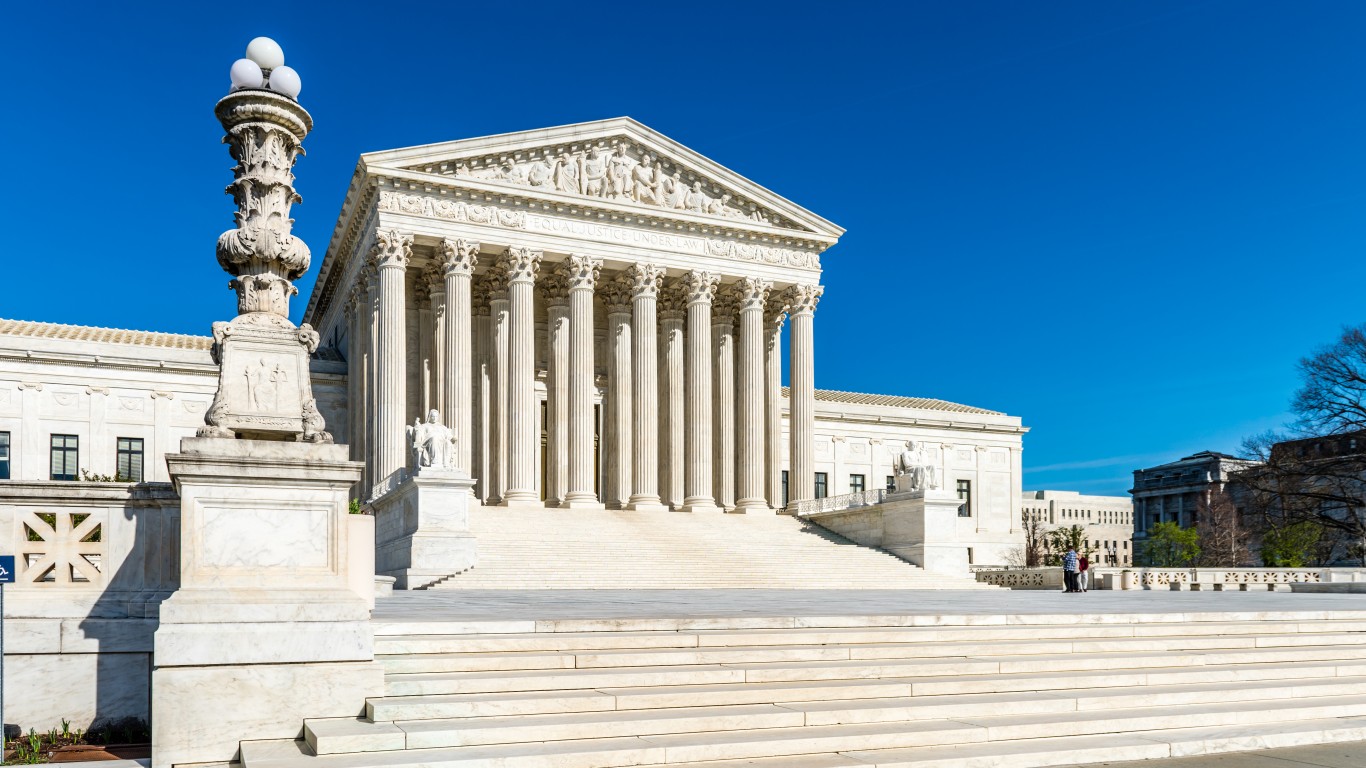
In a 5-to-4 ruling issued Friday morning, the U.S. Supreme Court reversed a lower court decision allowing arbitration disputes to proceed while the defendant appeals a lower court ruling. The defendant in the case was Coinbase Global Inc. (NASDAQ: COIN | COIN Price Prediction), the target earlier this week of a U.S. Securities and Exchange Commission lawsuit. (You wouldn’t believe these 25 really weird lawsuits were ever filed.)
[in-text-ad]
Writing for the majority, Justice Brett Kavanaugh sided with Coinbase and other business groups that supported the cryptocurrency exchange’s position calling for a stay in an arbitration proceeding while a lower court’s decision to allow the proceeding was being appealed:
Many of the asserted benefits of arbitration (efficiency, less expense, less intrusive discovery, and the like) would be irretrievably lost—even if the court of appeals later concluded that the case actually had belonged in arbitration all along. Absent a stay, parties also could be forced to settle to avoid the district court proceedings (including discovery and trial) that they contracted to avoid through arbitration.
[nativounit]
In the dissenting opinion, written by Justice Ketanji Brown Jackson and in which Justices Kagan and Sotomayor joined in full and Justice Clarence Thomas joined in part, Jackson wrote that the majority opinion imposes a “mandatory general stay of trial court proceedings,” a departure from the traditional approach to such cases. The rule, Jackson writes, “comes out of nowhere”:
[T]oday’s majority invents a new stay rule perpetually favoring one class of litigants—defendants seeking arbitration. Those defendants will now receive a stay even when, according to the usual equitable analysis, there is no good reason for one. And, in reaching this result, the Court concludes for the first time that an interlocutory appeal about one matter (arbitrability) bars the district court from proceeding on another (the merits). That logic has such significant implications for federal litigation that the majority itself shies away from the Pandora’s box it may have opened.
[wallst_email_signup]
As Bloomberg points out in its report, “Arbitration agreements are commonplace in the crypto industry, much as they are with other retail businesses that have large customer bases” because “arbitration can be less expensive and give[s] defendants key procedural advantages.”
[recirclink id=1238205]
The ruling lifted Coinbase’s share price by around 4% Friday morning, erasing half of the stock’s decline over the past month.









 Top Gaining Stocks
 Top Losing Stocks