


 The Bureau of the Census said Detroit lost 26% of its population over the last decade. That brought the number of people within its borders to 713,777. The New York Times pointed out that Detroit’s population has not been that low since 1910. There is no solution to Detroit’s problem. Government officials and the city of Detroit would like to think that all man-made problems can be solved by people. That is not true in Detroit’s case and has not been for some time. The city’s wastelands will never go away, and may increase in size over time.
Three years ago when it was clear how quickly the city was dying, the national media sent reporters to Detroit. Time magazine even set up a house in one of the worst parts of the Motor City to chronicle its demise. The editors of the publications who took up residence may have hoped that their articles would draw enough attention so that the national government would give Detroit a hand. That did not work, if it was their plan.
No one has to wonder what happened to Detroit. The migration of workers, mostly from the South, who came to Detroit to find factory work in the 20th Century filled the area with blue collars workers. The auto industry began its decline thirty years ago, mostly because of strong competition and poor workmanship. There was no work eventually for hundreds of thousands of people in southeast Michigan. Unemployment reached 25% in some cities. Home values came down by 70% or more over the last twenty years. Home equity disappeared. Many residents became destitute. There is no exact count of where all of these people went, but they left the industrial Midwest.
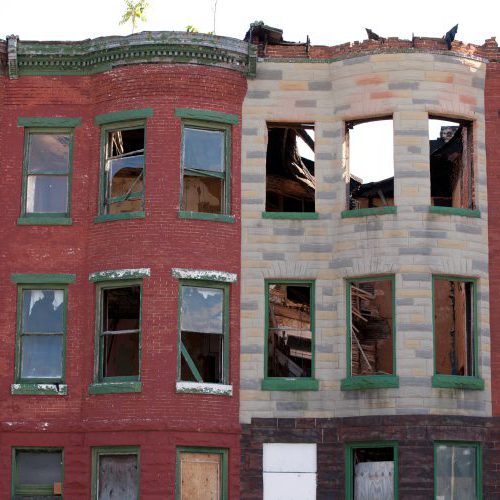
There are large areas of Detroit which are completely unoccupied. The mayor and urban experts suggest that the homes in these areas be destroyed. The neighborhoods could be planted with grass. Detroit would have the largest park system of any city in the world. It just would not have the money to maintain it.
Detroit has nearly no tax base compared with what it was just twenty years ago. It social services are in a shambles. That means that it has no chance to rebuild infrastructure and no enticements to bring new businesses back to town. The region is so blighted that even the most generous tax rebates or credits will not get firms to relocate in Detroit.
There is no reason for the municipal neighbors that have common borders with Detroit to want to take portions of the city Most of these cities and townships have financial and population problems of their own. Detroit is not alone in its struggle. It is just at the center of a region which may recover somewhat even if Detroit cannot.
America has never faced the prospect that a large city has disappeared. New Orleans may have been flattened by a natural disaster but the federal government was willing to bear some of the financial load to rebuilt it. The destruction of New Orleans happened in a flash. The scope of the damage could be measured which made it easier for taxpayers to understand the problem and try to solve it.
The federal government is too poor to help Detroit. It would cost tens of billions of dollars to aid the city, even if the money in the Treasury was available. That brings the discussion around to the issue of what tens of billions of dollars would buy Detroit. The people who are gone will not be back. There is no way to rebuild an American auto industry that will add hundreds of thousands of jobs, so Detroit presents America with that rare problem which has no solutions.
Douglas A. McIntyre





 Top Gaining Stocks
 Top Losing Stocks