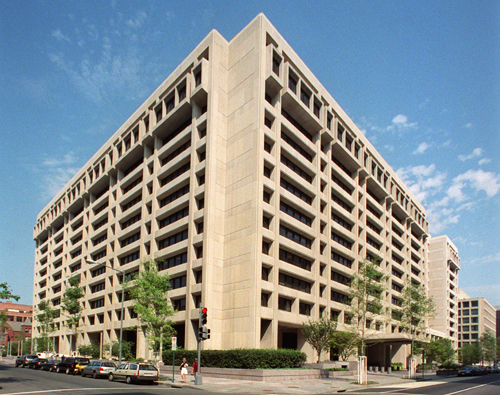
IMF Buries U.S. Growth as Drag on Global Economy

Photo of Douglas A. McIntyre
By Douglas A. McIntyre Published
This post may contain links from our sponsors and affiliates, and Flywheel Publishing may receive compensation for actions taken through them.

Barely buried in the new International Monetary Fund (IMF) forecast for global growth was the prediction for U.S. gross domestic product (GDP) improvement for 2013 and 2014. As the world’s largest economy, the United States has an outsized effect on the IMF’s number. American GDP recovery is expected to be bad, so if it is better than the IMF forecast, it will cause a better world — financially.

The IMF revised its GDP improvement figures down. In its World Economic Outlook the agency made the point:

Global growth is now projected at 3.1 for 2013 and 3.8 percent for 2014, a downward revision of ¼ percentage point each year compared with the forecasts in the April 2013 WEO.

As for America:

Growth in the United States is forecast to rise to rise from 1¾ percent in 2013 to 2¾ percent in 2014, as fiscal consolidation slows and private demand remains solid.

In addition to being poor English, the statement reflects a U.S. improvement much below what many economists and government agencies expect. In the administration’s just released Mid-Session Review for the government’s fiscal 2014 Office of Management and Budget forecast:

Real GDP is expected to rise by 2.4 percent during the four quarters of 2013 and to increase 3.4 percent during 2014.

Given the size of the U.S. economy, the difference between the forecasts is stupendous. America’s current GDP, which is well above $15 trillion, is as almost as large as the combination of the nominal GDPs of the next three countries by the measure — China, Japan and Germany.

The focus of the IMF’s revision has been the slowing of growth among the emerging nations, according to one of the most visible comments in its revised forecast:

Weakness in emerging market economies will dampen global growth prospects.

But that focus obscures the real trigger for 2013 and 2014. If the United States beats the IMF estimates, the global number will be much higher.

Photo of Douglas A. McIntyre
About the Author Douglas A. McIntyre →

Douglas A. McIntyre is the co-founder, chief executive officer and editor in chief of 24/7 Wall St. and 24/7 Tempo. He has held these jobs since 2006.

McIntyre has written thousands of articles for 24/7 Wall St. He is an expert on corporate finance, the automotive industry, media companies and international finance. He has edited articles on national demographics, sports, personal income and travel.

His work has been quoted or mentioned in The New York Times, The Wall Street Journal, Los Angeles Times, The Washington Post, NBC News, Time, The New Yorker, HuffPost USA Today, Business Insider, Yahoo, AOL, MarketWatch, The Atlantic, Bloomberg, New York Post, Chicago Tribune, Forbes, The Guardian and many other major publications. McIntyre has been a guest on CNBC, the BBC and television and radio stations across the country.

A magna cum laude graduate of Harvard College, McIntyre also was president of The Harvard Advocate. Founded in 1866, the Advocate is the oldest college publication in the United States.

TheStreet.com, Comps.com and Edgar Online are some of the public companies for which McIntyre served on the board of directors. He was a Vicinity Corporation board member when the company was sold to Microsoft in 2002. He served on the audit committees of some of these companies.

McIntyre has been the CEO of FutureSource, a provider of trading terminals and news to commodities and futures traders. He was president of Switchboard, the online phone directory company. He served as chairman and CEO of On2 Technologies, the video compression company that provided video compression software for Adobe’s Flash. Google bought On2 in 2009.

Featured Reads

Our top personal finance-related articles today. Your wallet will thank you later.

Continue Reading

Top Gaining Stocks

CBOE Vol: 1,568,143
PSKY Vol: 12,285,993
STX Vol: 7,378,346
ORCL Vol: 26,317,675
DDOG Vol: 6,247,779

Top Losing Stocks

LKQ
LKQ Vol: 4,367,433
CLX Vol: 13,260,523
SYK Vol: 4,519,455
MHK Vol: 1,859,865
AMGN Vol: 3,818,618