
Beyond Industrial Production, Has Capacity Utilization Peaked?

Photo of Jon C. Ogg
By Jon C. Ogg Published
This post may contain links from our sponsors and affiliates, and Flywheel Publishing may receive compensation for actions taken through them.

Tuesday morning’s economic releases included a gain in industrial production for the month of June. Production rose by 0.3%, rather than the 0.2% consensus expected by Bloomberg. Capacity utilization also managed to come in marginally ahead of estimates at 77.8% rather than the 77.7% consensus.

The good news is that this industrial production reading was after slight decreases in May and in April. The bad news is that even though capacity utilization was at the top of the range and ahead, it is still running too low for a recovery. The net result is that factories and plants are only running at 77.8% of capacity.

If you look at this chart for the use of capacity from the St. Louis Federal Reserve, you begin to see what is happening. You also must keep in mind that this includes the factory closures that have been seen. Even after the jobs have been sent overseas and even after plants have been consolidated, the United States is running on lower and lower capacity utilization.

The peak of the 1980s and 1990s at 85% is probably not realistic for a goal in capacity utilization. Getting back to 80% or above, on the other hand, is something that should be a goal. Higher capacity means higher output, even if higher output can be milked out of lower capacity rates as we are seeing. Higher capacity utilization means more jobs.

By the way, did you know that your state’s unemployment rate is influenced by whether it was considered a red state or blue state by the electoral college? It is.
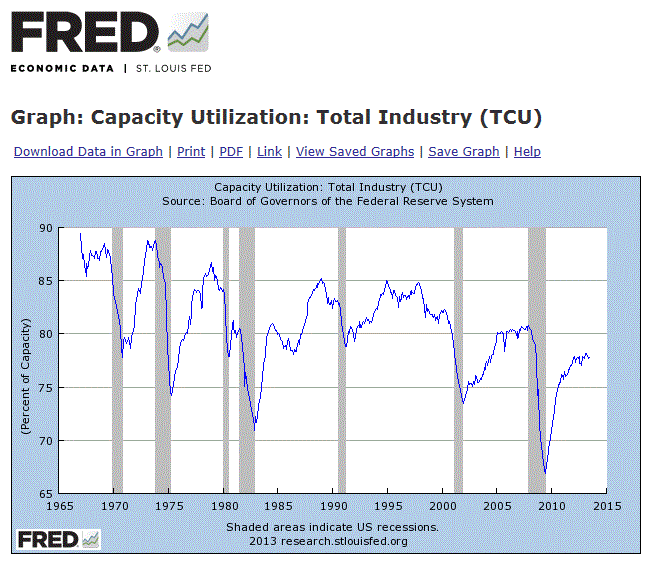
Photo of Jon C. Ogg
About the Author Jon C. Ogg →

Jon Ogg has been a financial news analyst since 1997. Mr. Ogg set up one of the first audio squawk box services for traders called TTN, which he sold in 2003. He has previously worked as a licensed broker to some of the top U.S. and E.U. financial institutions, managed capital, and has raised private capital at the seed and venture stage. He has lived in Copenhagen, Denmark, as well as New York and Chicago, and he now lives in Houston, Texas. Jon received a Bachelor of Business Administration in finance at University of Houston in 1992. a673b.bigscoots-temp.com.

Featured Reads

Our top personal finance-related articles today. Your wallet will thank you later.

Continue Reading

Top Gaining Stocks

CBOE Vol: 1,568,143
PSKY Vol: 12,285,993
STX Vol: 7,378,346
ORCL Vol: 26,317,675
DDOG Vol: 6,247,779

Top Losing Stocks

LKQ
LKQ Vol: 4,367,433
CLX Vol: 13,260,523
SYK Vol: 4,519,455
MHK Vol: 1,859,865
AMGN Vol: 3,818,618