



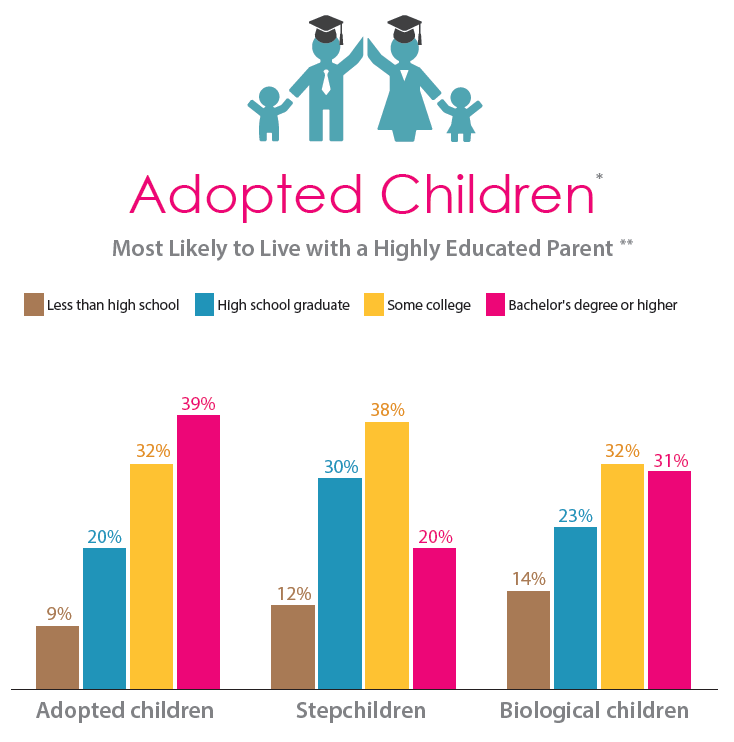
According to the American Community Survey statistics, some 17% of adopted children under age 18 lived with a householder with a graduate or professional degree. The report showed that only 12% of biological children and 6% of stepchildren lived with a householder with at least one of these degrees.
The Census Bureau used multiyear data from the American Community Survey, from 2009 to 2011, and used the 2010 Census and 2012 Current Population Survey for its results.
Now, when you consider that higher education degrees are also generally associated with higher income, what does this tell you? It implies higher income and lower poverty among adopted kids.
The report confirms these expectations with figures. It said:
In 2010, of the 64.8 million children of the householder under age 18, 93 percent were the biological children of the householder, 4 percent were stepchildren and 2 percent were adopted children… Adopted children lived in households that had higher incomes and were less likely to live in poverty (14 percent) than stepchildren (16 percent) or than biological children (21 percent).
Obviously, this is not meant to be a blanket hypothesis. The Census Bureau’s Fertility and Family Statistics Branch showed that there are many different circumstances around adoption, and also stressed that several data sources were used to explore the particular characteristics of each group.
The full report breaks out statistics regarding stepchildren and transracially adopted children. The infographic below visualizes the Census findings.















 Top Gaining Stocks
 Top Losing Stocks