



Salaried workers who are paid for 40 hours of work a week report that they work an average of 49 hours. Workers who are paid hourly wages work an average of 44 hours a week, according to the Gallup Work and Education Survey that included a combined sample for 2013 and 2014 of 1,271 adults at least 18 years old who are employed full-time.
Gallup notes that 13% of U.S. workers hold down more than one job, which may raise the number somewhat. However, counting just the 86% who say they hold one job, the number of hours worked in a week averages 46.
And lest we conclude that this is a recent phenomenon, Gallup data since 2001 are remarkably consistent for full-time workers. Part-time workers saw their hours drop sharply between 2001 and 2006, but hours worked has leveled out for these workers at around 25 to 26 hours.
Before the Great Recession, about 50% of U.S. workers held full-time jobs. The percentage currently is 43%.
What Gallup noticed, though, might be unexpected:
[H]aving an engaging job and workplace still trumps [longer hours and other workplace policies] in fostering higher overall well-being in workers. Highly engaged workers who log well over 40 hours will still have better overall well-being than actively disengaged workers who clock out at 40 hours. In other words, hours worked matters, but it’s not all that matters.
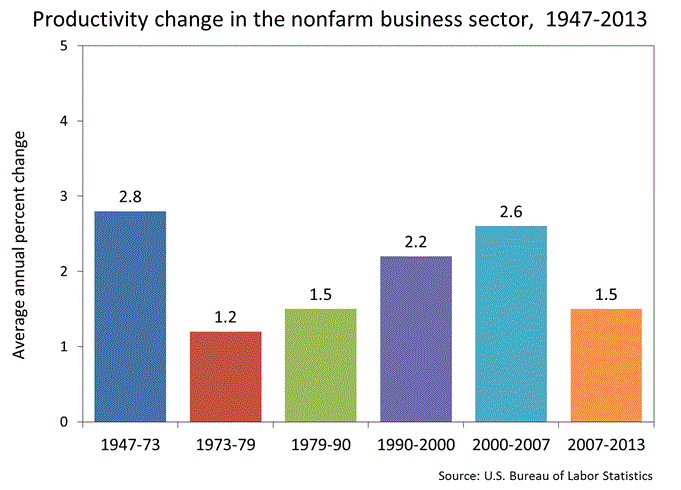
Oddly perhaps, U.S. productivity since 2007 is equal to what it was in the period from 1979 to 1990, not a particularly high-growth period in the United States. All those people working all those hours and productivity is still just a bit better than half what it was in the post-World War II years.









 Top Gaining Stocks
 Top Losing Stocks