


Earlier this month, India recorded its highest-ever temperature of 123.8 degrees Fahrenheit in a town in the northwest part of the country. Saturday morning, the city of Ramgundam recorded a temperature of 114.8°F, tied with a town in Algeria for the day’s highest temperature in the world. Ramgundam also posted Friday’s high of 115.5°F.
India’s temperatures ahead of this year’s monsoon have been unusually high. The country faces a massive drought, affecting about 330 million people (more than the total U.S. population). Last year 2,135 people died in India during the summer heat wave.
A study published in 2013 and cited at The Conversation found that the intensity of extreme Indian temperatures between 1951 and 2010 showed no significant change. Some things did change, though:
However, the study found a significant increase in the frequency of extreme temperatures and a remarkable trend in the duration of warm spells in India … . Warm spells, defined as at least six days of extreme temperatures relative to the location and time of year, increased by at least three days per decade over 1951-2010 – the largest trend recorded globally.
[nativounit]
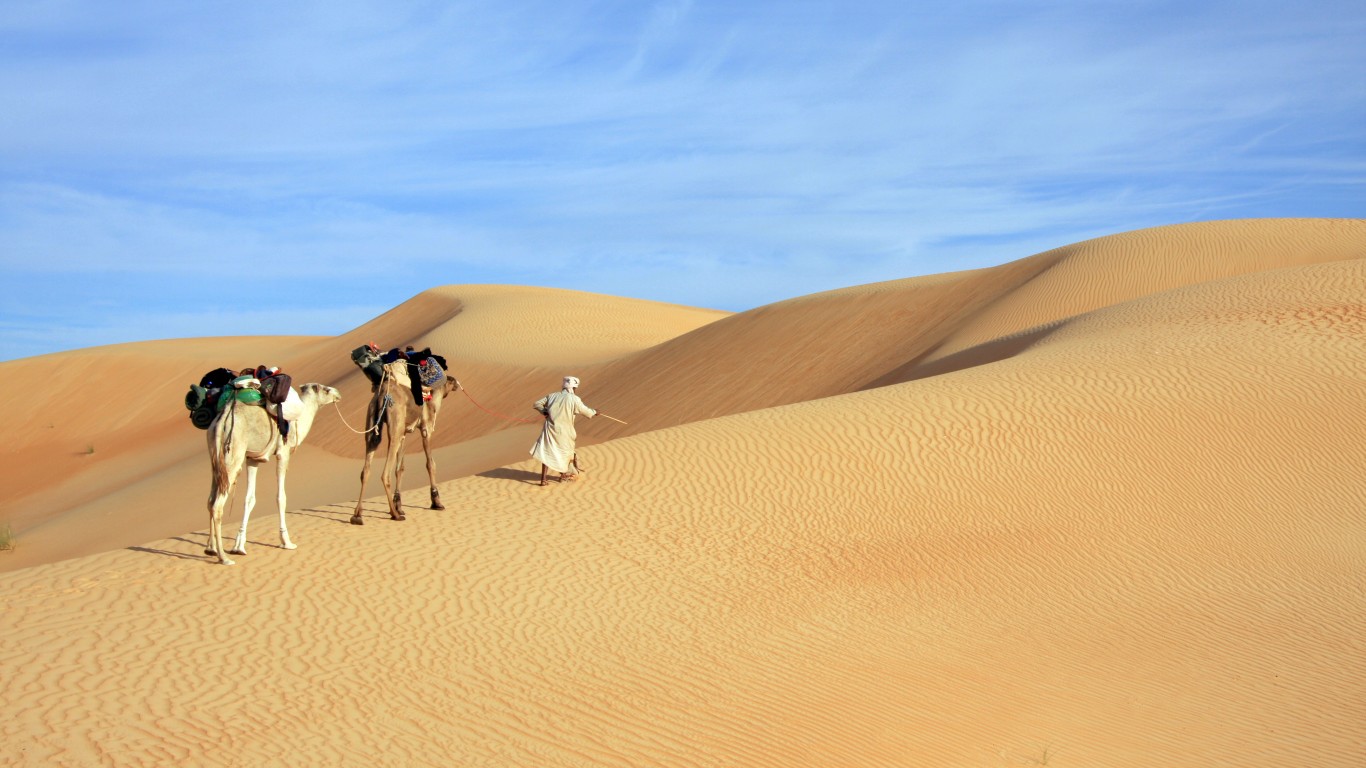
In Algeria, where the town of Ouargla also reached 114.8°F Saturday morning, rising temperatures may make parts of the country more than just inhospitable. Climate Action Network cited Jos Lelieveld, director of the Max Planck Institute for Chemistry:
In future, the climate in large parts of the Middle East and North Africa (MENA) could change in such a manner that the very existence of its inhabitants is in jeopardy. … Climate change will significantly worsen the living conditions in the Middle East and in North Africa. Prolonged heatwaves and desert dust storms can render some regions uninhabitable, which will surely contribute to the pressure to migrate.
Earlier this month, the World Bank issued a report claiming that $158 trillion in assets could be in jeopardy by 2050 unless action is taken to mitigate climate change. Much of this stupendous total is down to damage to coastal cities from rising sea levels. But countries in central Asia could lose as much as 11% of gross domestic product (GDP) due to water shortages, and countries in eastern Asia, including the Indian subcontinent, could lose up to 7% of GDP. In the Sahel transitional zone between the Sahara desert and the Sudanian savanna, up to 12% of GDP could disappear as the water resources dry up.
[wallst_email_signup]









 Top Gaining Stocks
 Top Losing Stocks