


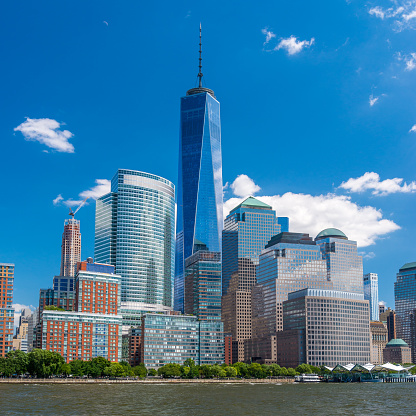
The World Trade Center tragedy happened 15 years ago. Lost among many of the stories is how huge the buildings were.
According to Scientific America and the JOM publication for the The Minerals, Metals & Materials Society, each of the World Trade Centers weighed 500,000 tons. As part of its detailed analysis:
To a structural engineer, a skyscraper is modeled as a large cantilever vertical column. Each tower was 64 m square, standing 411 m above street level and 21 m below grade. This produces a height-to-width ratio of 6.8. The total weight of the structure was roughly 500,000 t, but wind load, rather than the gravity load, dominated the design. The building is a huge sail that must resist a 225 km/h hurricane. It was designed to resist a wind load of 2 kPa—a total of lateral load of 5,000 t.
The two towers were at one point the tallest buildings in the world. 1 World Trade Center topped out a 1,368 feet. 2 World Trade Center at 1,362.
[nativounit]
The cost to build the two towers was approximately $900 million in 1968 dollars. North Tower construction started in August 1968 and tenants move in during December 1970. The South Tower construction started in late 1969 and was completed January 1972.
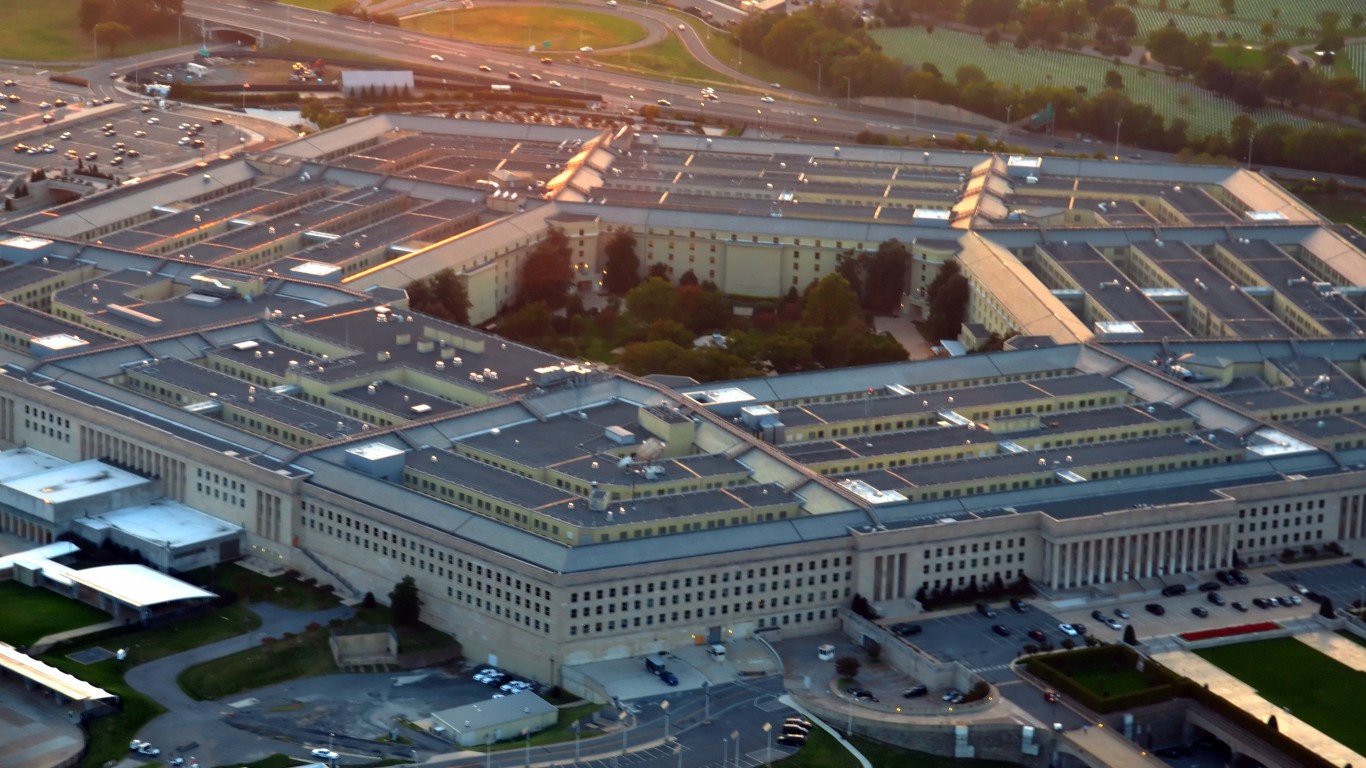
The Institute for the Analysis of Global Security (IAGS) estimated the cost of the destruction and its effects was $2 trillion which includes the Pentagon:
Counting the value of lives lost as well as property damage and lost production of goods and services, losses already exceed $100 billion. Including the loss in stock market wealth — the market’s own estimate arising from expectations of lower corporate profits and higher discount rates for economic volatility — the price tag approaches $2 trillion.
Among the big-ticket items:
The loss of four civilian aircraft valued at $385 million.
The destruction of major buildings in the World Trade Center with a replacement cost of from $3 billion to $4.5 billion.
Damage to a portion of the Pentagon: up to $1 billion.
Cleanup costs: $1.3 billion.
Property and infrastructure damage: $10 billion to $13 billion.
Federal emergency funds (heightened airport security, sky marshals, government takeover of airport security, retrofitting aircraft with anti-terrorist devices, cost of operations in Afghanistan): $40 billion.
Direct job losses amounted to 83,000, with $17 billion in lost wages.
The amount of damaged or unrecoverable property hit $21.8 billion.
Losses to the city of New York (lost jobs, lost taxes, damage to infrastructure, cleaning): $95 billion.
Losses to the insurance industry: $40 billion.
Loss of air traffic revenue: $10 billion.
Fall of global markets: incalculable.
[wallst_email_signup]







 Top Gaining Stocks
 Top Losing Stocks