


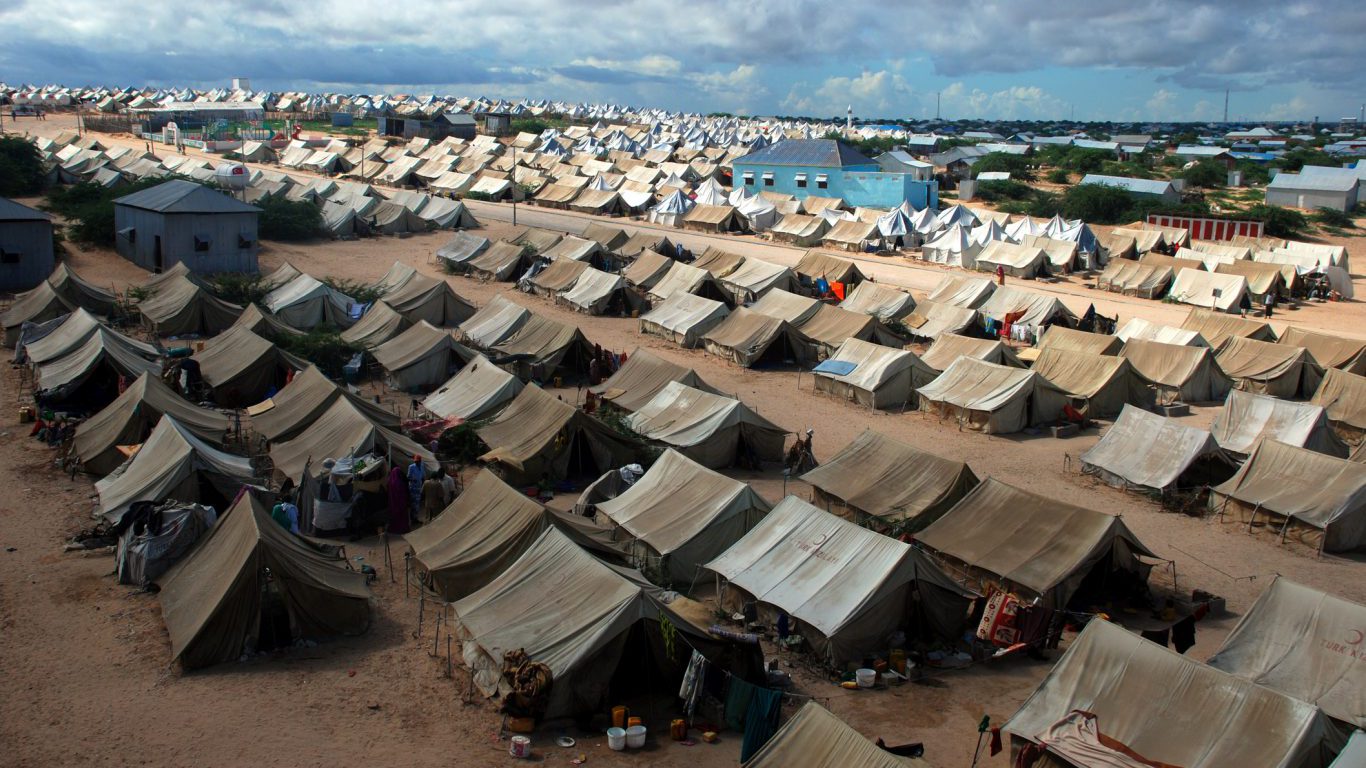
“I’m starving,” people blithely say when it’s been five or six hours since their last burger or plate of pasta. For much of the world, that phrase has a much more literal meaning. According to the United Nations’ ReliefWeb site, about 124 million people in some 51 countries face crisis-level food insecurity. In other words, they’re hungry — and in extreme cases, starving to death.
Last year, the United States Department of Agriculture’s International Food Security Assessment study evaluated food insecurity — which the USDA defines as “a household-level economic and social condition of limited or uncertain access to adequate food” — in 76 low- and middle-income countries in Asia, Latin America, the Caribbean, North Africa, and sub-Saharan Africa.
Of all the countries where people don’t get enough to eat, a dozen of the 15 most badly affected were in Africa. The most deprived of all was an East African nation most Americans likely couldn’t locate on a map: Eritrea.
More than 90% of Eritrea’s population faces food insecurity. It was also identified in a 2017 United Nations study as the country where clean drinking water is hardest to find, with more than 80% of the population lacking basic access to clean water.
With a history dating back thousands of years, Eritrea is a small funnel-shaped piece of land along Ethiopia’s northern border, facing Yemen and Saudi Arabia across the Red Sea. It became independent from Ethiopia only in 1993, after a war that lasted almost 30 years. A border dispute sparked more fighting between the two countries from 1998 to 2000, and then a state of “no war, no peace” persisted until last July, when the conflict was finally resolved.
Why don’t Eritreans have enough to eat? Their agriculture-based economy was devastated by the long years of war, which resulted in the wholesale destruction of villages and water supply systems, the slaughter of livestock, and the littering of fertile agricultural and pastoral regions with landmines. Lack of water not just for drinking but for irrigation is another factor, as rainfall is erratic in the region and droughts occur every three to five years.
The Eritrean government has invested in numerous initiatives aimed at improving access to both food and water — but according the USDA estimate, food insecurity in the country will have improved by only 1.4% by 2028. Here are the countries with the worst access to drinking water.







 Top Gaining Stocks
 Top Losing Stocks