Famous Colleges Aside, It’s Easier Than Ever to Get into Good Universities, Study Shows

Photo of Douglas A. McIntyre
By Douglas A. McIntyre Updated Published
This post may contain links from our sponsors and affiliates, and Flywheel Publishing may receive compensation for actions taken through them.
Famous Colleges Aside, It’s Easier Than Ever to Get into Good Universities, Study Shows

© Thinkstock

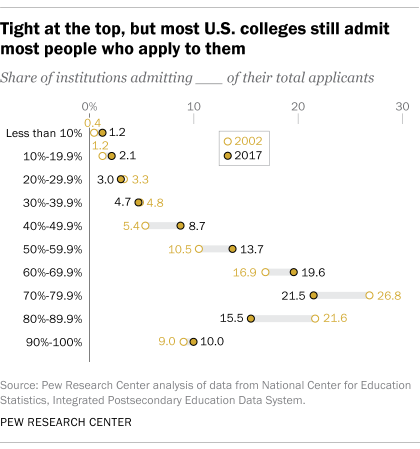
Among the things lost in the admissions scandal involving parents who paid money under the table to get their children into elite schools is that college is not that hard to get into. According to a new study, most colleges admit more than half of the applicants.

Pew Research examined application policies at 1,364 four-year colleges for the period from 2002 to 2017. Some 53% admitted more than two-thirds of annual applicants. This included some well-known schools: St. John’s University in New York (67.7%), Virginia Tech (70.1%), Quinnipiac University (73.9%), University of Missouri at Columbia (78.1%) and George Mason University (81.3%). None of these were on a list of the hardest colleges to get into by state.

Despite many of the high admissions rates, they have fallen at a number of colleges. Pew reports that 45% of colleges in the survey had cut admissions rates by over 10% since 2002, the period over which Pew measured the trends. The reason was not necessarily that admissions offices had become more aggressive. A growing number of students apply to multiple colleges. Pew researchers point out that “In absolute numbers, schools are making more admission offers than before, but not enough to keep pace with the soaring number of applications.” Total applications to colleges covered by the research rose from 4.9 million in 2002 to almost 10.2 million in 2017. Applications are currently on the rise at 100 or more major schools.

Why have applications risen so fast? Pew believes that among the primary reasons is the so-called Common Application, which allows students to apply to numerous colleges at once. Of the research pool of 1,364 colleges examined, 729 used the Common Application as part of their admission process.

[nativounit]

Pew pulled information on applications, admissions and enrollment from the Integrated Postsecondary Education Data System, a program of the research division of the U.S. Education Department’s National Center for Education Statistics. The analysis was restricted to schools for which there were data for both 2002 and 2017.
 

[recirclink id=537471]
[wallst_email_signup]

Photo of Douglas A. McIntyre
About the Author Douglas A. McIntyre →

Douglas A. McIntyre is the co-founder, chief executive officer and editor in chief of 24/7 Wall St. and 24/7 Tempo. He has held these jobs since 2006.

McIntyre has written thousands of articles for 24/7 Wall St. He is an expert on corporate finance, the automotive industry, media companies and international finance. He has edited articles on national demographics, sports, personal income and travel.

His work has been quoted or mentioned in The New York Times, The Wall Street Journal, Los Angeles Times, The Washington Post, NBC News, Time, The New Yorker, HuffPost USA Today, Business Insider, Yahoo, AOL, MarketWatch, The Atlantic, Bloomberg, New York Post, Chicago Tribune, Forbes, The Guardian and many other major publications. McIntyre has been a guest on CNBC, the BBC and television and radio stations across the country.

A magna cum laude graduate of Harvard College, McIntyre also was president of The Harvard Advocate. Founded in 1866, the Advocate is the oldest college publication in the United States.

TheStreet.com, Comps.com and Edgar Online are some of the public companies for which McIntyre served on the board of directors. He was a Vicinity Corporation board member when the company was sold to Microsoft in 2002. He served on the audit committees of some of these companies.

McIntyre has been the CEO of FutureSource, a provider of trading terminals and news to commodities and futures traders. He was president of Switchboard, the online phone directory company. He served as chairman and CEO of On2 Technologies, the video compression company that provided video compression software for Adobe’s Flash. Google bought On2 in 2009.

Featured Reads

Our top personal finance-related articles today. Your wallet will thank you later.

Continue Reading

Top Gaining Stocks

CBOE Vol: 1,568,143
PSKY Vol: 12,285,993
STX Vol: 7,378,346
ORCL Vol: 26,317,675
DDOG Vol: 6,247,779

Top Losing Stocks

LKQ
LKQ Vol: 4,367,433
CLX Vol: 13,260,523
SYK Vol: 4,519,455
MHK Vol: 1,859,865
AMGN Vol: 3,818,618