


People’s preferences about the weather where they live span a broad set of options. People who enjoy outdoor winter weather tend to leave in the northernmost cities of the Northeast or the Plains States that have high mountains. People who don’t want temperatures that drop below 60 degrees often live in Arizona, Florida or southern California. A favorite city among people who want very dry weather is Phoenix. People who like rain (probably a small part of the U.S. population) like cities such as Seattle.
America offers an extremely wide option for weather, with geography that runs from northern Alaska to the southernmost places in Texas and Florida. Temperatures across the country can be between well under zero to over 100 degrees Fahrenheit.
To determine the city with the best weather, 24/7 Wall St. used data from the National Oceanic and Atmospheric Administration (NOAA) to create an index based on minimum, maximum and average temperature, precipitation, cloud cover, wind, humidity and more.
The cities we considered for best weather are concentrated in just five states: Florida, California, Georgia, Hawaii and Texas. These states all have significant coastlines. The ocean releases heat relatively slowly compared to land, so coastal areas tend to stay warmer in the summer.
[nativounit]
This pleasant weather can be a huge driving factor influencing people to move, whether it is retirees spending their golden years in the sun or younger working adults who want to avoid snow.
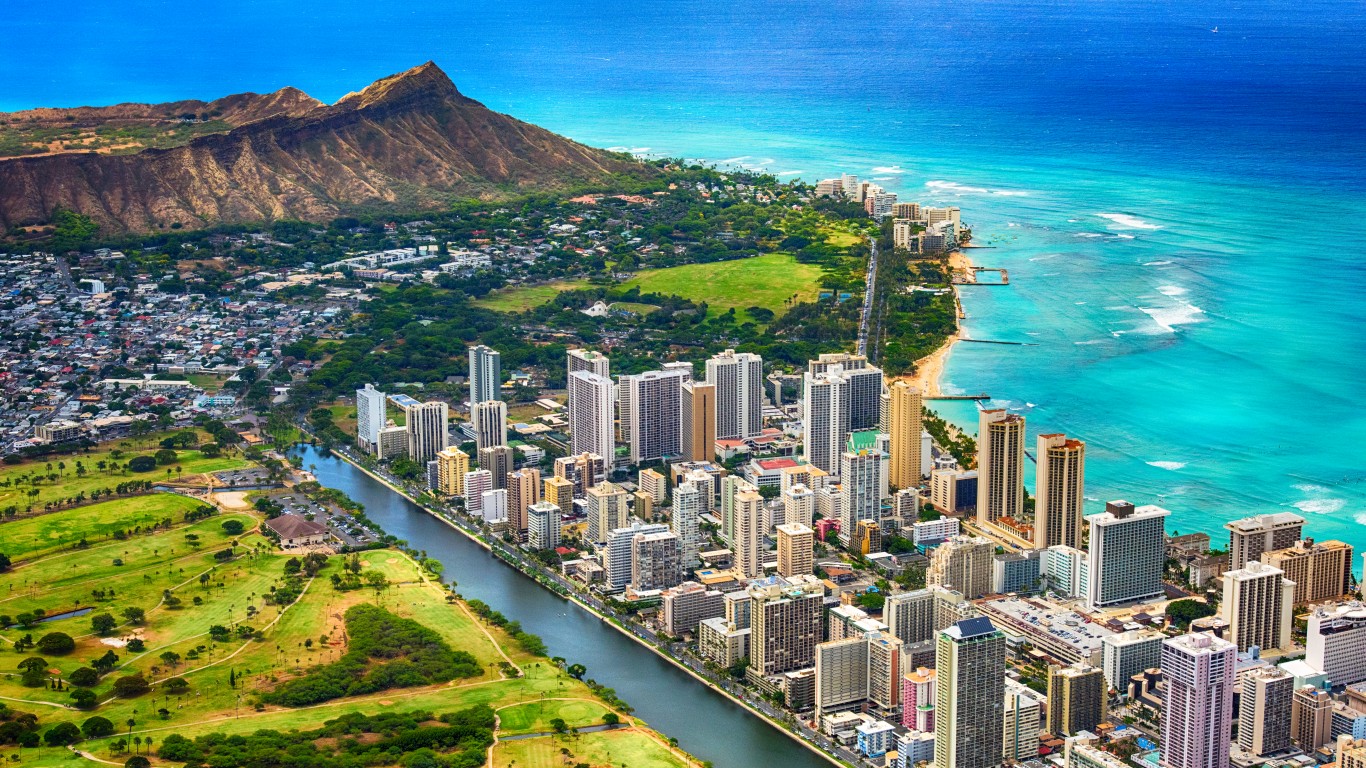
The city with the best weather in America is Honolulu, Hawaii. Here are the details:
- Average annual temperature: 77.7° F
- Average days of rain per year: 93 days
- Average days below freezing per year: 0 days
- Average sunny days per year: 90 days
To determine the city with the best weather, 24/7 Wall St. created an index based on minimum, maximum and average temperature, as well as precipitation, cloud cover, wind, humidity and more. While many people would choose a warm climate over a freezing one, for many there are some climates that are just too hot. We rewarded places with fewer rainy days per year, as most people prefer a precipitation-free, sunny day over rain or snow. We also penalized places that get too little precipitation, however, as an arid climate can hurt vegetation and lead to wildfires and water restrictions.
All values were indexed using min-max normalization to create a composite score for each city. All data were derived from the NOAA’s 2018 Comparative Climate Data and the 30-Year Climate Normals for 1980-2010, maintained by the Global Historical Climatology Network.
These were the exact measures included in the index:
- The average number of days per year with a maximum temperature of 90° F or higher
- The average number of days per year with a minimum temperature of 32° F or lower
- The average number of days per year with 0.01 inches of precipitation or more
- The average wind speed
- The mean number of clear days per year
- The mean number of cloudy days per year
- The absolute difference in average year-round relative humidity in the afternoon from an ideal 40% humidity level
- The absolute difference in normal daily maximum temperature from an ideal temperature of 72° F
- The absolute difference in normal daily minimum temperature from 72° F
- The absolute difference in normal daily mean temperature from 72° F
- The annual number of normal temperature days (the number of degrees that the daily average temperature falls below 65° F)
- And the absolute difference in average annual precipitation from an ideal annual rainfall total of 40 inches.
All values were weighted equally.
Click here to see all the cities with the best weather.
[wallst_email_signup]












 Top Gaining Stocks
 Top Losing Stocks