


As President Biden released his federal budget, worries about the national debt came to the surface, as they do with each annual budget release. The new budget proposal has $5.8 trillion in spending. Over $800 billion of that is for the military, the largest such expenditure by any country. Social spending is, for the most part, budgeted to rise fairly quickly. The administration expects taxes on the very rich and on corporations to keep the deficit low.
Looking out a decade, the administration expects deficits to total $14.4 trillion, which will add considerably to current the national debt of $23.3 trillion. As the figure rises, so do questions about how it can be paid down. These issues will become more acute as interest rates rise, and the U.S. government has to pay more in interest to support its borrowing.
Whether it is fair or not, deficits are usually assigned to the presidents in office when they increase or decrease, although the factors for much of the ups and downs are out of their control. Using federal government data, 24/7 Wall St. determined the effect each U.S. president has had on total national debt in the last 100 years. Presidents were ranked by the change in the national debt from the beginning of their first fiscal year in office to the end of their last. Debt figures are not inflation adjusted.
While American presidents have mandatory spending obligations, such as Social Security and Medicare, they have some level of control over discretionary budgets, as well as taxes. Still, a president’s budget, as well as any proposed changes to the tax code, must receive congressional approval. As a result, when it comes to the balance between federal spending and revenue, a president’s relationship with lawmakers matters.
[nativounit]
Additionally, American presidents are often faced with unforeseen challenges that take priority over a balanced budget. Many of the largest increases in the national debt took place in times of a national crisis. The attack on Pearl Harbor and America’s entry into World War II is the ultimate example. More recent examples include economic stimulus during the 2008 financial crisis and the COVID-19 pandemic. Other factors, such as GDP growth, can either help or hinder a president’s budgetary goals.
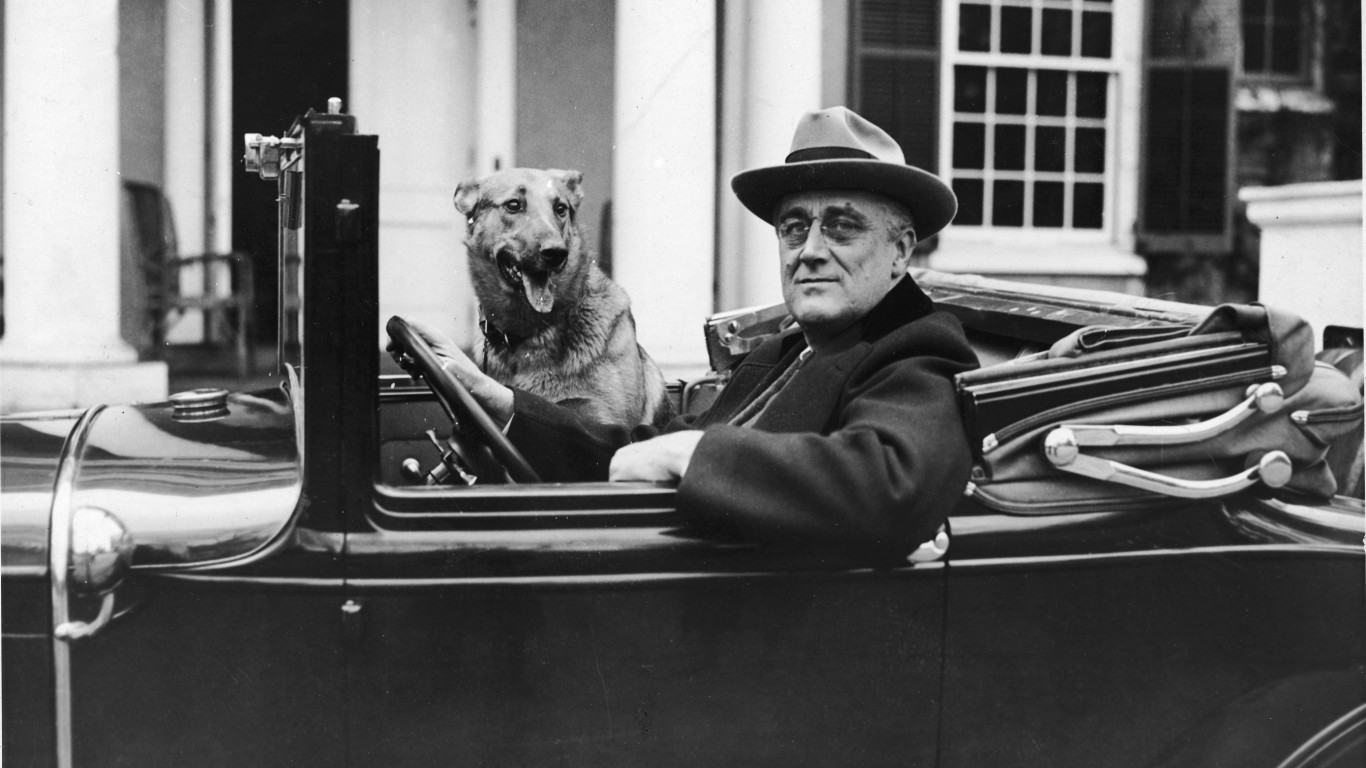
The president who oversaw the largest change in the federal debt was Franklin D. Roosevelt (1933-1945). Here are the details:
- Change in federal debt during presidency: +1,047.7% (+$236.1 billion)
- Total federal debt first year in office: $22.5 billion
- Total federal debt final year in office: $258.7 billion
Franklin Roosevelt served as president of the United States for 12 years, longer than any other president in history. Leading the country through the Great Depression and World War II, his presidency also spanned some of the most trying times in U.S. history.
To address the economic crisis at home, Roosevelt enacted a set of progressive policies designed to restore growth and prosperity known as the New Deal. Social Security, the Tennessee Valley Authority, unemployment insurance, and agricultural subsidies are all New Deal components that remain intact today. While this host of progressive policies came with steep costs, World War II was by far the largest contributor to the national debt. During the fiscal years spanning Roosevelt’s time in office, federal debt increased by 1,047%, or $236.1 billion.
[wallst_email_signup]
Click here to see all the presidents who oversaw the largest changes in the national debt.









 Top Gaining Stocks
 Top Losing Stocks