


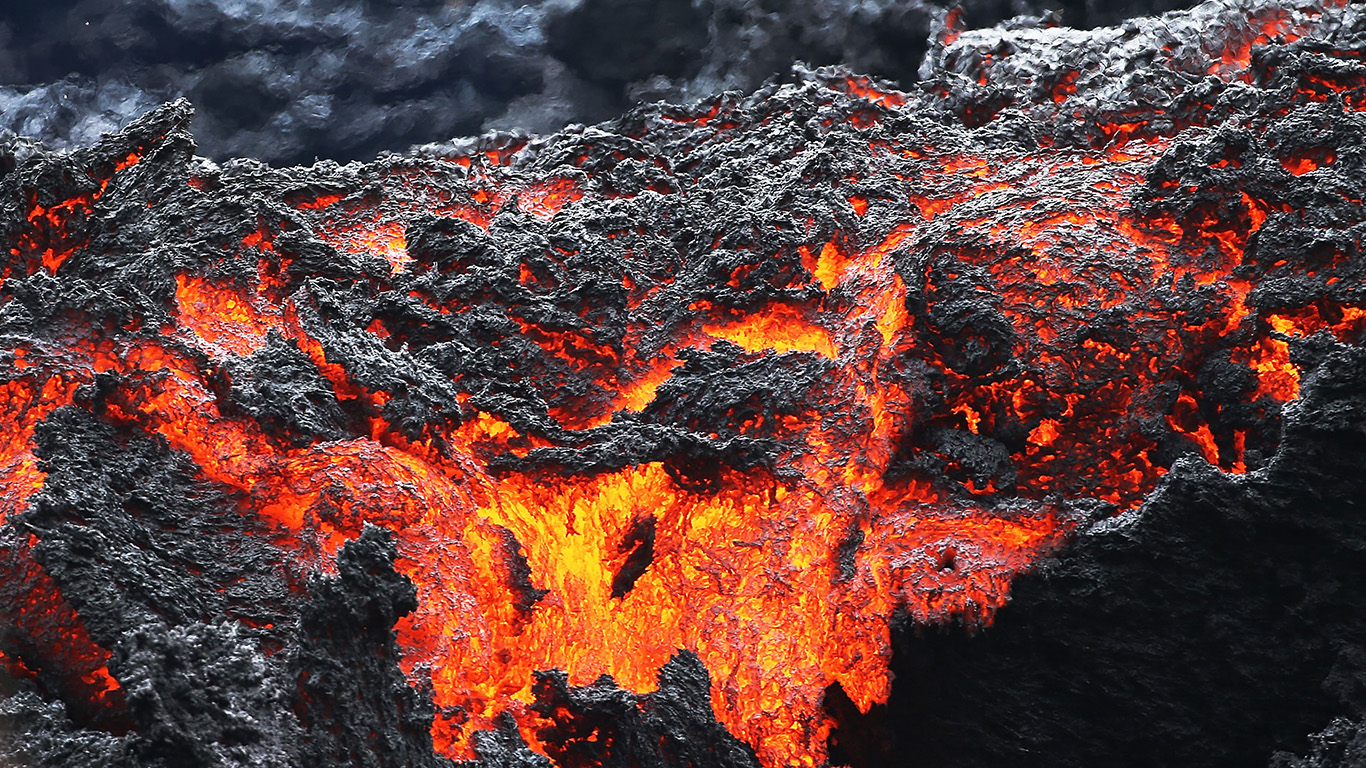
It has been centuries since a volcano killed a large number of people. The sole exception is the Nevado del Ruiz, Colombia, eruption in 1985. The most well-known deadly eruption remains Mount Vesuvius in 79 CE. Archaeologists continue to examine the city of Pompeii and have found hundreds of bodies of people who died in the streets. The catastrophe killed as many as 15,000 people. The volcano remains active.
Many volcanos are located in what is known as the Ring of Fire. National Geographic defines it as “a path along the Pacific Ocean characterized by active volcanoes and frequent earthquakes. The majority of Earth’s volcanoes and earthquakes take place along the Ring of Fire.” Some of the most dangerous volcanoes in the world are not thousands of miles away from the United States. Some are located within America’s borders.
Officially, volcanoes are ruptures in the earth’s crust, normally found where tectonic plates converge and diverge, that spew out lava, volcanic ash and gases. Many exist in the ocean.
Scientists have different ways of classifying volcanoes. As we examined volcanoes, we used the terms specified by our source material. Briefly, a stratovolcano (or composite volcano) is a steep symmetrical cone built of lava flows, volcanic ash and other materials. Some of the world’s highest mountains are stratovolcanoes. A lava dome is a comparatively small volcano built from dense lava flow.
[nativounit]
A caldera, considered particularly damaging to the surrounding environment, is a depression in the earth caused when the edges of the volcano collapse inward. A shield volcano is large and flat and composed almost entirely of lava flow. It is said to resemble a battle shield in shape. A pyroclastic shield is similar in form but formed mostly from rocks rather than fluid lava.
Not all volcanic eruptions are the same. Some are fairly calm and pose little threat to nearby inhabitants. Others can be violent, with catastrophic effects. Smaller volcanic events can be spectacular to witness from a safe distance, and many active volcanoes release dazzling lava without massive violent eruptions. However, others continue to pose major threats to cities around the world, even if they have previously erupted.
To identify the most dangerous volcano in the United States, 24/7 Wall St. reviewed the overall threat score from the 2018 update to the U.S. Geological Survey national volcanic threat assessment. The most recent eruption year also came from the USGS. The population within 30 kilometers and 100 kilometers (about 18 and 30 miles, respectively) of each volcano was obtained from The Smithsonian Institution’s Volcanoes of the World database.
The USGS assigns each volcano an overall numerical threat score based on some 24 metrics assessing “a volcano’s hazard potential and exposure of people and property to those hazards (independent of any mitigation efforts or actions).”
The most dangerous volcano in the United States is Kilauea, Hawaii. Here are the details:
- Overall threat score: 263
- Population within 30 kilometers: 8,495
- Population within 100 kilometers: 169,550
- Most recent eruption year: 2021
[wallst_email_signup]
Click here to see all the most dangerous volcanoes in the United States.






 Top Gaining Stocks
 Top Losing Stocks