


In a press statement “FOR IMMEDIATE RELEASE” posted on its website on July 13, the Columbus, Ohio firm laid out in detail the reasons for its decision. “Gas and oil drilling has been going on in this country for many years in the west and southwest. Fracking is another variation of the gas and oil business. In recent years, oil and gas exploration has come to New York, Pennsylvania and Ohio.”
Seeking to downgrade the possible impression that the statement represents a radical change of direction, the press release continued, “Nationwide has not changed our policies or guidelines, nor are we cancelling policies. Fracking-related losses have never been a covered loss under personal or commercial lines policies. Nationwide’s personal and commercial lines insurance policies were not designed to provide coverage for any fracking-related risks.”
Then Nationwide give the rationale behind its pronouncement, a direct slap at fracking companies’ insistence that the procedure is perfectly safe. The statement speaks for itself – “Insurance works when a carrier can accurately price the coverage to match the risks. When information and claims experience are not available to fully understand the scope of a given risk, carriers aren’t able to price protection that would be fair to both the customer and the company… From an underwriting standpoint, we do not have a comfort level with the unique risks associated with the fracking process to provide coverage at a reasonable price. Insurance is a contract and it is designed to cover certain risks. Risks like natural gas and oil drilling are not part of our contracts, and this is common across the industry. Our longstanding underwriting guideline is that we do not insure the oil and gas business.”
Seeking to soothe the potential impact of the statement on owners of Mutual Nationwide policies the document continues, “However, Nationwide will investigate all claims submitted by our customers that they believe are the result of damage from fracking. Every Nationwide claim is reviewed on a case-by-case basis… We encourage consumers to be knowledgeable about any risks to their property and assets. For advice, seek the help of financial and legal specialists who can discuss the unique nature of the risks associated with oil and gas exploration. We also advise consumers to talk to their insurance agent to understand what coverage is provided in their personal or commercial lines policies.”
Shorn of its carefully crafted legalese, the Nationwide Mutual statement is hugely significant for two reasons.
First, it is serving notice on current policy holders that even though the company will investigate fracking claims for indemnity on a “case-by-case basis,” they are unlikely to succeed.
But, more importantly, in its comments about “When information and claims experience are not available to fully understand the scope of a given risk, carriers aren’t able to price protection that would be fair to both the customer and the company,” Nationwide Mutual has discreetly but directly challenged fracking industry claims that the procedure produces undue risk, a major blow on the companies’ relentless and ongoing PR campaigns to convince people about the process being benign.
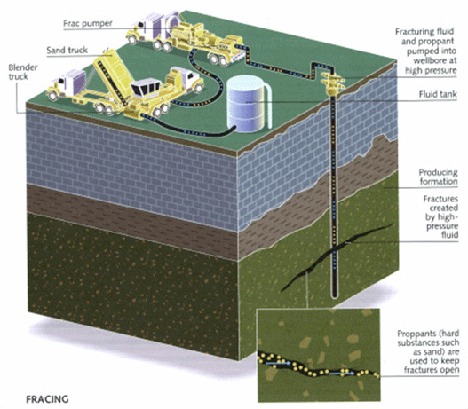
For “When information and claims experience are not available to fully understand the scope of a given risk,” read that Mutual Nationwide, like local and state governments, cannot get fracking operators to divulge the nature of the chemicals they use in the process, claiming that its proprietary business information. While the fracking mix is about 99 percent water, the remaining 1 percent includes highly toxic chemicals, including methanol, hydrofluoric acid, sulphuric acid and formaldehyde, which have been analyzed from water samples taken at fracking sites. Not surprisingly, local and environmental groups, fearing contamination and pointing to several legal cases already underway, maintain that fracking represents a serious threat to drinking water.
But sharpening Nationwide Mutual’s concerns are undoubtedly the mounting studies postulating a link between fracking and earthquakes and the pollution of subterranean aquifers.
Why not make your position explicit when both earthquakes and aquifer pollution can have broad consequences? Accordingly, the Nationwide Mutual statement is a clarification of its existing procedures, but the implications are immense.
For those landowners who have Nationwide Mutual insurance policies and have leased their land to fracking companies along with their neighbours, even though “the company will investigate fracking claims for indemnity on a ‘case-by-case basis,’” Nationwide Mutual makes clear that “Fracking-related losses have never been a covered loss under personal or commercial lines policies.”
So, unless you get a sympathetic claims adjuster, the message seems to be that you’re on your own, a not insignificant consideration in New York, Pennsylvania and Ohio, currently the epicenters of Marcellus shale fracking operations.
Equally important is the fact that many of these producing wells are “mom and pop” operations on small parcels of land. According to the natural gas advocacy group America’s Natural Gas Alliance, “A natural gas drilling site typically covers 6 square acres of land. Drilling down to the gas-rich shale generally takes a couple of weeks, hydraulic fracturing itself about two to three days per well.”
Not surprisingly, fracking advocates have pushed back, hard. Simon Lomax, a spokesman for the Independent Petroleum Association of America stated in an email that the memo was “reckless” and “it tells me that I won’t be buying home and car insurance from this company.”
There is an easy way to solve the debate – let the energy companies release the full list of chemicals used in their procedures, and let the Environmental Protection Agency and other federal agencies do their oversight jobs.
But wait! Fracking has academic supporters, too!
In May a university-funded study released by the Shale Resources and Society Institute at the University of Buffalo asserted that fracking is getting safer and should present no major environmental problems in New York when the state allows drilling to commence.
A report that underwriters at Nationwide Mutual obviously overlooked.
By. John C.K. Daly of Oilprice.com






 Top Gaining Stocks
 Top Losing Stocks