


by Nicholas Kusnetz, ProPublica, April 18, 2011, 4 p.m.
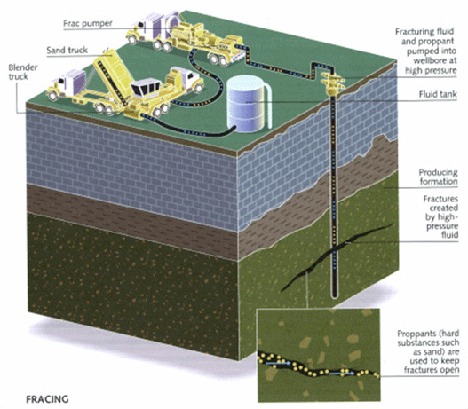
That list includes 29 chemicals that are either known or possible carcinogens or are regulated by the federal government because of other risks to human health. As we reported more than a year ago, most of the fluids now used in hydraulic fracturing, or “fracking,” are left underground when drilling ends.
The report notes that while the fate of these fluids “is not entirely predictable,” in most cases, “the permanent underground injection of chemicals used for hydraulic fracturing is not regulated by the Environmental Protection Agency.”
The amount of fluid that remains in a well varies depending on local geology. But in some states, including Texas and Pennsylvania, regulators do not know precisely how much of the fluid returns to the surface for each well. In many cases, particularly in the Marcellus Shale in the Northeast, more than three-quarters of the fluid is left underground.
In 2005, Congress exempted hydraulic fracturing from regulation under the Safe Drinking Water Act. That law allows the EPA to regulate the injection of hazardous fluids into underground wells, a practice widely used to dispose of drilling wastewater. As we wrote back in 2009:
If another industry proposed injecting chemicals — or even salt water — underground for disposal, the EPA would require it to conduct a geological study to make sure the ground could hold those fluids without leaking and to follow construction standards when building the well. In some cases the EPA would also establish a monitoring system to track what happened as the well aged.”
But the oil and gas industry lobbied to protect fracking from such regulation, arguing that most of the fluid remains underground only temporarily. Stephanie Meadows, then a senior policy analyst for the American Petroleum Institute, told us in 2009 that, “Hydraulic fracturing operations are something that are done from 24 hours to a couple of days versus a program where you are injecting products into the ground and they are intended to be sequestered for time into the future.”
When they approved the Safe Drinking Water Act exemption, lawmakers believed only about 30 percent of the fluids remained underground. Subsequent reports and interviews with drillers show the amount can reach 80 percent or higher.
The Democrats’ report, which provides the most comprehensive list of the chemicals used to frack natural gas wells, also highlights ongoing gaps in knowledge. It says drillers injected 94 million gallons of fluid — about 12 percent of the total amount used over the five years — containing at least one chemical deemed a trade secret.
“In most cases the companies stated that they did not have access to proprietary information about products they purchased ‘off the shelf’ from chemical suppliers,” the report says. “In these cases, the companies are injecting fluids containing chemicals that they themselves cannot identify.”
Much is still unknown about what happens to that fluid when it’s left inside the well, or whether it threatens drinking water. The industry says that multiple layers of rock protect groundwater from the fluid, but opponents have said water and chemicals might be able to follow natural fissures through the rock. The EPA has recently embarked on a multiyear study to look at this question as well as whether any part of the fracking process poses a threat to drinking water.
A spokesman for the group Energy in Depth, which represents natural gas drillers, said the Democrats’ report was unconvincing that fracking represents a real risk to drinking water.
“If the breaking news here is that fracturing fluids contain stuff you would never want to drink, that’s not much of a headline at all,” said Chris Tucker in an email. “The only way that’d be relevant in a public health context is if those materials were somehow finding their way into potable water supplies underground. Naturally, this report has no ability to show that, precisely because they aren’t, don’t, and according to regulators all across the country, never have.”
Chemicals used in fracturing operations have been found in drinking water, but those chemicals are also present in many other industry practices and have not been directly linked to fracking.
The report is the product of an investigation into hydraulic fracturing by Reps. Henry Waxman, D-Calif., Edward Markey, D-Mass., and Diana DeGette, D-Colo. In January, they released a report showing that the same 14 drilling companies had used more than 32 million gallons of diesel fuel or fluids containing diesel in fracking operations.
Follow on Twitter: @nkus






 Top Gaining Stocks
 Top Losing Stocks